

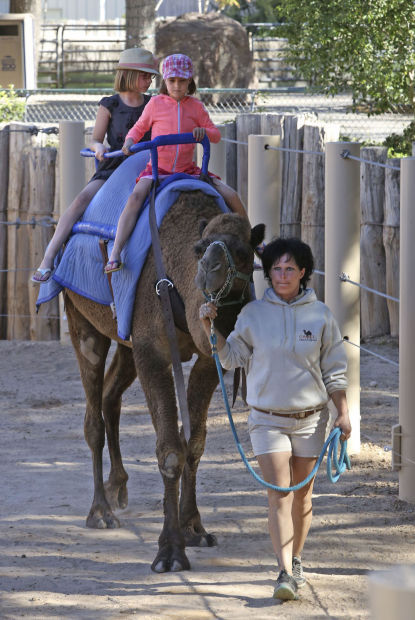
Zoo-goers can ride camels for a fee at the Reid Park Zoo.
Four camels — Luke, Riddle, Mack and Winston — joined the Tucson zoo Nov. 7. Rides began Saturday and since then, the quartet has given more than a 1,000 rides, according to Jason Jacobs, the zoo administrator.
“We are really excited about this because it provides a great experience for the visitors to interact with the animals,” he said.
The ride, which lasts about a minute and half, goes along the perimeter of the camels’ new home, a former elephant exhibit that has most recently been empty, he said. The exhibit was renovated with structural improvements, including a deck for people to use to mount the camels.
The zoo charges $7 per person and proceeds from the rides go back to the zoo’s operations. The rides are available from 9:30 a.m. to 3:30 p.m.
People are also reading…
The zoo decided to offer camel rides after it conducted a survey asking visitors what they would like to see more of, Jacobs said. People responded that they wanted more interactions with the animals.
The camels lending their backs to zoo-goers are dromedary camels, which are a domesticated species originating from the Arabian Peninsula. Many people think they are wild animals, Jacobs said, but dromedary camels have been domesticated for thousands of years.
“It’s comparable to how some cultures use horses to ride,” he said. “Other cultures use camels.”
In the search for camels, Reid Park Zoo consulted the Columbus Zoo in Ohio, which also has a camel ride service.
The Columbus Zoo referred Tucson administrators to Camel Towing Co., a Wisconsin-based company specializing in camel and pony rides and pig racing.
Camel Towing also is lending the zoo three of its staff members to lead the rides, said Matt Schobel, owner of the family business, which has been around in Wisconsin for about 35 years.
Interactive experiences like riding a camel are a good educational tool, he said. Watching a camel on television cannot compare to seeing, touching and riding one in real life, he added.
“Providing a hands-on experience with any animals will help people appreciate them,” he said. “It connects people with the animals more.”
Contact reporter Yoohyun Jung at 520-573-4224 or yjung@tucson.com. On Twitter: @yoohyun_jung.

Yoohyun Jung
Data reporter


