

WASHINGTON – New York State and its municipalities didn't get the direct aid they demanded, but upward of $54 billion will come to the state in other ways under the stimulus bill Congress was on the verge of passing Monday night to combat the pandemic-related economic downturn.
Most individuals will get $600 stimulus payments under the $900 billion measure. Small businesses, schools and hospitals will also be in line for direct aid. The bill also wipes away a series of year-end deadlines that could have cut off unemployment benefits for millions nationwide while allowing landlords to begin evicting tenants facing hard times.
Eight months in the making, the measure is less than a third of the size of a stimulus bill the Democratic House passed in May. Nevertheless, it is the second-largest economic stimulus package in history, and lawmakers from both parties said it should provide at least some relief to struggling individuals and businesses.
People are also reading…
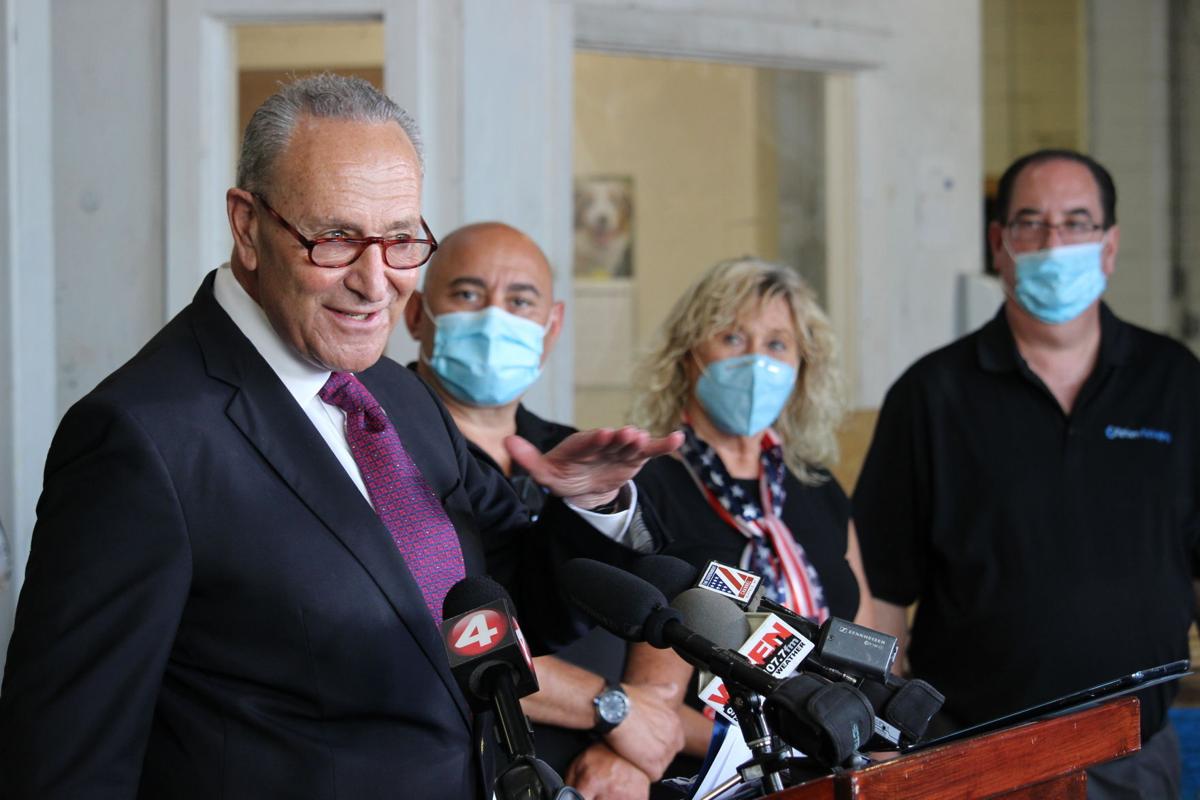
"Clearly, it is not a stimulus bill – it is an emergency survival bill," said Senate Minority Leader Charles E. Schumer, a New York Democrat and one of the four congressional leaders who negotiated the final package. "And we're going to fight for more dollars later."
Rep. Tom Reed, a Corning Republican, agreed.
"There's still work to be done," said Reed, co-chair of the House Problem Solvers Caucus. "And that is the state and local aid piece, coupled with liability protection."

As Congress dawdles and debates about whether to help local governments that have been sick with the novel coronavirus for months, county and municipal officials fear their budgets will soon be sicker than ever.
What's in the bill
The measure, set to pass both the House and Senate late Monday, provides something for most Americans.
The $600 stimulus payments to every American making less than $75,000 a year makes for the one of the single largest chunks of money coming to New York State: approximately $9 billion. Checks are expected to be issued as soon as next week.
Other big winners emerged in the measure, too, most notably New York's small businesses. The measure extends the popular Paycheck Protection Program, which gives small businesses loans that can be forgiven if they keep their workers on the payroll. Schumer estimated that more than $20 billion in new PPP money will come to the state, and Rep. Chris Jacobs, an Orchard Park Republican, noted that the new bill makes PPP loan expenses tax-deductible.
"These are critical provisions for small businesses, workers and communities," Jacobs said.
The legislation also tweaks the program to encourage lending to minority-owned businesses, while allowing restaurants to get larger forgivable loans than they got in the $2.2 trillion Cares Act that Congress passed in March. In addition, the new bill includes the $15 billion "Save Our Stages" proposal to provide relief to theaters, music venues, independent movie theaters and other cultural institutions, and Schumer said much of that money could come to New York.
The state's educational system also gained from the bill. The measure sets aside $5.8 billion for the state's education stabilization fund, including $4 billion for elementary and secondary education and $1.3 billion for public universities and colleges.
"It's always good news when the federal government is going to send school districts more money," said Michael Cornell, the schools superintendent in Hamburg and president of the Erie-Niagara School Superintendents Association.
Yet it may not be quite as good news as it seems. Congress set aside money for schools in the Cares Act, but Cornell said the state simply cut its aid to school districts by the amount of new federal funds aimed at each district. Cornell said he would not be surprised if the same thing happens to the latest round of federal education funding.
The state will also get $1.6 billion in aid for Covid-19 testing, tracing and vaccine distribution. On top of that, New York hospitals will share in an additional $1 billion under the measure.
Some $6.5 billion in extended unemployment benefits are likely to come to the state under the bill, which provides 24 weeks of benefits to the unemployed who exhausted their earlier benefits. Those people will also get a $300 weekly unemployment supplement.
In the meantime, the bill extends an eviction moratorium to Jan. 31, and will provide $1.3 billion in emergency rental assistance in New York alone. The needy will also benefit from a 15% increase in food stamp benefits through June 30.
Despite all those provisions, the bill won lukewarm reviews from many lawmakers, including Rep. Brian Higgins, a Buffalo Democrat.
"It's too late. It's too light," Higgins said. "But something is better than nothing."

Congress won't be sending money to Buffalo, Erie County or any of the nation's other fiscally stressed states and municipalities anytime soon.
What's missing
Despite its size, the stimulus measure is missing something governors and local leaders nationwide demanded: direct federal subsidies to help them balance their budgets after the pandemic shrunk tax collections.
With New York facing a huge budget shortfall, Gov. Andrew M. Cuomo has been demanding for months that the federal government do more. He did the same Monday, saying Senate Majority Leader Mitch McConnell, a Kentucky Republican, put Democrats in an "impossible situation" by refusing to consider direct aid to state and local governments.
"We have a $15 billion deficit caused by Covid, caused by the federal government, caused by their incompetence, caused by their negligence, caused by the Covid spring ambush," Cuomo said. "I can't make up a $15 billion deficit. That means we will lay off people."
Local leaders were equally unhappy. Niagara Falls Mayor Robert Restaino called the omission of local aid "a callous political act."
"As cities struggle to make their way out of the pandemic, more cuts to personnel and reductions in services become the only method Congress has given us to avoid tax increases to maintain services – increases that will further impact the working families Congress claims to care about," Restaino added.
Members of Congress stressed, though, that the current stimulus bill was really a stopgap measure. President-elect Joe Biden has vowed to push additional pandemic relief next year, and Schumer said Biden has told him state and local aid will be a priority.
"Donald Trump was one of the barriers here: He was saying he didn't want it," Schumer said.
But with Biden as president as of Jan. 20, "I think we have a better chance to get Republicans to join us in getting state and local aid," Schumer added.
Reed, meanwhile, noted that the Problem Solvers Caucus has already drawn up a legislative proposal for marrying state and local aid with liability reform, which McConnell is demanding. While Democrats have so far steadfastly refused to consider liability reform, Reed said the Problem Solvers' proposal provides a pathway to a possible compromise.
"With our bipartisan group of senators, we came up with legislative text, so there is groundwork," he said. "There is foundational work that has already moved the ball in order to have that conversation going forward."


