

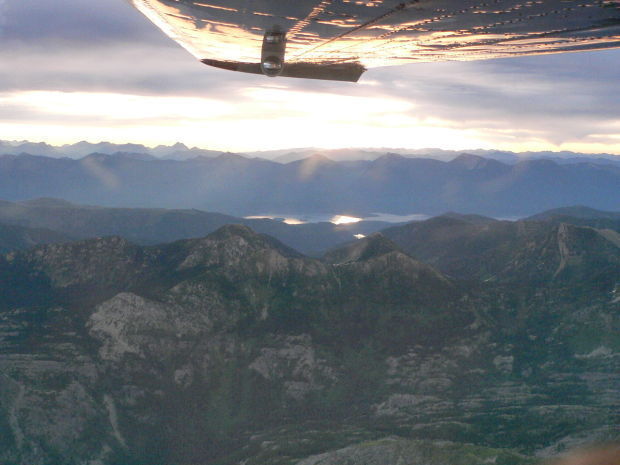
A nonpartisan survey of Rocky Mountain state voters found 68 percent consider federal public lands as “American places” rather than places that belong to the people of individual states.
“It was striking to see they grasp these are American places by a 2-to-1 margin,” Republican pollster Lori Weigel said of the 2015 Western States Survey released Tuesday. "And there was significant intensity behind that. A greater proportion of people felt strongly about that.”
In Montana, 58 percent of respondents thought federal lands belonged to everyone in the nation, with 49 percent saying they felt strongly that way.
Those who thought of public lands as state places belonging to the people of Montana totaled 35 percent, with 27 percent considering that a strongly held opinion.
However, Montana was not as strongly in favor of federal ownership as some other states. Coloradans supported the “American place” idea by 72 percent, and Arizona backed it with 71 percent.
People are also reading…
Only Wyoming was below Montana, with 54 percent supporting federal ownership and 37 percent favoring state ownership. The remainders (about 9 percent in each state) either believed in shared ownership or didn’t have an opinion.
The results played well with habitat and wildlife conservation groups, who’ve generally opposed state lawmakers’ efforts to transfer public lands to local control.
"Once again, a survey of public sentiment underlines just how off-track state and congressional lawmakers are when they push to take public lands out of public hands,” National Wildlife Federation policy director Kate Zimmerman said in an email. “Voters get it; these are America’s public lands. They belong to all of us and we all have an obligation to take care of them and ensure our children, grandchildren and beyond enjoy the same opportunity to experience America’s great outdoor legacy.”
The telephone study reached 2,400 voters in Montana, Wyoming, Utah, Colorado, Arizona and New Mexico. Each state had 400 registered voters participate, divided equally among Republicans, Democrats and Independents. The margin of error was 2.9 percent up or down for the whole survey and 4.9 percent for individual states.
***
Overall, the poll found mountain state residents consider the outdoors as a top reason behind their choice of where to live.
“Clean air, clean water and a healthy outdoor lifestyle are a majority significant factor for all respondents,” said David Metz, the poll’s Democratic analyst. “That came up more than cost of living or schools or the economy.”
Montanans ranked highest among the six states for choosing a healthy outdoor lifestyle as their reason for living in the West (95 percent). They were also tops for liking the ability to “live near, recreate on and enjoy public lands like national parks and forests” (91 percent).
Arizona was the lowest state choosing closeness to public lands as a reason to reside, at 75 percent. The average for the region was 80 percent.
By comparison, 63 percent of the region considered quality of public schools a significant reason to stay. Taxes were significant for 61 percent, and “opportunity to open my own business” was 45 percent.
“I always assumed that business owners chose where to locate based on cold, hard economic numbers, like distance to markets or tax rates,” said Dan Lloyd, economic development officer for Gov. Steve Bullock. “But executives and entrepreneurs weigh quality of life more than I expected. Transportation and water and sewer are all important, but those can be found in nearly all communities. It really is our access to our national amenities that set Montana and the West apart.”
More than 95 percent of Montanans considered it important or very important to protect natural areas for future generations, conserving wildlife habitat and ensuring recreational access for “hiking, biking, hunting and fishing.”
Another 91 percent were concerned that public land managers have the resources they need to take care of the land and visitor services.
In contrast, 78 percent of Montanans thought making public land available for grazing was somewhat or very important. And 77 percent thought it was somewhat or very important to make sure energy and mineral resources were available for development and mining.
The poll also found strong support for using money from federal offshore energy leases to ensure access to outdoor recreation and habitat – a federal program called the Land and Water Conservation Fund.
Montanans matched the regional average with 75 percent in favor. Only 8 percent of Montanans somewhat or strongly opposed the program, while 14 percent were neutral or didn’t have an opinion.
And nearly three-quarters of Montanans favored allowing presidents to use the Antiquities Act to designate public lands as national monuments. Opponents made up 17 percent, while one in 10 felt neutral or didn’t have an opinion.
Regional support for creating national monuments was 80 percent.


