

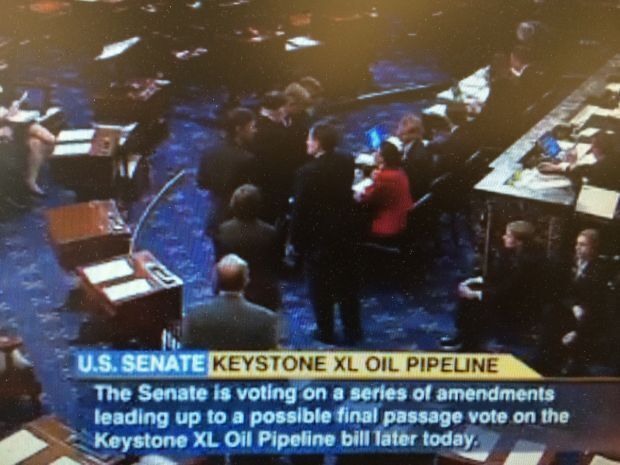


Both Montana’s senior Democratic Sen. Jon Tester and junior Republican Sen. Steve Daines voted to approve the Keystone XL pipeline Thursday, but the delegation split on the locally important Land and Water Conservation Fund.
Senate Bill 1 authorizing permits for the 1,179-mile-long project passed 62-36 shortly after 2 p.m. MDT. TransCanada’s Keystone XL pipeline would move petroleum from the tar-sand deposits of northern Alberta south through northeast Montana and the Bakken Formation oil fields to Steele City, Nebraska. Existing pipelines would move the crude oil from there to refineries on Texas’ Gulf Coast.
Keystone XL would have a capacity of about 830,000 barrels a day along its 1,179-mile span, including 100,000 barrels coming from Bakken suppliers. That would boost Montana’s access to refinery buyers through the Baker depot.
Bill manager Sen. Lisa Murkowski, R-Alaska, called the legislation necessary for jobs, energy security and relations with Canada. She noted senators had proposed almost 250 amendments, of which 41 were debated on the floor.
People are also reading…
"I am very pleased we are at this point, after three solid weeks of debate," Murkowski said after the vote. "We have now officially passed our bipartisan bill to approve the Keystone XL pipeline."
Sen. Barbara Boxer, D-Calif., countered the bill was a sweetheart deal that would hurt the global climate.
“This is the only time in the history of the Senate we have given such a big hug and kiss to a private company,” Boxer said. “They can never lose their permit. We don’t do that for any other company, let alone a foreign special interest company.”
Under Senate rules, the bill had to get at least 60 votes to reach cloture, meaning no one could stall it with a filibuster. It passed that requirement early Thursday afternoon on a vote of 62-35, with both Tester and Daines in favor. However, the final vote on the bill was closer.
President Barack Obama has threatened to veto the bill. All Senate Republicans and nine Democrats voted in favor. But at least 66 senators would be needed to override a veto.
Daines offered two amendments to the final version of the bill, although both failed. He also co-sponsored the measure as a member of the House of Representatives last year.
“This job-creating project will increase economic opportunity in Montana – in turn, raising tax revenues to fund our schools and infrastructure while lowering energy costs for the hardworking Montana families that need it the most,” Daines stated in an email after the vote. “For far too long, this project has been stalled by Washington politics. It’s time for President Obama to stand with the American people and approve this project.”
“The Keystone pipeline will make our nation more energy secure and it will create jobs in Montana," Tester said in an email after the vote. "I urge President Obama to sign the bill into law. But Keystone is not the only solution for our energy future. We must step up our work to make cleaner energy alternatives a larger part of our nation's energy strategy.”
On Thursday morning, the Senate rejected an amendment by Daines that would have given priority to a popular habitat-buying program, but did not actually reauthorize it. Daines’ amendment supporting the Land and Water Conservation Fund failed 47-51. It needed 60 votes to be attached to the Keystone bill.
Eight Republicans broke ranks and voted against Daines’ amendment, while two Democrats supported it. Montana’s Democratic Sen. Jon Tester voted against the amendment.
Immediately following that vote, Sen. Richard Burr, R-N.C., put up another amendment that would have explicitly reauthorized the LWCF before it expires on Sept. 30, 2015. It also failed, on a vote of 59-39. Tester voted in favor of Burr’s amendment, while Daines voted against it.
The Land and Water Conservation Fund collects royalties from federal offshore oil leases and makes the money available for matching grants to buy fish and wildlife habitat.
In its 50-year history, it has provided about $16 billion for conservation projects. That includes $400 million in Montana. The Blackfoot-Clearwater Game Range north of Ovando is an example of LWCF funding.
Daines’ two-sentence amendment read “reauthorizing the Land and Water Conservation Fund should be a priority for Congress and should include improvements to the structure of the program to more effectively manage existing federal land.” Burr’s amendment would have permanently reauthorized the LWCF on passage.
Daines’ spokeswoman Alee Lockman said the senator supports LWCF, but wants to improve it.
“We’ve heard from Montanans that there’s potential to improve transparency in the program, to ensure funds are better utilized to expand access to public lands, and to increase the state’s role in the program,” Lockman said in an email. “Steve believes it’s important that there’s an opportunity for these improvements to be considered. The amendment affirms the importance of the Land and Water Conservation Fund, while allowing the opportunity for commonsense improvements to be incorporated so that the program can be even more effectively used to maintain and increase access to our public lands."
However, Daines’ move angered many conservation group leaders in Montana, who argued it was an attempt to stall the 50-year-old program.
“Montanans are losing enough access already as more and more special interests roadblock our traditional access to public lands,” Tony Jones of Ravalli County Fish and Wildlife Association said in an email. “The last thing Western sportsmen and women need are Washington, D.C., politicians making it harder for sportsmen to access our public lands.”
“Last year, the LWCF celebrated 50 successful years of bipartisan support in protecting some of America's great public landscapes,” John Sullivan of Montana Chapter of Backcountry Hunters and Anglers said in an email. “Our public lands in Montana are under attack from all sides. We are disappointed with Sen. Daines’ attempt to dismantle such a successful public land conservation program. We hope Sen. Daines will reverse course and listen to the citizens of Montana.”
Daines also offered an amendment trying to restrict the Antiquities Act, in response to Obama’s proposal to turn almost 12 million acres of the Alaskan National Wildlife Refuge into federal wilderness. That would preclude oil and gas drilling on the 1.5 million-acre coastal plain while protecting 5.6 million acres of the Brooks Mountain Range and 5 million acres of the Porcupine Plateau – breeding ground of one of the world’s largest caribou herds.
That amendment failed on a vote of 50 in favor, 47 opposed, and also needed 60 votes to pass.
Murkowski proposed an even more pointed amendment that would release any wilderness study area proposed by the Bureau of Land Management or U.S. Fish and Wildlife Service if not acted upon within one year of the recommendation. It failed, 50-48.


