
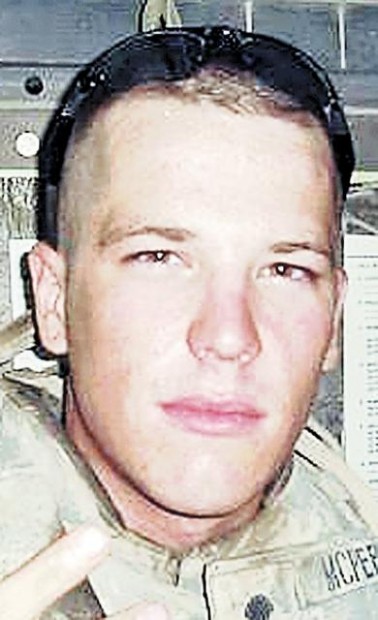
WASHINGTON — Two soldiers, including one from Tucson, who died in Iraq in February may have been killed by their own comrades, the Army said Wednesday.
The Army said it is investigating the deaths of Spc. Alan E. McPeek, 20, of Tucson, and Pvt. Matthew Zeimer, 18, of Glendive, Mont., who were killed in Ramadi, in western Iraq, on Feb. 2.
The families of the two soldiers were initially told they were killed by enemy fire.
According to Army Col. Daniel Baggio, unit commanders in Iraq did not at first suspect they were killed by U.S. forces, but an investigation by the unit concluded that may be the case.
A supplemental report filed Feb. 28 suggested that the initial reports might have been wrong but that an investigation was still under way, he said. According to the Army, the unit did not include friendly fire in that report "because they were reluctant to make the claim until the unit-level investigation was complete."
People are also reading…
It took another month before the families of the two soldiers were told, on March 31, that friendly fire was suspected.
Rose Doyle, McPeek's mother, declined to discuss the latest development. "I don't feel comfortable talking," she said. "Whatever I say isn't going to bring my son back."
McPeek, a combat engineer, was killed on his last day in Iraq, which also happened to be his mother's birthday. He died along with Zeimer, who had recently arrived in Iraq as his replacement.
McPeek was a 2004 graduate of Mountain View High School on the Northwest Side. He was assigned to the 16th Engineer Battalion, 1st Brigade Combat Team, 1st Armored Division, at Giessen, Germany.
Zeimer was a member of the 3rd Battalion, 69th Armor Regiment, 3rd Infantry Division, based at Fort Stewart, Ga.
Wednesday's disclosure comes on the heels of the announcement March 26 that nine high-ranking Army officers, including four generals, made critical errors in reporting the friendly-fire death of former NFL star Pat Tillman, an Army Ranger, in Afghanistan. The military found no criminal wrongdoing in the shooting of the former Arizona Cardinals defensive back.
Three other soldiers were wounded in the incident that killed Zeimer and McPeek. There has been no indication whether they were also hit by friendly fire.
According to published reports at the time of the incident, McPeek, Zeimer and other soldiers came under attack by insurgents at their outpost in central Ramadi. A report in the Army Times newspaper said the two soldiers ran to a roof to fight back, but a shot, possibly from a recoilless rifle, was fired through a concrete wall near them and the impact killed them.
Army officials said they could not confirm those early reports, and they said they have no new details on what actually happened.
"What this suggests is there was the confusion that you frequently find on the battlefield," said Army spokesman Paul Boyce. "As soon as there is information that contradicts the initial report about the circumstances of a soldier's death, we notify the family about that suspicion."
Rep. Denny Rehberg, R-Mont., whose office was notified about the investigation, said, "Hopefully, this will bring some answers and perhaps some closure for everyone. Regardless of the findings, this young man (Zeimer) is a hero that has earned the respect of an entire nation."
According to reports, Zeimer had been in Iraq only about a week and reported to the outpost just two hours before the attack.
The Army came under heavy criticism over its handling of Tillman's death. Though dozens of soldiers knew quickly that he had been killed by his fellow troops, the Army said initially that he was killed by enemy gunfire when he led his team to help another group of ambushed soldiers. It was five weeks before his family was told the truth, a delay the Army has blamed on procedural mistakes.
Army officials are reviewing whether any action should be taken against the officers who provided misleading information as the military investigated Tillman's killing.
As a result of those problems, the Army instituted a number of changes in its notification process and ordered that unit commanders now must investigate every hostile death, in part to ensure that families receive accurate information about how their loved one died.

 Northwest Tucson's Uptown project lands 2 restaurants, tasting room