
Petrified wood is found in many locations on all seven continents; so, why has no one used petrified wood for tree-ring science?
The answer is that no one has succeeded, until now. And why should anyone care? Because comparison of annual changes in the average growth in the same kind of tree from modern times and from the distant past can tell us about the ancient forest environment when the ancient trees were growing.
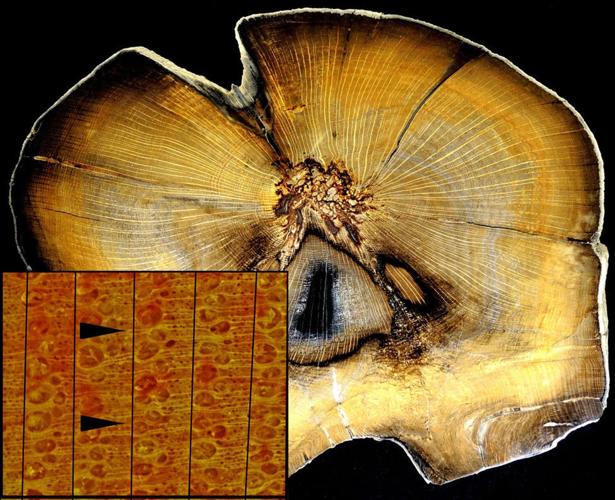
In late 2012, researchers at the University of Arizona’s Laboratory of Tree-Ring Research viewed the surfaces of polished petrified oak samples under a microscope and found clear indications of tree rings, cells and even features within the cell walls. Remarkable.
By coincidence, these specimens, originally from a petrified wood site in Oregon called Stinking Water, are also highly collectible. Polished slabs of Stinking Water petrified oak from many different trees are preserved in museums, rock shops and in personal collections, and are easily identifiable by their degree of preservation and distinctive coloration.
People are also reading…
Researchers examined and measured dozens of slabs from the Stinking Water site through museum visits and with the help of dealers and collectors who visited Tucson’s Gem and Mineral Show.
Samples from the same trees and different trees can be differentiated by the strength of the pattern matching, so the researchers know they have data from more than 20 separate oak trees. The tree-ring growth patterns in the petrified oak matched visually and statistically, proving the preserved trees had grown at exactly the same time.
So how were these trees preserved so perfectly? Geological evidence from the site, such as the presence of pillow basalts, indicates the forest in which these trees grew had been flooded after damming of the nearby stream (almost certainly by a lava flow) created a lake that submerged the trees. The lake and trees were then buried by volcanic ash and lava flows during a subsequent or continuing eruption, thus preserving the trees as they stood.
Figure 1 placement
After matching the patterns between samples, the researchers produced a composite of all the specimens, called a chronology, and compared that chronology with chronologies from over 125 modern oak sites in the United States using many kinds of time-series statistics derived from the original measurements.
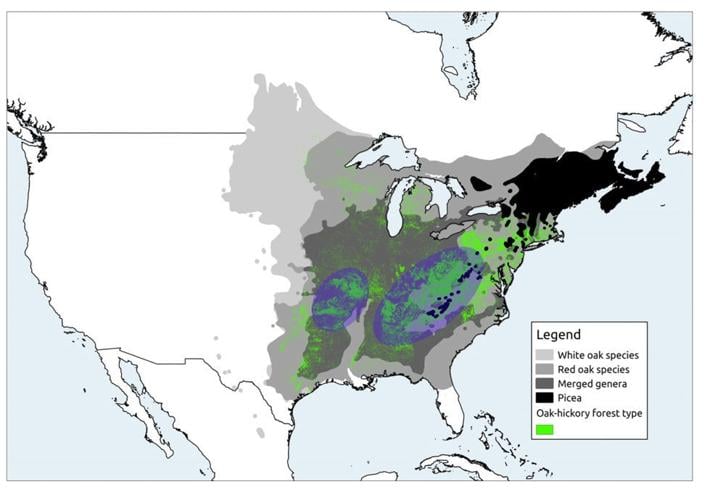
This comparison indicated that the environment where the Stinking Water oaks grew was most similar to the environment of modern oaks growing in the central and southern Appalachian Mountains and in the Ozark and Ouachita mountains(Figure 2).
Figure 2 placement
Another way to estimate the environmental conditions in deep time is to determine the modern environments where all or most of the types of trees and plants preserved at an ancient site now grow together. The types of trees at the Stinking Water site included the white oak group, the red oak group, hickory, elm, ash, walnut, poplar, juniper and spruce.
The kinds of trees preserved at the Stinking Water site can co-occur in the modern world in areas that are identical to the locations indicated by the comparison of the modern and ancient oak tree ring statistics. With the exception of spruce, all the tree types can be found together along the western slopes of the central and southern Appalachian Mountains, and in the Ozark-Ouchita mountain highlands(Figure 2). Also involved in the research were paleobotanist Walt Wright and geologist Martin Streck of Portland State University.

William E. (Ed) Wright is a principal research specialist-principal at the Laboratory of Tree-Ring Research. His research interests include past climates, climate change, tree physiology and archaeology, using tree rings and wood chemistry (stable isotopes).

Christopher Baisan is a senior research specialist at the Laboratory of Tree-Ring Research. His research interests include forest ecology, forest disturbance (forest fires and insect outbreaks) and past climates discerned from tree rings. He has been working for 30 years in this field.