

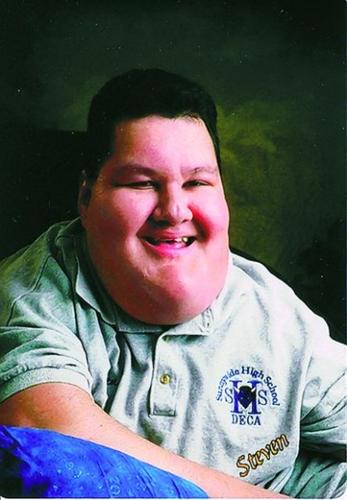
What Steven Barrios lacked in mobility he made up for in personality.
In almost all of the thousands of family photos Frances and Albert Barrios have of their son, Steven is beaming. To mix things up, he sometimes threw in a silly expression.
Steven Barrios was born with arthrogryposis, a disease that causes joints to freeze. Most children lose movement only in a few places, but Barrios could move only his neck and jaw.
"As handicapped as he was, most kids would have given up and the parents would have, too," said Tucson police School Resource Officer Sue Roeder, who met Barrios when he was in third grade. "But they let him be a normal kid."
Barrios was a normal kid — taking family vacations, attending public schools and Pima Community College to prepare for a career in computer drafting and Web design.
People are also reading…
Until the day he died — Oct. 14, seven days shy of his 22nd birthday — Barrios never let his limitations overcome him.
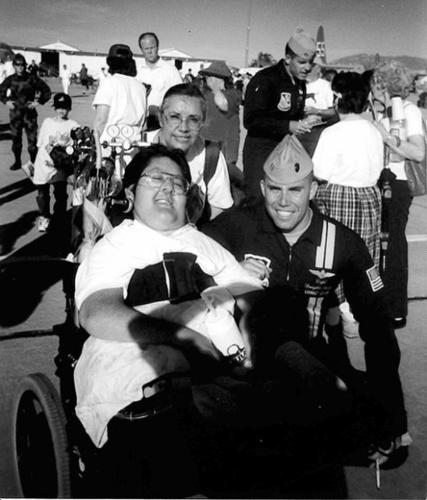
Through 10 major surgeries, countless minor procedures, doctors' visits and occasional seizures, he remained a typical kid. He rooted for the Dallas Cowboys, was a fan of the Blue Angels Navy and Marine Corps flight demonstration team, enjoyed watching sci-fi movies, collected miniature replica motorcycles from Orange County Choppers and, said one of his two older sisters, Lielani Kubina, was sometimes a brat.
"He always had something to say," Kubina said. "You could be arguing and he'd always have the last word."
Perhaps it was that stubbornness — and a sarcastic sense of humor — that helped Barrios persevere for more than two decades, defying his doctors' expectations.
"We took his picture right after birth because they didn't think he was going to live," his father said. "He was on oxygen from Day One until the day he died."
Dr. Burris Duncan began treating Barrios when he was an infant. The doctor has seen other children with arthrogryposis, but Barrios was the only one so severely affected.
"He was an exceptional young man," Duncan said. "I've never seen courage like this young man had."
Retired social worker Sharon Brewer met Barrios when she worked at a children's clinic.
"I've never known anyone who's lived as long as he did," she said. "The body becomes really big, the head becomes really big and breathing becomes difficult. Most of the kids I've seen die in the early years."
Unsure of their son's life expectancy, Frances and Albert Barrios recorded every event — big and small — with photos: naps, baths, birthday parties, family dinners, trips to amusement parks, Halloween costumes, high school graduation.
"He was always smiling. He was a ham," his mother said.
But as his parents steeled themselves for the worst, Barrios found ways to adapt.
He still had a little movement in one hip when he was a baby and "he used to crawl around on his back on the floor like a little worm," his mother said.
As he got older, Barrios learned to "mobilize forces," Duncan said.
"I think he was able to mobilize people who met him in a way none of us can do," he said. "He made so many people happy and grateful for what they have."
It was Barrios' zest for life, Roeder said, that drew people into his orbit.
"He was a really, really cool kid," she said. "He was a really jovial kid who wanted to be involved in life. He went for it and did all that was possible."
Before he opted for a career in computers, Barrios was interested in law enforcement. When he was 5, he told his kindergarten teacher his secret wish was to be a police officer. Family friend and Tucson Police Department Officer Fernando Rodriguez arranged a daylong visit and ride-along with officers. Barrios was made an honorary officer, too. Six years later, Rodriguez and Roeder arranged for another ride-along, this time giving Barrios a lift to school in a police helicopter.
"He wasn't able to move his limbs," Rodriguez said, but "when we placed him in the helicopter, he was moving every part of his body. He was squirming with happiness."
Tucson artist Chris Rush met Barrios eight years ago. He agreed to let Rush paint his portrait to appear in a Tucson Museum of Art exhibit on children with physical limitations.
"Steven's appearance was very unusual, but he had immediate presence," Rush said. "He was obviously a very perceptive and intelligent young man."
Barrios' portrait was one of the largest Rush has ever painted. Though Barrios was breathing through a tracheotomy tube, Rush eliminated the device from his painting, focusing instead on the boy's character.
He painted Barrios in muted tones. Then almost a teenager, Barrios was captured on canvas sitting upright, his underdeveloped legs jutting from his 12-year-old body. The portrait was in a 1999 TMA show.
"All these sophisticated people were walking around feeling secure in their good tastes when, at a crucial moment, Steven was wheeled in … with all his machinery in tow and about 20 family members," Rush said. Barrios was placed in front of his portrait, and "at that moment the 100 people in the room all started to cry."
"It was one of the greatest moments of my life," Rush said. "It was when life really trumped art. It broke down all the walls of the gallery and real life just fell down on top of us."
Though Barrios impacted countless people and mastered life to the best of his ability, his achievements weren't his alone.
"He had a family that was absolutely phenomenal. I don't think I ever saw him without both parents there and involved with his care," Duncan said.
Brewer also credits Barrios' family with his ability to thrive.
"When I picture him, I see his dad and his mom and his sisters all together," she said. "I don't think Steven would have survived without them. He was very healthy, physically and emotionally, and I think a lot of that came from his family."
Find a photo gallery of this Life Story at azstarnet.com/slideshows
Life Stories
This feature chronicles the lives of recently deceased Tucsonans. Some were well-known across the community. Others had an impact on a smaller sphere of friends, family and acquaintances. Many of these people led interesting — and sometimes extraordinary — lives with little or no fanfare. Now you'll hear their stories. Past "Life Stories" are online at go.azstarnet.com/lifestories


 Historic bank vault now new Tucson speakeasy


