

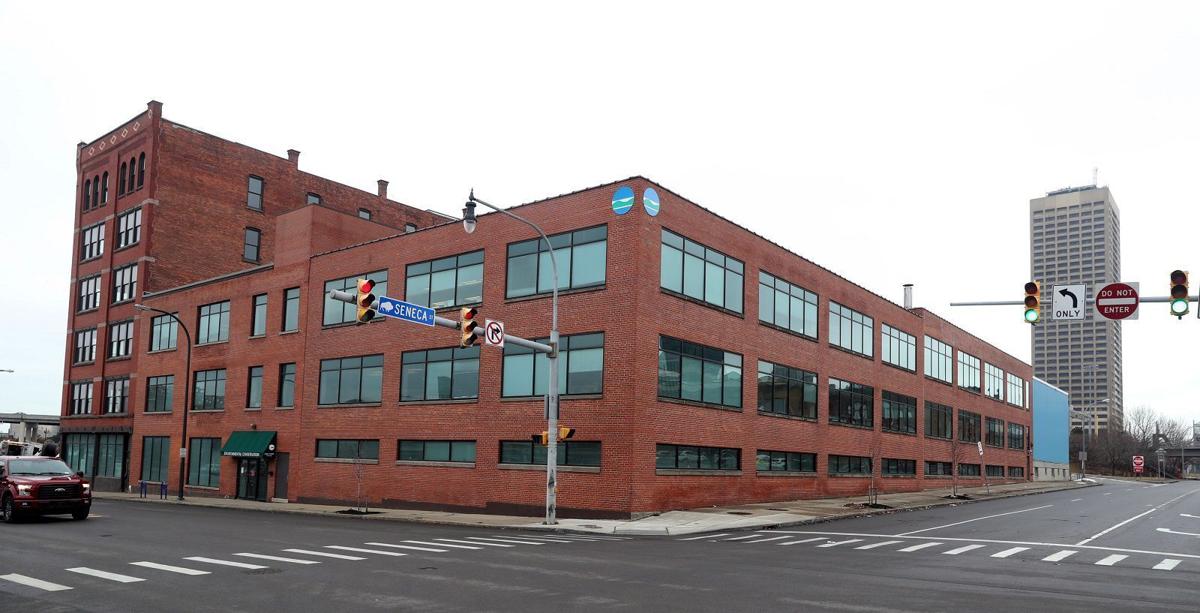
ALBANY – State environmental conservation workers in Buffalo are tasked with protecting the public from contaminated sites, oil and chemical spills, air pollution and dirty water.
Now, some of those employees say something is putting their own health at risk: their workplace provided by the state in a private downtown Buffalo office building.
The Public Employees Federation, a union representing white-collar workers at the Department of Environmental Conservation, says the Cuomo administration is not paying enough attention to a number of brain cancer deaths among several staffers assigned over the years to the building at 270 Michigan Ave., according to documents obtained by The Buffalo News.
Claiming worker efforts to get the agency to move out of the building were rebuffed, the union has filed a grievance against the state, alleging terms of its employment contract were violated by the state’s decision earlier this month to renew a lease for its Western New York regional DEC headquarters.
People are also reading…
State officials and the building’s owner, Ellicott Development Co., say the DEC facility – home to 125 employees – has undergone numerous public and private testing in recent years and that no dangers have been discovered that represent a threat to the workers.
DEC Commissioner Basil Seggos, in a statement Tuesday, said “protecting the health and safety of our employees is our top priority and we act immediately to investigate and determine a course of action when the health of our people is at stake."
Seggos said DEC and two other state agencies conducted “exhaustive investigations” on the building in 2013 and 2019, which included indoor air and radiological data collection. Those tests confirmed “that this building does not present a health risk.”
State officials said a 2019 health department review gave the building a clean bill of health and resulted in four recommendations to reduce potential exposure to what are called volatile organic compounds, including on-site inspections of the building's DEC labs, ensuring bulk petroleum products are secure and having an outside assessment of exhaust systems; all four items were completed by DEC, officials said.
The building is set to undergo a redevelopment that also will include installation of a sublevel ventilation system, the state and building owner said Tuesday. Seggos said the work is being done “out of an abundance of caution and to be responsive to our employees” and to ensure “without a doubt that indoor environmental quality is not a concern and our employees are protected."
The union, in documents obtained this week, claims that the lease renewal “ignores” a health investigation carried out by a cancer surveillance office at the Department of Health more than six years ago that found the office has witnessed a “statistically significant higher than expected” number of brain cancer cases.
The union said five DEC workers assigned to the building have died of brain cancer, though it did not say when the first of those deaths occurred. A health department investigation, the initial phases of which began in late 2011, said a diagnosis for glioblastoma multiforme was confirmed in an undisclosed number of people who worked for DEC in the building.
The union, in its filing, wants workers relocated “to a safe and appropriate work location as soon as practicable.”
The building is owned by Ellicott Development Co., the firm founded by Buffalo businessman Carl Paladino, the Republican Party candidate who lost to Democratic Gov. Andrew M. Cuomo in 2010.
“It’s unfortunate that people have gotten sick there,’’ said William Paladino, the CEO of Ellicott who owns the firm with his father. “The last thing we want to hear is somebody getting sick at one of our properties," he added.
But Paladino stressed that extensive testing has never “proven there is anything wrong with the building itself” and that the building does not pose a danger to occupants.
Still, the state has asked for work on the building that Paladino said will cost more than $100,000. It is uncertain if the state or developer is paying those costs; Paladino said the work is being done not because there is any danger ever found with the building but rather "to further put the minds at ease" of the people in the building.”
DEC is occupying the building on a month-to-month basis as a new lease, likely 10 years in length, is negotiated, state officials said. The state spends $810,862 a year in rent for the building.
PEF brought its complaint after workers on Feb. 5 were told the state was going to renew its lease for the building, which was built in 1890 and for 80 years housed the Buffalo Envelope Co. The grievance was filed by members of the union with the Governor’s Office of Employee Relations, which handles matters involving the state and its unionized workforce.
A PEF spokeswoman at its Albany headquarters did not return calls for comment.
The complaint says the state’s lease renewal “ignores” a June 2013 state health department finding that “unusual exposure from this office space” may be the cause of brain cancer deaths among five DEC workers who were assigned to the building. A sixth person was diagnosed in March 2019 with brain cancer, the union filing states.
The health department investigation noted that DEC turned over manifests of hazardous waste shipments to the site when it was home to the Buffalo Envelope Co.; a number of chemicals and other substances were shipped, the report said, from the 1980s until 2000. “Low level groundwater contamination” was also reported nearly 20 years ago from various substances found in petroleum products, the DOH study found.
The five DEC staffers assigned to the building who died from brain cancer, including an unknown number who were retired at the time of their diagnosis, all were under the age of 71 and most were under the age of 55. “These cases, as a group, are therefore unusually young," DOH reported. DOH cautioned that the it might also not be surprising for the younger cancer age diagnoses because the review looked at people still in the workforce.
The cases were diagnosed between 1996 and 2011, said the DOH review, completed before the 2019 diagnosis of another DEC worker at the building.
The DOH study said all of the staffers who had brain cancer worked for the DEC for more than 20 years; almost all of them also worked at 600 Delaware Ave., where DEC was housed before moving to Michigan Avenue in 1991. The affected people worked at that location for between seven and 20 years, DOH reported.
The DOH investigation noted that while there was a higher brain cancer rate among DEC staffers “than would be expected in a population of this size over the 15-year time frame of the diagnoses," it also noted "a statistically significant excess can occur by chance."
In the end, the DOH review said a possible role for the brain cancers from the industrial uses formerly in the building and nearby area “cannot be ruled out." It also added, however, that work some of the individuals performed in the field as staffers with an environmental agency, such as visits to hazardous waste sites, also could have played a role in some of the brain cancer cases.
The PEF grievance states that DEC and the state Office of General Services, which is in charge of office rentals for state agencies, had been on notice about employees’ concerns about the Buffalo building for more than six years and “failed to secure an alternate office location." The decision to remain at the current regional headquarters was made “despite its potential threat to employee’s health and safety and the liability to which the state is exposed," the grievance states.


