
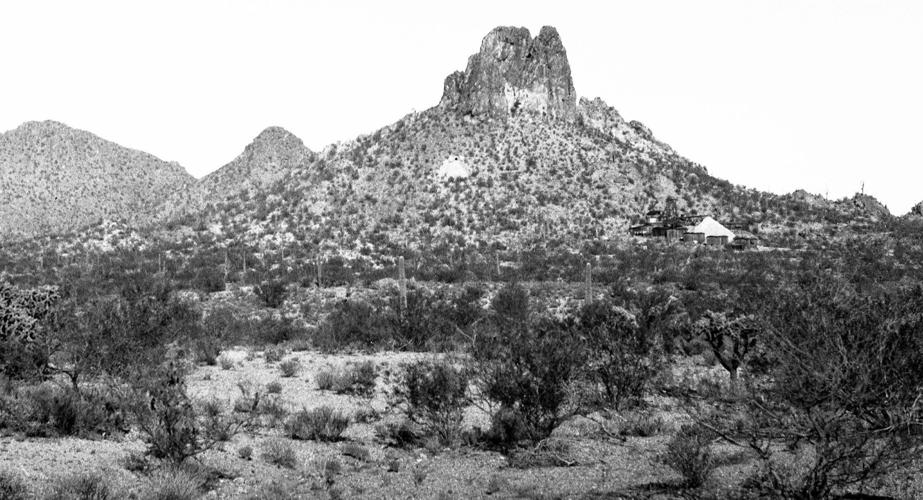
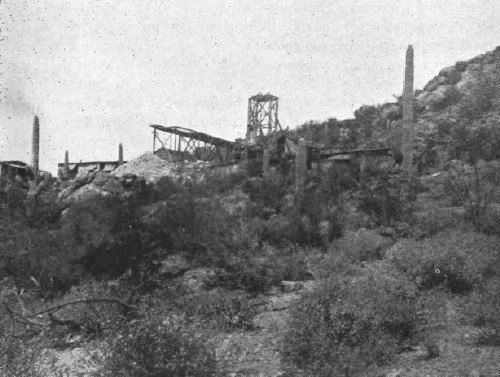
The majority of mining operations in and around the Tucson Mountains encompassed an area that became known as the Amole Mining District.
Remnants of active mining in the district include open cuts, shallow shafts and tunnels, many of which are evident to this day, scattered across the mountains.
The term “amole” — for which the mining district and the second-highest peak in the Tucson Mountains were named — refers to the heart of the agave plant, which is indigenous to the area.
The Amole Mining District made its mark on the history of the Tucson Mountains both commercially and visually, despite being poor in ore.
The district was one of the earliest in North America. Prospecting began in the 1690s after the founding of the San Xavier Mission by the Jesuits.
Heightened activity occurred in 1898 when the Saginaw Mining Co. began to work its claim in the district. Subsequent shafts revealed rhyolite and quartzite mixed with chalcopyrite and pyrite. Some cerrusite and galena carrying silver were also extracted.
People are also reading…
Mining in the district was difficult. Low-grade ore and mismanaged production hindered the effectiveness of mining throughout the district.
As was the case for many small mining operations in the district, the mines did not contain a high-enough ore grade to outweigh the costs of mining at a profit.
However, mining companies remained undeterred and continued their exploratory and sometimes speculative practices, as is evidenced by the plethora of mining camps that sprung up across the Tucson Mountains.
Local newspapers helped add to this euphoria by publishing accounts of potential mineral wealth.
Examples of both successful and unsuccessful mining ventures found in the Tucson Mountains included the Arizona Consolidation Mine, Battle Axe Mine, Bee Hive Mine, Busterville Mine, Colorado Mine, Columbia Mine, Gould Mine, Isabel Mine, Ivy May Mine, Mile Wide Mine, Old Mission Mine, Old Yuma Mine and Saginaw Hill.
There was an active search for gold in the various layers of shale and limestone found throughout the region.
One of the deepest shafts dug in the southern Tucson Mountains was the Ivy May Mine at 750 feet. First worked by S.W. Purcell of Tucson and later operated by the Arizona Tucson Copper Co., it produced 0.7 of an ounce of gold per ton. Gold, silver and copper ores valued at $60 per ton were acquired from the Ivy May Mine. Onsite equipment consisted of a machine shop, head frame and hoist.
Nearby properties were operated by the Hermosa Copper Co. prior to their acquisition by the Arizona Tucson Copper Co. in 1919.
That same year, the Arizona-Tonopah Mining and Milling Co. and Southwestern Metal Mine Inc. broke ground at the base of 2,867-foot-high Beehive Peak with excavations in the form of a 185-foot tunnel driven into the mountain.
A 60-foot winze, a connector between different levels in an underground mine, some 100 feet into the tunnel encountered little profitable ore.
However, a nearby prospect produced 17 ounces of silver.
Another nearby prospect shaft measuring 5 feet in depth produced 1 ounce of gold. Discoveries such as this led to further exploration, with A. J. Harshberger, superintendent for the Arizona-Tonopah Mining and Milling Co., documenting small caches of gold, silver and copper found in rhyolite porphyry at 100 feet.
Archivist, historian and author William Ascarza’s forthcoming book is “In Search of Fortunes: A Look at the History of Arizona Mining.” For more information contact M.T. Publishing Co. at (812) 468-8022; http://tucne.ws/1KzgNnv

 Jim Click’s Tucson dealerships sell for $93 million