

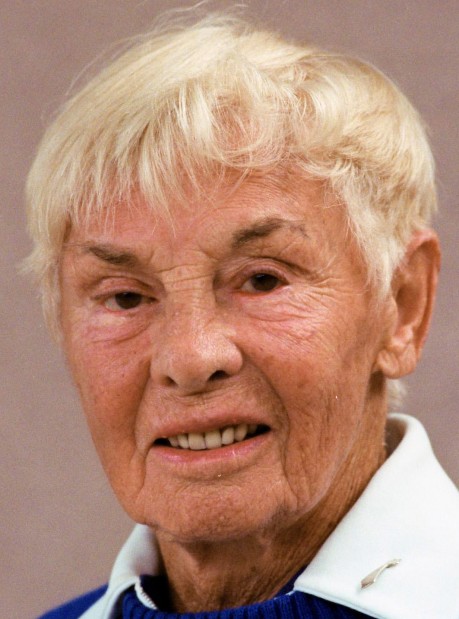
No doubt about it, Bonnie Prudden proved her point:
Exercise does a body good.
Despite suffering a bone-crushing accident, joint replacements, cancer and heart bypass surgery, the international fitness pioneer, TV personality and adviser to presidents remained healthy and active for all of her 97 years. She was still exercising from her hospice bed, just days before her death, Dec. 11, six weeks shy of her 98th birthday. Per Prudden's wishes, there will be no memorial service.
"One of the things that set Bonnie's program apart from any other one was her basic program could be adapted to any age and any ability," said Enid Whittaker, a longtime friend and associate. "She did prenatal exercise and baby exercise all the way up to bed exercise for people in nursing homes."
Prudden grew up in New York, where she was introduced to exercise as a toddler. Her parents consulted a doctor about their daughter's nocturnal wanderings - at 3 years old she was climbing out her bedroom window at night to wander the neighborhood.
People are also reading…
"He told them, 'There's nothing wrong with her that exercise and exhaustion won't cure," Prudden said in a 1994 Arizona Daily Star article. Her parents enrolled her in a Russian ballet school, and "I never went out the window again."
After graduating from high school, Prudden became a professional hoofer on Broadway as a member of the pioneering modern dance company of Doris Humphrey and Charles Weidman.
In 1936, Prudden married a wealthy industrialist.
"We went to Europe for the honeymoon. My first climb was on the Matterhorn," said Prudden who eventually became a world-class mountain climber.
That same year, Prudden hit a rock while skiing in Vermont, an accident that left her pelvis broken in four places. Doctors told the then-23-year-old she would never climb or ski again, she would be unable to have children and she would have a permanent limp. Ignoring the dire predictions, Prudden went on to have two daughters, Joan and Suzy, returned to climbing and skiing and became the first woman awarded the National Ski Patrol badge.
It was concern for the health of her daughters that paved her road to the White House. When Prudden learned there were no physical education classes in school for girls, she started a free after-school fitness program for the neighborhood kids.
Wanting a way to measure the fitness level of her students, Prudden began applying a test that involved six simple exercises performed in just 90 seconds. Over seven years she tested thousands of children in the United States and Europe. She discovered American children failed the test 60 percent of the time, while children from European countries had a failure rate of only 8 percent. After her findings were published, Prudden was invited to the White House to meet with Dwight D. Eisenhower, who created the President's Council on Youth Fitness based on Prudden's findings. In 2007, she received the President's Council Lifetime Achievement Award.
Notoriety from the Eisenhower meeting landed Prudden on the cover of Sports Illustrated, in a yoga pose, wearing a leotard of her own design. In the late 1950s, she penned the magazine's first fitness column and went on to write 15 books on exercise and myotherapy, a non-invasive pain-relief technique she developed based on pressure points. She opened the Bonnie Prudden Myotherapy clinic in Tucson when she moved west in 1993.
Prudden was a regular contributor to the "Today" show and other programs on television in the United States and internationally. In 1965, she made 35 episodes of the "Bonnie Prudden Fitness Show" on CBS.
Longevity was an fortuitous side effect of Prudden's fitness and pain-relief program. Her primary goals were to improve quality of life and make exercise fun, Whittaker said.
Advanced age didn't deter Prudden.
In June Prudden spoke at a myotherapy workshop, giving two two-hour lectures. In July she led another weekend workshop.
"Old age is not caused by weakness, but by pain and muscle dysfunction," Prudden said in 2001. "You can't turn back the clock. But you can wind it up."
What is myotherapy?
The "myo" in myotherapy comes from the Greek word for muscle. The procedure involves the manipulation of trigger points - irritable spots in damaged muscles - to relieve pain. Myotherapy involves finding trigger points, applying pressure to them for five to seven seconds, followed by low-impact exercise. For more information about myotherapy workshops, go to www.bonnieprudden.com
Contact reporter Kimberly Matas at kmatas@azstarnet.com or at 573-4191.

 Tucson's El Güero Canelo for sale


