

From the third-floor windows of the downtown Joel D. Valdez Main Library, facing south, visitors can see the colorful La Placita, which obscures the drab-coated Tucson Convention Center and the barrios beyond.
Forty and more years ago, if the library had been on North Stone Avenue, the view would have been much different: people, homes and businesses in a vibrant multi-ethnic community.
The 1960s demolition and construction of the convention center and La Placita forever altered the view. More pointedly, urban renewal demolished the lives and livelihoods of many Tucson families.
In recognition of what downtown's barrios looked like before the bulldozers came, the Pima County Public Library will create a photo exhibit of the neighborhoods and its residents. The exhibit, which will contain 18 photographs from the Arizona Historical Society collection, will coincide with the celebration of Arizona's centennial in February.
People are also reading…
Christine Dykgraaf, librarian and project coordinator, said the exhibit's goal is to reflect the diversity of the early barrios, which were home for Mexican-Americans, African-Americans, Jews, European-Americans and Chinese-Americans.
While the state will celebrate 100 years of statehood in February, Dykgraaf said the library wanted to focus on Tucson, specifically on its barrios, since it already has a photo exhibition of early Tucson.
To provide a more accurate and representative exhibition, the library has asked current and former barrio residents for their ideas and thoughts.
On Saturday library staff held a community meeting at the Santa Rosa Library on South 10th Avenue, in Barrio Santa Rosa south of downtown. Residents and their relatives were able to voice opinions, provide information about photos, vote on the photos they liked best and suggest titles for the entire display.
"The library is making a concerted effort to maintain this as a community project, not a library-down project that purports to know intuitively what photos best depict the culture and way of life lost along with the barrios' streets and buildings in the late 1960s," she added.
One resident is Ronald Lee, owner of Holiday Mart on West 22nd Street, east of Interstate 10. He liked the idea of the exhibit.
The photo collection will help people, especially younger Tucsonans, understand how barrio residents lived and where they developed their values, Lee said.
"It brings the past to the present so people can know where the basic foundations come from," Lee said.
Lee's family owned the Westside Market at South Osborne Avenue and West 19th Street, which was demolished. The family moved the market to its present site on the edge of Barrio Santa Rosa in 1966.
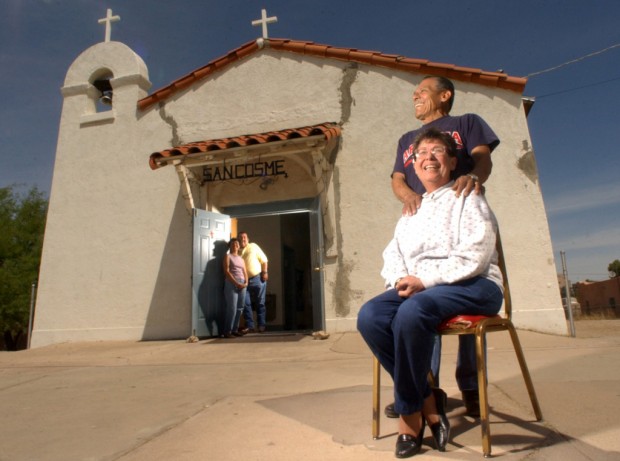
Four decades after urban renewal, discomfort and anger still seeps through some residents who were forced to abandon their homes and businesses of many years.
Proponents of urban renewal saw the barrios as blight and a barrier to economic growth. In the 1940s the business and political establishment, most of whom did not live in the barrios, laid the groundwork for condemning and acquiring about 80 acres.
Residents and business owners saw it differently. Generations of Tucsonans had lived and worked in the barrios. However, they didn't have the political and economic representation in city government and boardrooms.
"La Calle," a book by Lydia Otero, an associate professor in the University of Arizona's department of Mexican American and Raza Studies, documented the systematic destruction of the downtown barrios.
In February, when the library opens the exhibit, Otero will be a featured speaker.
Dykgraaf said a committee of seven former barrio residents and library staff will make the final selection of the photographs.
The exhibit will be displayed on the library's first floor during most of February. Later the 18 photographs will be on permanent display on the third floor, giving visitors a different perspective
Ernesto Portillo Jr. is editor of La Estrella de Tucsón. He can be reached at netopjr@azstarnet.com or at 520-573-4187.

 Tucson's El Güero Canelo for sale


