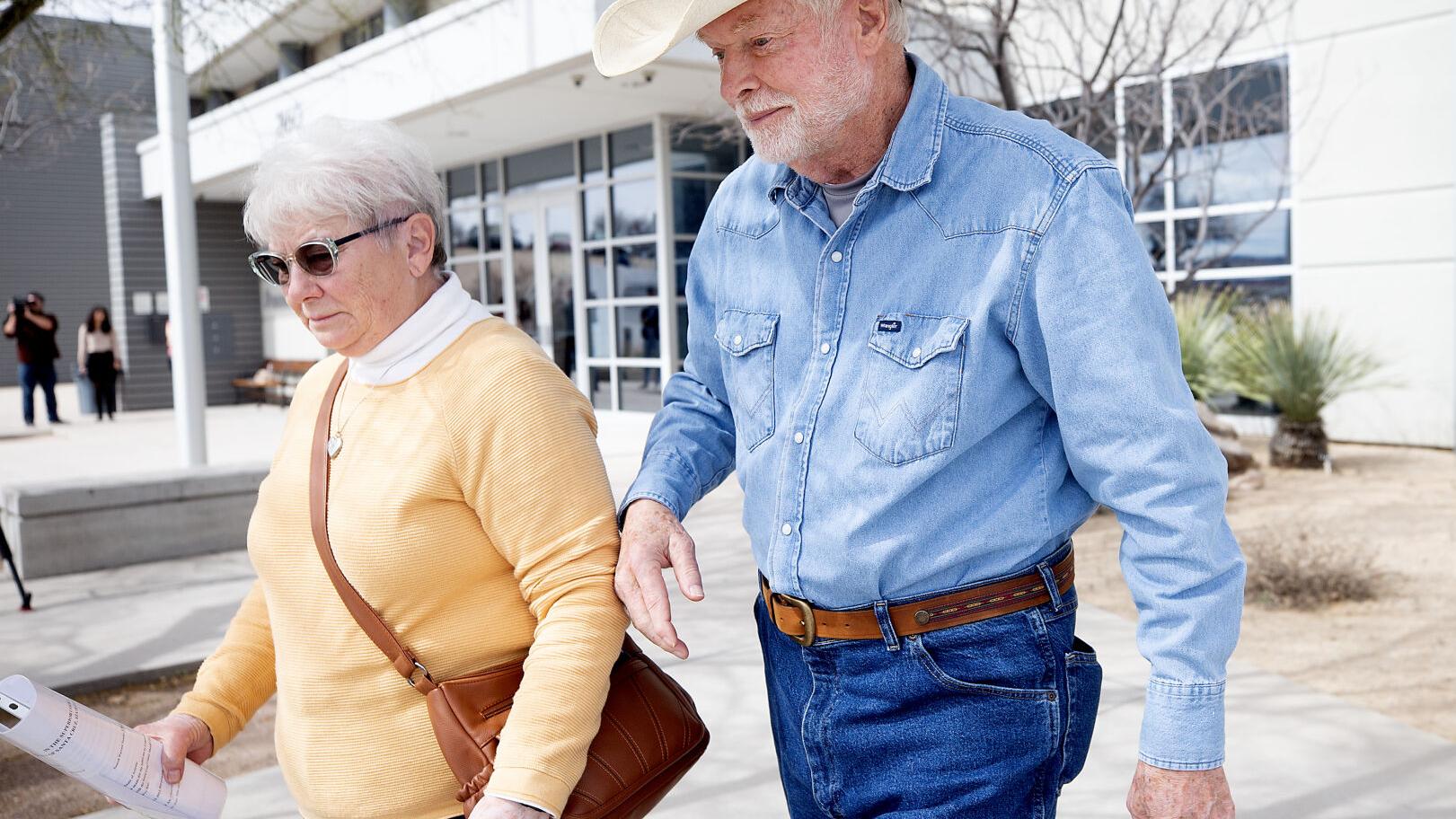
A border agent said a rancher told him there were people shooting at him and he was shooting back and that he “possibly struck something,” during emergency calls on Jan. 30, which directly disputes subsequent claims made in court by the rancher’s defense attorney.
The agent from the Nogales Border Patrol station was speaking on a call to the Santa Cruz County Sheriff’s Office at about 2:40 p.m. that day.
“Disregard,” the Border Patrol agent, who identified himself as a supervisor, said about a minute later on the call. “Now the person’s not sure if he’s being shot at. I don’t know if this guy’s crazy or what’s going on.”
The Nogales-area rancher, George Alan Kelly, later told a sheriff’s dispatcher the same day that he found the body of “an animal — it’s not a vegetable or a mineral” on his property.
People are also reading…
When deputies arrived, Kelly took them to the body, which was of 48-year-old Gabriel Cuen Buitimea, of Nogales, Sonora, who had been shot to death, according to court records.
Kelly, 74, has pleaded not guilty to second-degree murder in Cuen’s death. His defense attorney, Brenna Larkin, told a judge Kelly only fired a warning shot over the heads of a group of armed, possible drug runners who approached him on his property.
Larkin did not respond Thursday to the Star’s requests for comment.
Prosecutors say Cuen, an undocumented migrant, was unarmed and that Kelly shot him in an unprovoked attack as he tried to run away.
The two phone calls are among numerous Jan. 30 recordings between border agents, the sheriff’s office and Kelly, public records obtained late afternoon Wednesday by the Arizona Daily Star and first reported on by the Nogales International.
The prosecutor, Chief Deputy County Attorney Kim Hunley of Santa Cruz County, said Thursday that ethical rules prohibit her from commenting on a case currently proceeding.
Conflicting statements
There are conflicting statements on whether Kelly said he was shooting or being shot at during another recording between the Border Patrol in Nogales and the sheriff’s office, a few minutes after the first call.
“He called a couple of minutes ago to our ranch liaison, not into here directly, and said that he was shooting at five who are shooting back at him,” the agent told the sheriff’s office.
Later in the call an agent said Kelly’s last statement, eight minutes prior, was that “he thinks they were shooting at him, and he thought he heard gunshots and then he saw people running, but he didn’t see any firearms, but he’s checking his ranch with his weapons to check his livestock.”
The sheriff’s office asked if Kelly shot back, and the agent said, “No. At least he’s not saying he did.”
The agent also said Kelly had made similar calls previously and they ended up being about undocumented migrants on his property.
In another follow-up call, at 5:52 p.m., from the supervisor at the Ajo Border Patrol station, the agent told the sheriff’s office dispatcher that Kelly called the Border Patrol ranch liaison again, and this time “he’s being intentionally vague.”
“What he said was, in checking his property, he believes that he possibly struck something. He said those words, ‘possibly struck something,’ “ the agent said. “And then my ranch liaison says, ‘Hey, is somebody shot on your property? Can you call 911?’ And he says, ‘No, I call you guys because you guys are usually the fastest ones to come.’ “
‘I’m not admitting to anything I’ve done’
At 5:58 p.m., a sheriff’s dispatcher called Kelly to get more information. Kelly first told the dispatcher she should send a deputy to his ranch immediately but was hesitant to say why. He responded to many of the dispatcher’s questions with long pauses and answers he acknowledged were vague.
“It’s very serious, ma’am, and I can’t — I’m not going to talk over the telephone,” he said.
When the dispatcher, based on the information she had from the Border Patrol, asked what he shot at, he responded, “I didn’t shoot at any — I haven’t said I shot at anything.”
“I don’t want to get you in trouble, and I don’t want to get me in trouble,” Kelly told the dispatcher. “But I don’t want to break the law or anything like that. So, what I’m telling you is that we need a sheriff deputy out here … immediately and that’s all I can say ma’am.”
When she asked if anyone was hurt and whether to also send an ambulance, he said, “You know the thing ‘you have the right to remain silent, anything you say can and will be held against you.’ Well, I’m not admitting to anything I’ve done, but all those things tend to add up, and I don’t know what happened. I just know what I just saw about 15 minutes ago, and it’s something that an ambulance cannot help; EMTs cannot help. There’s nothing out here that can be aided by EMT or emergency services.”
At one point Kelly said he was referring to “the body.” The dispatcher asked Kelly to take the deputy to what he found when the deputy arrives, and Kelly said he “has a flashlight on over it.”
“I only approached the body to make sure that the animal ― it’s not a vegetable or a mineral ― the animal wasn’t alive, and it was not alive,” Kelly told the dispatcher.
“There was no sign of blood. There was just an animal laying face down,” Kelly said.
When the dispatcher confirmed, “An animal?” Kelly repeated, “It’s not a vegetable or a mineral.” He said he would take a deputy to it.
When deputies arrived, he took them to Cuen’s body, where he had set a lit flashlight on the ground, according to court records.
Prosecutors say no weapons or drugs were found on Cuen’s body.
The defense says Cuen was likely shot by someone else, not Kelly.
Prosecutor: ‘Extreme indifference’ to life
Kelly was originally charged with first-degree murder in the case, which he also pleaded not guilty to, before the state reduced the charge to second-degree.
Prosecutor Hunley explained the reduced charge by saying that even if Kelly shot Cuen by accident while intending to fire a warning shot, the state can establish he committed second-degree murder because of “extreme indifference” to human life in which “he recklessly caused his death.”
Larkin, Kelly’s attorney, countered: “Our position is that that did not happen, that Mr. Kelly would not do such a thing, and that instead, what happened was that he was approached by armed men who were on his property.”
The autopsy report found that the bullet entered Cuen’s body from the back lower right portion of his rib cage and exited from his left upper chest area, The Arizona Republic reported, citing testimony from Jorge Ainza, the Santa Cruz County sheriff’s detective who arrested Kelly.
A judge set a September trial date for Kelly, who was released on a $1 million cash bond on Feb. 22.
There is a self-published book on Amazon likely authored by Kelly called “Far Beyond the Border Fence.” The book summary says it’s “a contemporary novel which brings the Mexican Border/Drug conflict into the 21st century.”
Authored by a man with the same name as Kelly, the novel focuses on a man named George and his wife, Wanda, which is the name of Kelly’s real-life wife.
“Several times each week illegal immigrants would cross the VMR ranch,” says a section in the book. “They were led by armed human smugglers called Coyotes. George and his foreman had to patrol the ranch daily, armed with AK-47′s.”
George Alan Kelly’s defense lawyer Brenna Larkin lays out what she sees as issues with the prosecutor’s case against Kelly during a hearing in Justice Court in Nogales on Feb. 22.
The prosecutor for the state outlines their position, during a hearing in Justice Court in Nogales on Feb. 22, in the case against George Alan Kelly, whom Santa Cruz County Sheriff’s deputies arrested after finding the body of a Mexican national on Jan. 30 on Kelly’s property near Nogales.
Contact reporter Danyelle Khmara at dkhmara@tucson.com or 573-4223. On Twitter: @DanyelleKhmara

Danyelle Khmara
Reporter


 Tim Steller's column: Alleged killing by rancher raises old border clichés