

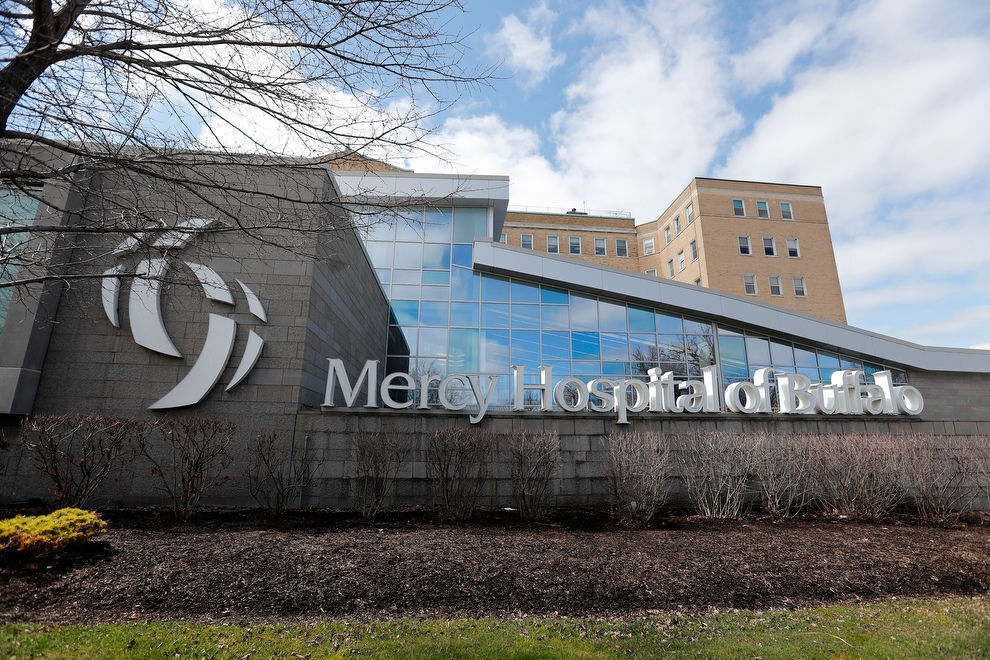
Strikes involving nurses at area hospitals have been rare in the past two decades – but a strike authorization approved Thursday night by Communication Workers of America members at Mercy Hospital has put that possibility on the table as their contract nears expiration.
Since 2001, nurses have almost never gone on strike at a local hospital.
"I would be surprised if, no matter how contentious the negotiation got, it came to that," said Larry Zielinski, a former Buffalo General Hospital president, referring to the situation at Mercy Hospital.
During contract talks, it's not unheard of for unions to hold a strike authorization vote to empower their leadership to call a walkout if negotiations fail to produce a new contract. But such authority often goes unused, since the two sides typically reach agreement on a contract first.
People are also reading…
In 2001, 170 registered nurses at what was then St. Joseph Hospital in Cheektowaga went on strike for three weeks before approving a new deal. That same year, 127 registered nurses at Lockport Memorial Hospital went on strike for five weeks.
Longer ago, there was a nurses strike at Buffalo General Hospital in 1983 that lasted 79 days. And a nurses strike at DeGraff Memorial Hospital in North Tonawanda in 1987 lasted 13 weeks.
Now, unionized workers at Mercy Hospital, including nurses and staff, are in the spotlight. Of the CWA members at the hospital who cast ballots, 97% voted in favor of giving their union the power to call a strike if a new deal isn't reached when the current one expires.
Catholic Health is "disappointed" that the CWA is threatening to strike at Mercy Hospital, but has a contingency plan in place to keep the South Buffalo hospital open and operating if a walkout occurs, said JoAnn Cavanaugh, a Catholic Health spokeswoman.
"A strike in any work situation is an absolute last resort, but that is especially true in a hospital," said Debora Hayes, the CWA's area director.
Negotiations between the union and Catholic Health are continuing, with six contracts covering 2,500 workers set to expire Sept. 30 at a total of three facilities. By previous agreement between the two sides, Mercy Hospital is the only one of the three facilities where a strike could take place. The CWA represents about 2,000 workers at Mercy Hospital.
The CWA members have made hospital staffing a central issue in their push for a new contract. Nurses who spoke at a news conference Friday described a workforce that is strained and exhausted, and they urged the health system to hire more workers to support patient care.
The timing of a potential strike, amid the Covid-19 pandemic, was criticized by Catholic Health.
"It is unconscionable the union would take registered nurses and other crucial health care workers away from patients’ bedsides and out of our hospital to walk the picket line while Covid-19 cases continue to rise in our community," Cavanaugh said.
The contract talks continue, with assistance from a federal mediator. Catholic Health hospitals has filed unfair labor practice charges against the CWA with the National Labor Relations Board, accusing the union of "bad-faith and surface bargaining."
Hayes, a veteran union leader, said workers who deliver health care " have such a passion for what they do, and for the care of their patients."
A strike at a hospital presents special challenges, with the need to provide capable patient care around the clock. By law, the CWA would have to give Catholic Health 10 days' notice of an intent to strike, to allow the health system time to prepare. The state Health Department would get involved in the process at that point.
Cavanaugh said that with about three weeks to go until the contracts expire, "there is sufficient time to reach fair, market-competitive contracts."
Matt Glynn


