
PIMA COUNTY FAIRGROUNDS — Behind the rows of gun-filled tables at the back of the exhibition hall, a large red banner shines like a beacon:
AK-47.
Beneath the sign, Joeken Firearms owner Joe Cox does a brisk business selling the popular semiautomatic rifle at gun shows such as this one and at his store in Winslow. The rifle is fun to shoot and easier to clean than other rifles, and, perhaps more importantly, it carries a powerful allure, he says.
"It looks cool," Cox says. "Why do people buy flashy cars? Because they look cool."
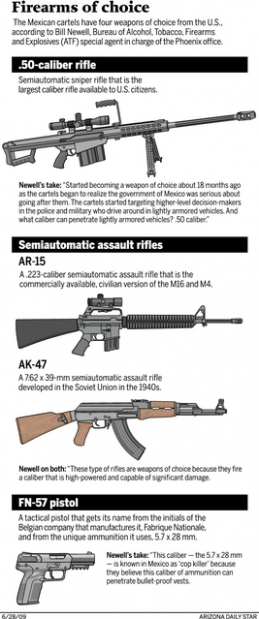
Semiautomatic rifles such as the AK-47 and AR-15 — commonly called assault rifles — are favorites of the warring drug cartels in Mexico, which get most of their weapons in the U.S. and smuggle them south, says the Bureau of Alcohol, Tobacco, Firearms and Explosives, commonly known as ATF.
People are also reading…
Firearms traffickers find it relatively easy to come to the U.S. and buy the high-powered weapons that fuel the billion-dollar drug-smuggling trade. There are two reasons for that:
First, U.S. gun laws are rooted in the Constitution's Second Amendment, which protects the rights of U.S. citizens to keep and bear arms. That make it easier to buy guns here than in Mexico. Second, the principal agency assigned to stop criminal purchases, ATF, is grossly understaffed.
"If you wanted to design a system to supply gun traffickers, you would be hard-pressed to design one that would be easier than the U.S.," said Kristen Rand, legislative director for the Violence Policy Center, a Washington, D.C.-based nonprofit group that works to reduce firearms violence in the U.S.
The Violence Policy Center and other gun-control advocates say tougher gun laws are the solution. But gun-rights supporters and the ATF say stricter enforcement of current laws is all that's needed.
"We don't need new gun laws in America to fix a problem in Mexico," said Alexa Fritts, spokeswoman for the National Rifle Association. "Any laws that we impose, such as trying to outlaw certain types of firearms in the U.S., would only affect law-abiding Americans."
The NRA disputes the common claim that 90 percent of guns used in crimes in Mexico come from the U.S. It points out that fully automatic rifles, grenades and rocket launchers used by the Mexican cartels are illegal to sell in the United States.
"Those are not things they are walking out of U.S. gun shops with," Fritts said.
The ATF contends that cartels get two-thirds of their weapons through either "straw purchases" — they pay somebody with no criminal record to buy a gun from a licensed dealer — or by buying from unlicensed dealers who are not required to perform background checks or record sales.
That's a major roadblock in the Obama administration's quest to slow the flow of guns into Mexico. Southbound inspections at border ports and highway patrols by multi-agency task forces stand little chance of slowing the smuggling, Rand said.
"There are 2,000 horses let out of the barn," she said. "They catch four or five of them. It's a completely ineffective way of trying to deal with this problem."
Efforts by U.S. law enforcement to combat illegal gun sales remain scattered and uncoordinated, said a Government Accountability Office report issued this month.
For example, ATF and Immigration and Customs Enforcement — the other main agency working on the issue — do not regularly coordinate, resulting in duplication and confusion during operations, the report says.
The National Southwest Border Counternarcotics Strategy, issued this month by the Office of National Drug Control Policy, included a chapter on slowing the flow of illegal firearms into Mexico. But it's unclear if resources devoted to the issue under the Obama plan will be tied to the new strategy, the GAO report found.
As evidenced by the options at gun stores or gun shows, the cartels aren't limited to hunting rifles and small handguns. Firearms used in crimes in Mexico are increasingly powerful and lethal, the report found.
"Basically, you can outfit your own army, which the Mexican cartels have done," Rand said.
Until now, politicians have been too afraid of the gun lobby's power to propose any changes to long-standing laws, said Garen Wintemute, a professor at the University of California-Davis who published a study on buying guns in the Southwest. "Politicians who think that something should be done about the issues are still terrified about actually doing something," Wintemute said.
But gun dealers say traffickers will find a way to get weapons, with or without more laws.
Cox, one of 6,700 federally licensed firearms dealers in the border states, said selling high-powered guns is no different from a car dealer selling a fast and powerful car. Society doesn't blame the car dealer when a person buys a Ferrari, gets drunk and kills somebody, he said.
"Anybody can come up here, buy a gun and turn around and do something illegal with it," Cox said. "There's absolutely nothing anybody can do to stop that. . . . You can't dictate morality and somebody's actions."
Tucked in beside the licensed gun dealers at the gun show are dozens of small booths run by private dealers. Some offer small collections of antiques or hunting rifles; others have high-powered arsenals.
Licensed dealers must conduct background checks for each sale. Unlicensed dealers don't have to do checks or record sales, which would make it easier to find a buyer if a gun is later used to commit a crime. And the law doesn't restrict how many guns they can sell each year.
The practice of letting people sell guns without a license was created so collectors of antique weapons could sell a few guns a year without having to become licensed, Wintemute said. The law forbids private dealers to sell guns "with the principal objective of livelihood and profit through the repetitive purchase and resale of firearms" but does not define that.
The ATF delivers "cease and desist" letters to unlicensed dealers who seem to be supporting themselves by selling firearms, said Bill Newell, ATF special agent in charge of the Phoenix office.
The GAO report said the lack of required background checks on private sales makes it difficult for the U.S. government to combat illegal sales.
Criminals don't buy only at gun shows, but gun-control advocates and the ATF agree that shows are a particularly vulnerable area. The ATF estimates that at least 25 percent of sellers at gun shows may be unlicensed.
Criminals "can go in and basically buy guns off paper, if you will," Newell said. "They know that, and that's a concern."
Newell insists that his agency doesn't oppose gun shows and says the ATF doesn't send agents to every show. It does so based on tips about potential criminal purchases, he said.
ATF agents regularly conduct training at gun shows about how to avoid straw purchases, and they distribute posters about the do's and don'ts of conducting business at gun shows. Most dealers there try to avoid selling to criminals, Newell said.
The NRA's Fritts said firearms traffickers know gun shows are teeming with law-enforcement members and avoid them, focusing on the black market.
John M. Hoffman, a Southern Arizona private gun dealer with a small collection, said he always asks for an Arizona driver's license and never sells to someone he suspects could use the gun for criminal purposes. If the buyer doesn't know anything about the gun he wants to buy, for instance, it's likely he is buying it for someone else, Hoffman said.
"I feel like we do a pretty good job of policing ourselves," he said.
Licensed dealer Mike Detty of Tucson said that if potential buyers come in a group and only one speaks English, he'll deny the sale. "It's not worth it for me to lose my way of making a living and going on the radar of ATF," he said.
Gun-control advocates want to "close the loophole" by requiring background checks on all gun sales, not just ones made by licensed dealers.
The Violence Policy Center proposes five other steps to slow gun trafficking to Mexico:
• A ban on importing semi-automatic assault weapons.
• Import restrictions on non-sporting firearms.
• Release of ATF crime gun- trace data.
• Aggressive investigation of licensed firearms dealers.
• Laws to reduce firepower.
But many gun owners oppose more laws, and firearms-rights groups such as the NRA often complain to members of Congress about ATF crackdowns, UC-Davis professor Wintemute said.
In August 2006, the ATF drew criticism during congressional hearings for tactics used at gun shows in Richmond, Va. The complaints prompted an investigation by the Office of the Inspector General.
"When ATF tries to do its job, it puts its own life at risk," Wintemute said. He added that the gun-rights lobby has helped keep ATF a low-priority agency.
When Newell started with the agency 21 years ago, there were 1,600 ATF agents nationwide. Today, there are 2,500, one of the smallest increases of any federal agency in that time. By comparison, the number of U.S. Border Patrol agents swelled from 6,000 in 1996 to more than 18,000 agents in April 2009.
There are 40 ATF agents in Arizona, the second-most-popular source for guns traced from crimes in Mexico, Newell said.
"I need at least double that to really stem the illegal flow of firearms to Mexico, and not only to Mexico but to violent criminals here," he said.
ATF is getting more agents under the Obama administration's campaign.
The NRA's Fritts said the group supports ATF efforts to enforce current laws and doesn't oppose the Obama administration's plan to curtail gun smuggling into Mexico. "What we don't want to see," she said, "is our freedoms weakened under the guise of crime reduction."