An immigrant couple's forced return to an unfamiliar homeland, and the impact on their U.S.-born children, is the subject of a new play opening Nov. 5 at a cultural center on Tucson's south side.
The play "Los Que Regresan," Spanish for those who return, centers on the story of a Mexican immigrant who came to the U.S. through the desert, and his wife, who was brought to the U.S. as a child.
Facing the threat of detention and deportation, the couple takes their U.S.-citizen children back to Mexico, a country where they haven't lived in decades, said Alba Jaramillo, actor and co-founder of Teatro Dignidad, a Tucson theater company that promotes human rights through its bilingual performances.
The couple and their children return to a place where their struggling families aren't in a position to receive them, and where they face the threat of violence, said Jaramillo, who is also co-director of the Immigration Law & Justice Network.
People are also reading…
The wife, who grew up in the U.S., and her Jalisco-based mother-in-law ultimately become members of the "Madres Buscadoras," which translates to Searching Mothers, a collective of families that conducts searches for their missing loved ones in Mexico, often victims of violence wrought by organized crime groups.
Families returning to unfamiliar home countries deal with financial challenges, language barriers, the specter of violence, as well as the fear of being detained while returning to Mexico, Jaramillo said. The play also invites audiences to think about the impact of U.S. immigration policy on U.S. citizens, including spouses and children of immigrants, she said.
"We want to really humanize what it's doing to the psychology" of immigrants, and their loved ones, forced to live in fear, she said.
An estimated 4.4 million U.S.-born children are part of mixed-status families, according to the Pew Research Center.

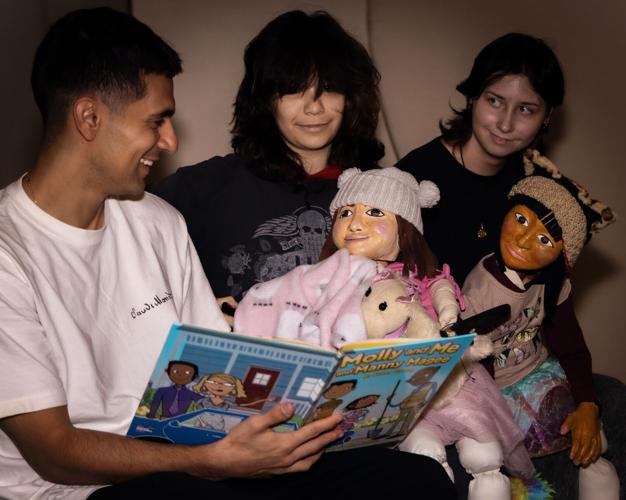
The play Los Que Regresan, Spanish for "those who return," tells the story of an immigrant couple who leave the U.S., with their U.S.-citizen children, to return to an unfamiliar home country. Actor Mario Weihs, pictured in a rehearsal at left, plays Vicente, a young man who self-deports with his family. Puppeteers Elliot Cravalho and Cassius Bjelk, center and right, depict his two U.S.-born children. Los Que Regresan opens Nov. 5 at the Louis Market Center for Cultural Organizing on Tucson's south side.
Jaramillo said Teatro Dignidad reached out to Mexican playwright Hugo Salcedo to commission the play, at the time when Donald Trump was running for his second term as president on the "promise of mass deportation."
"We knew this was going to create a lot of fear, that people were going to leave (the U.S.) on their own, and all the horrible things that were coming," she said. "The play will also explore the immigration policies, but it is our intent to put a face to a family that is going to go through this, because it’s happening all around us."
It's Salcedo's second commission by Teatro Dignidad, which in 2024 commissioned and staged Salcedo's original play, "2 Nogales." The play's English translation premiered in Tucson and Boston, and the Spanish version was also performed in multiple venues in Sonora. It will premiere in Guadalajara in November, Salcedo said.
The English translation of "Los Que Regresan" for its Tucson performances was done by Eva Zorrilla Tessler.
Salcedo is drawn to writing about migration "because of its deep roots in human history," he said, writing in Spanish in WhatsApp messages. To research "Los Que Regresan," Salcedo studied news reports and documentaries chronicling migrants' journeys, and spoke directly with immigrants who chose to leave the U.S. to understand the challenges they faced in Mexico.
The Trump administration has said about 2 million people have self-deported in his second term. But a new analysis from the nonpartisan Migration Policy Institute found the figure is likely between 310,000 and 1.5 million immigrants carried out "self-departures," in the first 18 months of the second Trump administration. The October analysis included immigrants, both unauthorized and lawfully present in the U.S., who had at least one year of U.S. residence and who left voluntarily.
Salcedo said the theater is the "ideal place" to spotlight social and political issues, and broaden public discussion about them, through "a stage production that lies somewhere between documentary and dramatic fiction."
"In this sense, my instrument is political theater that invites reflection both individually and within the context of the community," he said. "'Los Que Regresan' speaks of the migrant condition in the United States, of ICE persecution and wrongful deportations; but it also touches on aspects of the love and resilience of our Latino community."

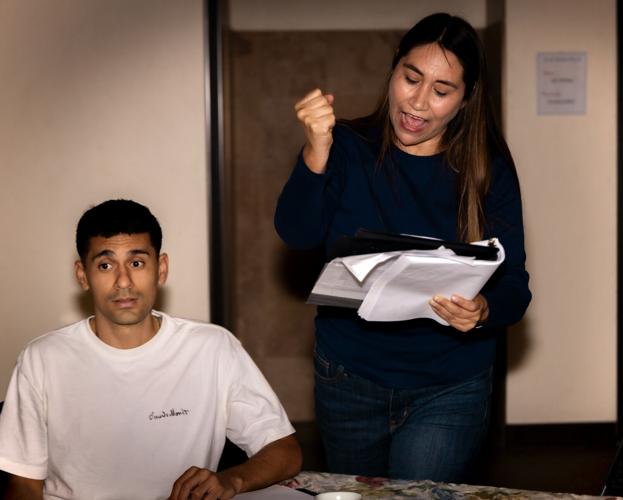
In this scene from the play "Los Que Regresan," Spanish for "those who return," a family arrives in Tlaquepaque, Jalisco after self-deporting from the U.S. "It is a scene of joy when the family reunites, followed by uncertainty about how they will make ends meet and worries about how they will survive and find work in an area controlled by cartels," said Alba Jaramillo, pictured at right, along with actor Mario Weihs. "Los Que Regresan" opens Nov. 5 at the Louis Market Center for Cultural Organizing.
He also hopes the play strikes a chord with politicians and decision makers, "to show them the unfortunate reach of their decisions made without considering the consequences, decisions that are a genuine attack on people's human and civil rights," he said.
Formerly a Chinese grocery, the Louis' Market re-opened in April as a cultural center, thanks to the work of the Southwest Folklife Alliance and community-led Regeneración.
"We’re so exited about this venue because it's the first cultural center in the south side of Tucson, in the heart of the immigrant community," Jaramillo said. "This is going to be the first major event and we’re really happy to be there, because we want the neighbors to come, the families that are being impacted by this."
Jaramillo hopes for a couple of hours, audiences will "live what these characters, who reflect our impacted community, are going through."
"This is the power of theater, because it's not just about preaching politics," she said. "It's not even about listening to a protest. It's about putting yourself in the shoes of these family members. I think that’s the transformative experience. ... It has the power to change hearts and mind."
A community preview of the play opens Thursday, Nov. 5 at the Louis' Market Center for Cultural Organizing, and opening night is Friday, Nov. 6. The play runs through Nov. 22.
Contact reporter Emily Bregel at ebregel@tucson.com. On X, formerly Twitter: @EmilyBregel

Emily Bregel
Border reporter


 'Dangerous' moment, as Trump's DHS ignores DACA protections, advocates say