Stephen Paul loves to point out the 40-gallon still set up in the small alcove leading into his cavernous Whiskey Del Bac distillery on Tucson’s west side.
Next to it is the 5-gallon still that he started with in 2007, about a year after his wife had suggested the idea of drying malt over mesquite wood to capture the essence of the desert in a bottle.
“Just the notion of being able to make a single-malt whiskey that was truly from this place just captivated me,” Paul recalls.

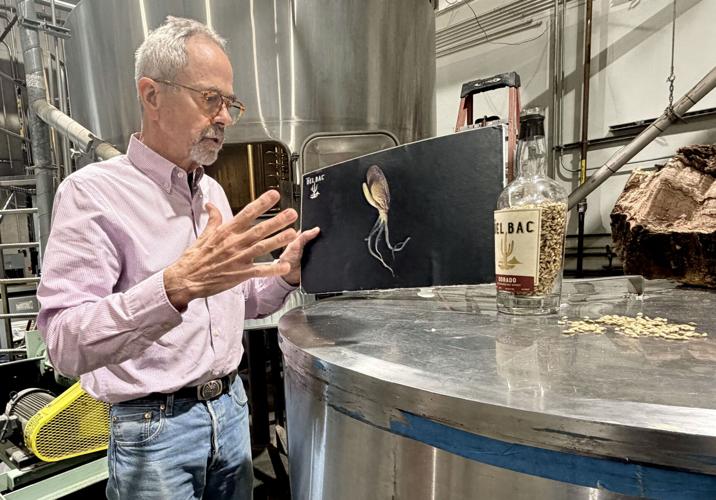
During a recent tour of his distillery, Whiskey Del Bac founder Stephen Paul explained the process of smoking malt over a mesquite fire, a signature of his 15-year-old whiskey brand.
That experiment turned into an award-winning, best-selling whiskey that last April landed in the portfolio of a Florida spirits company that hopes to grow the brand well beyond its Sonoran Desert roots.
After seven months, No Sleep Beverage Inc. has already taken the distinctive mesquite-smoked whiskey to Texas and has plans to put it on store shelves in southeast Florida and parts of New York.
People are also reading…
No Sleep Beverage Inc. acquired Whiskey Del Bac along with Nine Banded Whiskey out of Austin, Texas, and New York’s Ume Plum Liqueur.

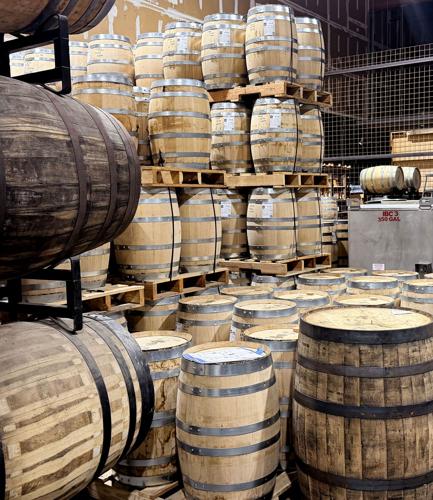
Whiskey Del Bac crafts its American single-malt whiskeys from its cavernous facility in the west side Broadbent Business Park, from distilling the whiskey to aging it in these white oak barrels.
“All three of these brands have sort of a unique cultural component. They all speak to sort of a cultural zeitgeist and have culture embedded as part of the brand,” said No Sleep CEO and founder Nick Papanicolaou. “Our goal is really to … tell that story.”
No Sleep is marketing all three brands together, which Papanicolaou said “allows us to synergize those costs and essentially improve the revenues or sales across the brands.”
The acquisition came after two years of talks against the backdrop of a prolonged market decline in alcohol sales that started in 2023 and has hit the craft beverage industry particularly hard, according to the American Craft Spirits Association.
The association’s 2026 Craft Spirits Data Project, released in August, showed craft spirit makers’ sales dropped year-over-year by 3.7%, with the actual sales of spirits declining by 8%.
Most of the drop can be attributed to makers overestimating the market coming out of the pandemic, when the craft alcohol market experienced an extraordinary boom. Much of the sales increase in 2021 and 2022 was driven by consumers ordering in large volume during the COVID-19 shutdown.
When the pandemic passed, consumers switched gears and stopped buying alcohol, so instead of seeing a 35% jump in sales that Paul had projected during that time, Whiskey Del Bac had a 10% jump.
“I always like to talk about how we beat the spread,” said Whiskey Del Bac’s master distiller Mark A. Vierthaler.
Faced with more inventory than they could sell, which was endemic of the craft beverage industry as a whole coming out of the pandemic, Whiskey Del Bac paused production from late 2024 until early this year.
“When we have a nice deep stock, one of the most responsible things we can do is slow production down,” Vierthaler said. “And because we age and are able to harvest so quickly, we actually can be pretty flexible in terms of being able to turn that faucet on and off.”
Vierthaler said they are now producing less than half as much whiskey as they did before hitting pause in 2024, with the goal of increasing that every year. In the years leading up to the pandemic, Whiskey Del Bac was producing as much as 10,000 cases annually, or 120,000 750 ml bottles.
“We're aiming at producing around 44,000 bottles a year for 2027, and then again increasing each year after that,” he said.
The distillery has the potential to increase production even more after upgrading its facilities in 2022. The expanded capacity could boost production to 18,000 cases.
And with No Sleep at the helm, Whiskey Del Bac is looking at increasing its market access outside of its home base.
Whiskey Del Bac sells 80% of its product in Arizona, but it also has distribution in 22 states.
“They currently have a presence in those markets. What we're going to do is … get them a proper distributor … and the right feet on the street … to actually sell these brands,” said Papanicolaou.
“I think they would probably also admit that they expanded too quickly,” he added. "They were in 20 plus markets, including Texas, Florida and New York, but without having those resources to support it. That's where we come in with the money to say, 'let's spend the right amount of money in a select few markets and hire people in a select few markets to get that word out'.”
“They really get our whole ethos and what we're doing,” said Paul, who, at 75 years old, has scaled back his involvement in the distillery to two days a week. “They don't want to change that, and so the acquisition involved them basically investing in the company.”
Papanicolaou said there are no plans to make any changes at the Tucson distillery, including in personnel or the actual whiskey.
“I think people make the assumption that when a small distillery or any kind of mom and pop company gets acquired that the people acquiring are going to come in and change everything,” Paul added. “They don't want to change everything; they really value what we're doing.”
Contact reporter Cathalena E. Burch at cburch@tucson.com. On Bluesky @Starburch

Cathalena E. Burch
Reporter