You could look at the new proposal to defund Rio Nuevo more as a statement of principle than as a real proposal.
That's in part because even if GOP legislative leaders want to eliminate Rio Nuevo, Democratic Gov. Katie Hobbs doesn't. Eventually, the two sides are going to have to strike a budget deal.
"Unlike Republicans, governor Hobbs prioritizes critical economic development tools like Rio Nuevo and won't support a budget that doesn't put Arizonans first," Hobbs' office said in a statement.
Beyond the politics, it would likely be prohibitively complex and expensive to suddenly unwind the economic-development program for central Tucson that has been overseen by the state government since 2010. It could be done, but it might not save more than a couple of million dollars a year in the end, certainly not the $19 million that Rio Nuevo received in state sales taxes during the latest year, Rio Nuevo Board Chair Fletcher McCusker said.
People are also reading…
That's a good thing, because even though Rio Nuevo represents a form of "crony capitalism," as the GOP legislators said in announcing their budget plan Monday, it has undeniably borne fruit in Tucson. From the west side, all the way up to Park Place mall, the small and large injections of funding and tax rebates have helped build up a central Tucson that would be worse without.

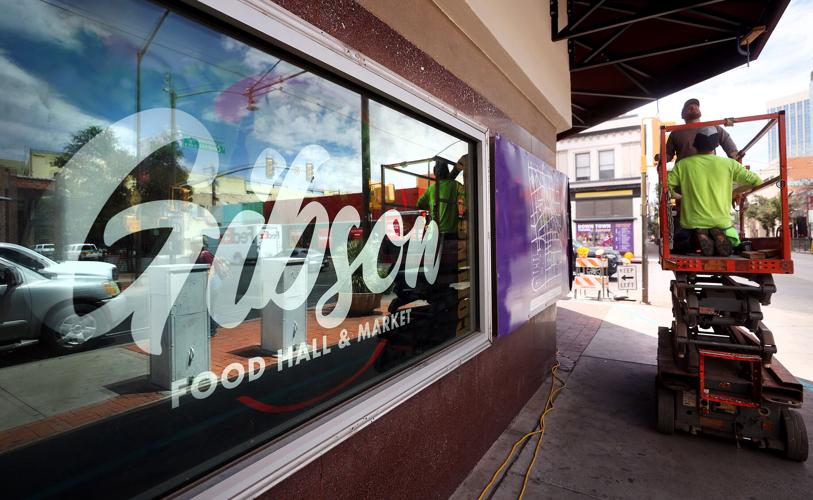
Staff from Arizona Awning and Canvas work Friday on installing an awning at Johnny Gibson's Food Hall, 11 S. Sixth Ave. in downtown Tucson. Rio Nuevo's small and large injections of funding and tax rebates have helped build up a Tucson downtown and midtown that would be worse without.
Consider the new hotels on Cushing Street, South Stone Avenue and East Broadway downtown, or the gradual redevelopment of the Sunshine Mile east of downtown, or the funding of annual events and even off-duty police coverage at the Ronstadt Transit Center. This system, under which a portion of state sales tax is returned to Tucson to underwrite tax-generating business projects, built a lot of that.
For people like me, who love a downtown with street life, that's what makes our little exercise in crony capitalism worthwhile. I frequently benefit by sitting at the long counter in Caffe Luce on Congress downtown, part of a broader mixed-use development originally supported by Rio Nuevo.
Even with all the drawbacks of doing development this way, I look out at the passersby and acknowledge it produces some good results at a relatively low price.

Arizona Daily Star columnist Tim Steller
Tends to benefit insiders
The drawbacks of this tax-increment-financing approach are considerable. Among them:
• A series of insiders tend to benefit from Rio Nuevo support, names like Stiteler, Schwabe, Fenton and Dabdoub regularly appearing on the board's agendas for new projects or adjustments to old ones. That's in part a simple effect of who owns property and does projects downtown. But it leaves the impression of a club that most of us aren't part of.
• District-funded projects can drive cost increases in areas where these developments occur. While the Rio-Nuevo-assisted Mercado District has become a successful and attractive redevelopment on the west side of the Santa Cruz, for example, there is little doubt it has helped increase housing costs in what has long been a working-class area.
• Since 2010, the Rio Nuevo district's mission is relatively limited, to supporting businesses and efforts that will increase sales-tax revenue. This means many cultural projects, like those envisioned when the district was approved by voters in 1999, are out of luck.
• Although the district was approved by Tucson voters, that was of a different vision of the downtown and west side district. The current, state-driven priorities are not what the voters approved, although the district's supporters use voter approval as a shield against a state shutdown.
You can see the difference between the original vision and the current one in some of the projects that have received recent district support. The district was drawn as a blob around downtown, plus a long, contiguous stretch along East Broadway to include the El Con and Park Place malls. The idea was that those malls could add heft to the sales tax revenue counted in the district and be put toward central-city projects.
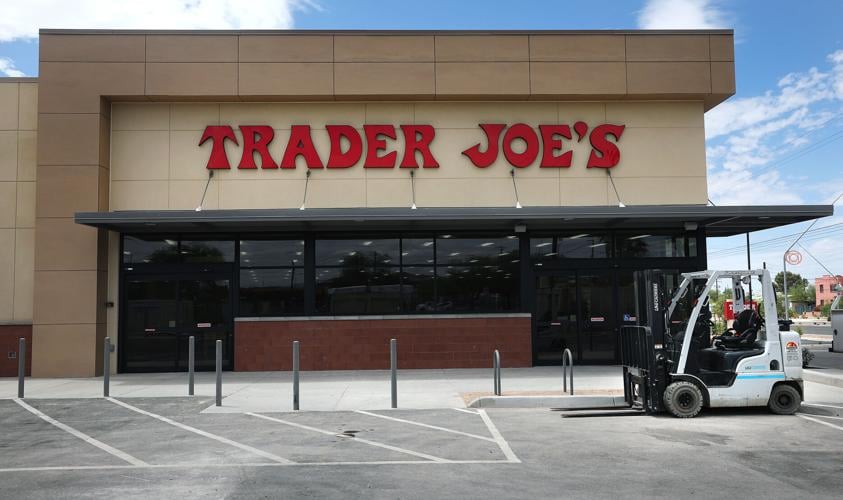
As a result, though, that whole stretch of East Broadway to Park Place is eligible for redevelopment support from Rio Nuevo. That's what explains why Rio Nuevo is helping the redevelopment of part of the old Sears building at Park Place as a Cold Beer and Cheeseburgers restaurant, and why it helped the development of the property where Trader Joe's is soon to open at Broadway and Plumer Avenue.

Tucson's newest Trader Joe's store opens Friday morning on East Broadway at South Plumer Avenue.
'Can they actually survive on their own?'
Democratic former Tucson legislator Pamela Powers found herself working with Republican colleagues in the late 2010s to question or end tax breaks and special tax incentives that they all considered "crony capitalism." For Powers, that included Rio Nuevo, even though it was returning additional state sales tax money to Tucson.
She and other legislators demanded that the district become more transparent in its processes and reports, as well as showing its impacts. Some businesses that received sales-tax rebates or direct funding did not survive for long, she noted.
"Can they actually survive on their own, or will they fold?" Powers asked in an interview Friday. "The idea is that we’re growing our business. How many of them stick around? How many can maintain the business after the subsidies are gone?"
The longtime chair of Rio Nuevo, Fletcher McCusker, told me Friday, that, analytically "We don’t look back."
"If we give money to a developer and they go out of business, there’s no requirement that they pay us back," he said.
"What we have found is that when a particular provider goes out of business, a new provider takes over the space," he said.
He cited the site of the Funky Monk bar and Hi-Fi Kitchen & Cocktails at Fourth Avenue and Congress as examples. Both have closed, and both are being replaced by new projects. Of course, those projects also require some help from Rio Nuevo.
'Forward movement worth building on'
The thing is, Rio Nuevo is steadily fulfilling its mission, if you measure its mission by sales tax collected. The district gets about half of the state's sales tax of 5.6% per dollar spent, collected within the district's boundaries.
Rio Nuevo's portion of the sales tax collected in the district has risen from $9.9 million in fiscal year 2013 to $19.1 million in fiscal 2025. This increase isn't all due to the district's activities, but they've certainly helped.
The fact that Rio Nuevo is bringing in a growing portion of state sales tax and has been changing the way it operates has encouraged the two Tucson City Council members who represent the wards in which the Rio Nuevo district operates.
"While by no means perfect, Rio Nuevo is one of the few ways we can exert local control over a portion of state sales tax that would otherwise go to Phoenix to be spent on any number of things that don't directly benefit Tucson," Ward 6 Council Member Miranda Schubert said in a text message.
Ward 1 Council Member Lane Santa Cruz said via message, "I support the continued work of Rio Nuevo. It's come a long way in recent years, and we've seen more alignment and forward movement that is worth building on."
Beyond that, it simply would not be easy, or gain much, for the state to unwind Rio Nuevo suddenly. Not only is the district paying $9 million per year in debt service, but it has obligations that, according to an analysis released by McCusker, add another $6.9 million per year. Then there are the $175 million in deals that have been approved or are approaching contracts.
In the end, the analysis concludes, the state would only collect $2.4 million per year by ending Rio Nuevo.
But if people are really concerned about how Rio Nuevo is unfolding, perhaps it shouldn't be the state deciding whether it continues. Maybe it should be the people of Tucson, who, after all, approved a different Rio Nuevo plan in 1999 and are used as the shield against changes due to that vote.
Let us vote again to be sure that we want to keep this going til 2035, and the state can be assured that not only would it not be gaining much from cutting Rio Nuevo, but it also still has the local people's support.
Contact columnist Tim Steller at tsteller@tucson.com or 520-807-7789. On Bluesky: @timsteller.bsky.social

Tim Steller
Columnist


 Tim Steller's column: Renaming U of A's Chavez building? Let's do Marley, too