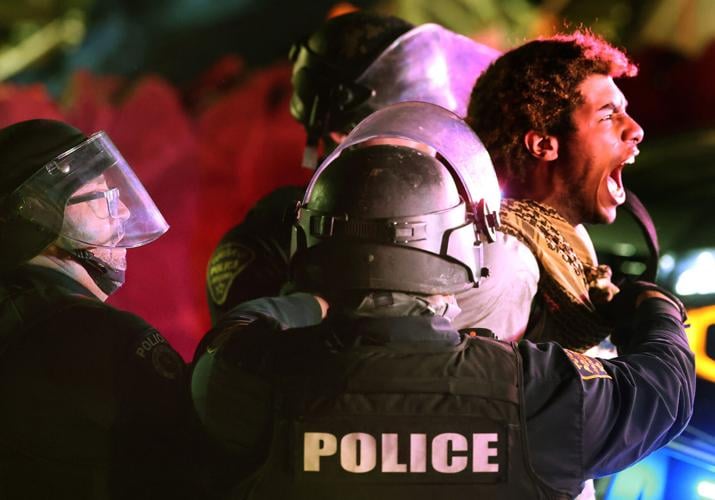
Two years ago this month, as U of A seniors prepared for graduation, a police crackdown occurred on campus that continues to reverberate as graduates don cap and gown this year.
In the climax of months of protests, students twice set up encampments on campus. Both times, police broke them up after then-UA President Robert Robbins ordered a "zero-tolerance" policy, amid arguments by Jewish students that the camps represented an antisemitic threat.
"It was definitely very intense," physics graduate student Max Thomas recalled this month. "We had set up camp around mid-afternoon and held it down well into the evening. There was a sentiment among the camp on that final night that maybe these nights have not gone as we want. We are going to stay until the end, whatever it comes to. Our moral posture is strong enough that we are not going to acquiesce to force."
People are also reading…
Arizona Daily Star columnist Tim Steller
"At a certain point the riot police came in pretty fiercely with less than lethal munitions. I’ve been hit with pepper balls. Then they came in with tear gas after we put up some resistance. I had never been hit with that before. It was excruciating. I wanted to stay behind and hold it down, but it was a physical reaction to run."
The students were protesting Israel's war in Gaza, which began after Hamas attacked Israel on Oct. 7, 2023, killing about 1,200 people and taking about 250 hostages. By May 2, 2024, Israel had killed 34,568 Palestinians in Gaza, according to UN figures. Two years later, on May 6 this year, the death toll in Gaza stood at 72,619, the UN reported, and war had expanded to Iran and Lebanon.
But the atmosphere on campus has been quiet when it comes to protesting Israel's war actions. Activists attribute that not just to the physical crackdown on the camps, but a broader, nationwide campaign of intimidation against those speaking out.
In retrospect, that move to establish protest camps, which happened across the country, was a crucial escalation. It caused more fear on the part of Jewish students than run-of-the-mill protests had, and justified crackdowns by university presidents around the country.
When I tried over the last few weeks to communicate with some of the students who spoke out in 2024, most didn't respond. The message had hit home for them that this sort of speech could be punished, as shown on that last night of the campus encampment.
"At that point, my mentality and a lot of people organizing and participating in the encampments is 'Maybe we don’t have as much power as we thought we did,' " Thomas recalled. "They have these weapons, and whenever they give the code to go, it’s over on our end."
Crackdowns struck fear
It wasn't just the police crackdowns on encampments that struck fear into protesters. Across the country, formal discipline and even international notoriety resulted from their actions. The groups Canary Mission and Betar tried to blacklist professors and students who had spoken out against Israel's actions.
Even Israeli Prime Minister Benjamin Netanyahu weighed in, saying in April 2024, "What’s happening in America’s college campuses is horrific. Antisemitic mobs have taken over leading universities. They call for the annihilation of Israel."
Then the Trump administration took office in January 2025 and cracked down on universities, arguing they had allowed antisemitism to flourish, and targeted individual foreign students who had spoken out, even arresting a Turkish student at Tufts University who had co-authored an innocuous op-ed.

Tucson police took a protester into custody in May 2024 when several area law enforcement agencies cleared a pro-Palestinian encampment from the University of Arizona campus.
That year, the Arizona Legislature passed a bill, sponsored by Tucson Democratic state Rep. Alma Hernandez, banning overnight encampments on campus. She argued that the 2024 encampments created an atmosphere of hostility for Jewish students as well as making a chaotic mess of campus.
When I spoke with Rabbi Shmulie Shanowitz, director of the Chabad House on campus, he pointed to the establishment of those camps, modeled after an encampment at Columbia University, as a turning point.
"There have been many other protests throughout (that period), and many of those protests were done the right way, coordinated with the university," he said.
Some Jewish students might have taken offense, though others were participants in the protests, but in any case, it was clearly First Amendment-protected action.
The encampment, he said, "wasn’t a peaceful scene for Jewish students. It came across as very hostile and intimidating. The university, I think, handled it very well."
Arguments bolstered
Protesters I spoke with at the U of A in April 2024 and this month rejected vociferously the characterization of their movement as antisemitic, saying their activism was motivated by the actions of the state of Israel, not enmity against Jews in general.
In the quiet period since the 2024 crackdown, the protesters' original arguments have been bolstered. The word "genocide" was bandied about in 2024 in chants like "Netanyahu, you can't hide / We charge you with genocide." It was easy to dismiss as a spirited exaggeration, especially because the public understanding of genocide is that it must be like the attempted extermination of Jews in Nazi Germany, which isn't necessarily the case.
As time passed, experts on genocide came to the conclusion that, in fact, Israel's actions in Gaza met the definition not just of war crimes, or of crimes against humanity, but also genocide.
Two Israeli human rights groups came to that conclusion in July 2025, as did Israeli genocide scholar Omer Bartov. The International Association of Genocide Scholars came to that conclusion in August 2025.
An independent UN commission found in September 2025 that Israel committed four of the five acts that are considered genocidal, when "committed with intent to destroy, in whole or in part, a national, ethnic, racial or religious group."
Those acts included killing members of the group; causing serious bodily or mental harm to members of the group; deliberately inflicting on the group conditions of life calculated to bring about its physical destruction in whole or in part; and imposing measures intended to prevent births within the group.
Israel vehemently denied that it has committed war crimes or genocide, arguing in part that the UN commission is biased against the country.
Fear of severe consequences
The decline of protests on the UA campus did not likely reflect a change of opinion, certainly not among activists. More broadly, young American adults are the most likely age group to be critical of Israel.
Among American voters age 18-34, 63% viewed Israel negatively in an NBC survey taken in February and March, which reflects similar results in other polls conducted this year. This year's result was up from 37% of that age group viewing Israel negatively in a 2023 survey.
"This newest generation of students — Gen Z and Gen Alpha — their consciousness about Palestine has been so raised that there’s no going back," said Audrey Zelinka, who was an undergraduate protesting at ASU in 2024 and is getting a master's degree in public health from the U of A this year.
Protests have diminished largely because of the fear of severe consequences, activists told me.
"University administration siding with law enforcement over concerned campus community members and the federal crackdown on First Amendment rights are the causes of the 'much less' activism on college campuses in years since 2024," said Hannah McKinney, organizer and spokesperson for the United Campus Workers, via email.
Miranda Lopez, a member of the same group and 2025 recipient of a UA master's degree, said there was also some dissension among members about whether to protest for the Palestinian cause, combined with the natural flux in university students who graduate and move on.
"People are definitely a lot more cautious when it comes to protesting on campus," Lopez said. "There’s a sense that we need to be careful because the administration has this police force at their disposal, and they’re willing and able to use it if they want."
The UA administration has changed since 2024, but still, that's a sad commentary on the state of free speech on campus, which is bolstered by strong state laws passed in 2016 and 2018. At the time, the Legislature was looking to protect disfavored conservative speech on campus, but the law should work equally for disfavored pro-Palestinian activism.
One of the paragraphs of those laws says, "It is not the proper role of an institution of higher education to shield individuals from speech protected by the First Amendment, including, without limitation, ideas and opinions that may be unwelcome, disagreeable or deeply offensive."
The last two years show there are ways to suppress those ideas and opinions anyway.
Contact columnist Tim Steller at tsteller@tucson.com or 520-807-7789. On Bluesky: @timsteller.bsky.social

Tim Steller
Columnist


 Tim Steller's column: Chuck George, TV meteorologist, returns to Tucson, teaching