May 13
UA piano student
to give Tuesday recital
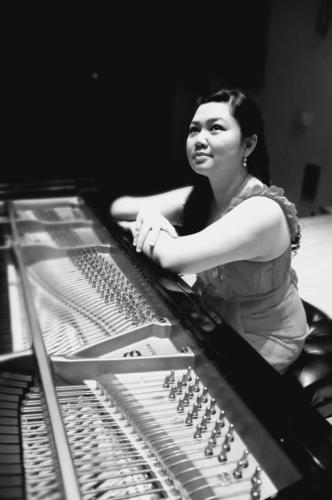
Pianist Chiew Hwa Poon, first-place winner of the UA’s 2014 Lois Trester Piano Competition, will perform at Academy Village at 11:30 a.m. Tuesday.
The annual competition, where Poon also received the Audience Prize, is open to all University of Arizona piano students.
Poon’s solo recital will include a varied program ranging from pieces from two sonatas by the Baroque composer Domenico Scarlatti to two rags from the American composer William Bolcom’s “Garden of Eden.”
She also will perform one of Franz Liszt’s etudes, “Recordanza,” Sergei Prokofiev’s “Sarcasms” Op. 17 and two poèmes by Alexander Scriabin.
People are also reading…
A native of Malaysia, Poon completed her master of music degree in piano performance at Missouri State University in 2008. She is pursuing her doctor of musical arts degree in piano performance at the UA under the guidance of Professor Tannis Gibson.
Her solo performance experiences include participation in the Gijon International Piano Festival in Spain (2009) and with the Missouri State University Symphony Orchestra as the winner of its concerto competition.
Poon says she enjoys performing as a collaborative pianist, and was particularly gratified to play in the Eighth Annual Chamber Music Showcase as part of KUAT-FM’s Community Concert series.
Poon is a graduate teaching assistant. Also since 2011 she has served as a volunteer piano teacher with The Symphony Woman’s Association program for underserved children.
Priscilla Moore
May 14
Professor to discuss US missteps in Syria’s war
The Syrian civil war, now in its fourth year, is increasingly seen as a proxy war between Iran and Russia on the side of Syria’s minority government and the United States and its European Union allies on the side of the rebels.
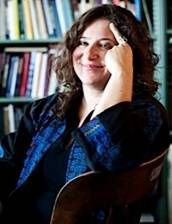
One of the UA’s top experts on Syria and Middle Eastern affairs, Leila Hudson, argues that the Obama administration’s failure to adequately support pro-democracy rebels in Syria is having serious ramifications not just in Syria but in Ukraine and other trouble spots around the globe.
Hudson will offer an update on the Syrian civil war at 3:30 p.m. Wednesday.
Hudson is the associate director of the UA’s School of Middle Eastern and North African Studies, where she also serves as an associate professor. She is the director of the Southwest Initiative for the Study of Middle East Conflicts at the UA and director of the university’s year-old Arabic Language Flagship Program.
She said she plans to devote part of her talk at the Senior Academy to the civil war’s tragic effects on the people of Syria and part on the global implications of what she calls America’s “inability to have any positive effect on the situation.”
In an analysis written last month for the Huffington Post, Hudson compared America’s problems in influencing the outcome of civil wars in Syria and Ukraine.
In both conflicts, she said, “Washington has been unable to marshal the opposition into a structure capable of governing itself, let alone the country, while Moscow has shrewdly put its money where its mouth is, investing resources in military assets and security-seeking loyalists.”
Hudson earned a bachelor’s degree from Yale University and master’s and doctoral degrees from the University of Michigan. Her research interests include Middle Eastern conflict dynamics, political history and media.
Mike Maharry
May 15
Students invent device to determine frailty
Frailty in older individuals, while often ignored by the public and medical professionals, can contribute to unsuccessful surgical outcomes, loss of independence and a general loss of quality of life. One reason it is ignored is that the traditional method to determine frailty involves considerable time and space in a medical facility and a very subjective analysis by a doctor.
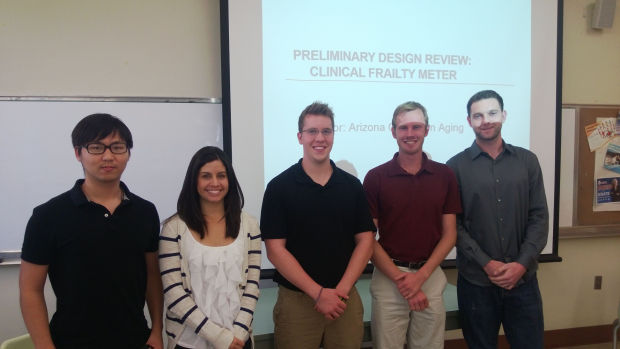
A group of UA senior engineering students has developed a “Frailty Meter,” a diagnostic tool used to determine whether a person is frail or not. They will explain how this device works in a presentation at 3:30 p.m. May 15 at the Arizona Senior Academy.
The students are part of a unique UA program for senior-year engineering students, where they form teams to bid and work on a variety of real-world projects proposed, sponsored and paid for by industry and other UA departments.
Although many universities have similar “capstone” classes, they typically are specific to a particular discipline (electrical, mechanical, optical, etc.); the UA program intentionally puts together teams with students in multiple majors to accomplish projects that take broad expertise to satisfy project requirements.
This year, there were 54 projects involving 307 students who completed the public demonstration of their projects on Design Day Tuesday.
The frailty project, sponsored by the Arizona Center on Aging, draws on prior UA research defining the motions of frail and nonfrail patients. This year’s project team developed hardware and software to diagnose frailty quickly in a small amount of space.
Ivar Sanders
Retired UA professor
to offer views on Cuba
Since the dawn of the era of Fidel Castro in the late 1950s — and certainly since the Bay of Pigs in 1961 and the Cuban Missile Crisis in 1962 — the average American has only been able to guess about life in Cuba, even though it’s only 90 miles from the continental United States.
Until 1990, it was under the wing of the Soviet Union and mightily influenced by the social and economic policies and practices of that power. But the world has changed; Fidel himself is no longer president, and gradually U.S. citizens are trickling into Cuba again.
Sarah Dinham, professor emerita of educational psychology at the UA and resident of Academy Village, recently spent two weeks in Cuba with an organization that has overcome the many travel obstacles set up by both the Cuban and American governments.
She will share her thoughts and impressions in a talk titled “Cuba: Then, Now and When?” beginning at 3:30 p.m. May 16 at the Arizona Senior Academy.
Dinham will emphasize Cuba’s rich and complex society in light of its historical heritage and its work to make socialism function in a modern world economy.
She will touch on varied aspects of Cuban culture and life: the still-strong Spanish influence in the country, elements of how the economy works, creative adaptations in transportation, government presence in ordinary life, housing, rural and urban poverty, the thriving arts, the free education and medical care in Cuba today, and some questions about what the future could bring.
Her talk will be enriched by portraits of Cuban people, Cuban music, photographs and suggested additional reading.
Janet Kerans