

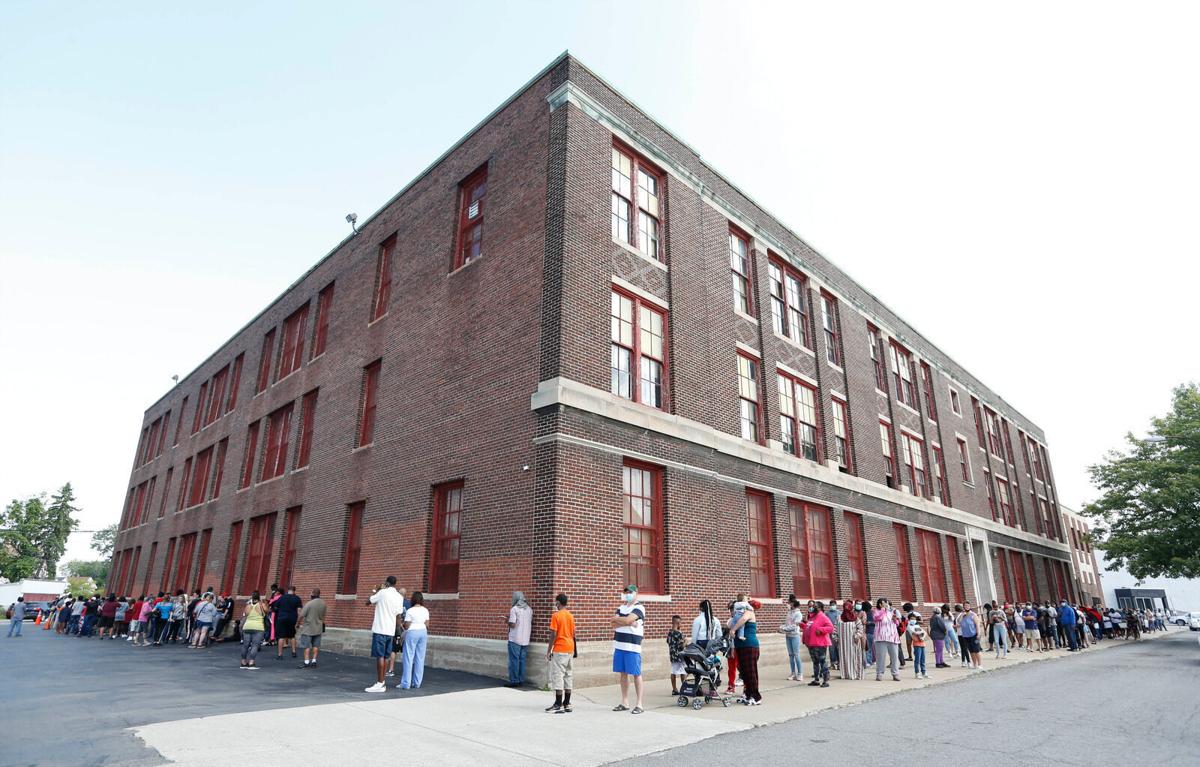
As school started this year, some Buffalo parents had to wait in line for two, sometimes three hours, just to get a school-issued laptop or iPad updated or fixed so their children could log into school.
Six weeks into school, some families still don't have district iPads.
Nearby, in Williamsville, some parents fumed early in the school year that kids learning remotely would not be able to take electives such as AP Latin or computer programming.
Within days after classes started, all of those students had access to the electives they wanted.
That contrast is emblematic of the inequities exacerbated by the pandemic.
People are also reading…
While inequity – long rooted in race, segregation and socioeconomics – has plagued education for decades, experts fear the problem has grown worse during the eight months since the pandemic began and shifted learning online.
“These gaps are not new in the U.S. education system,” said Emma Garcia, education economist at the Economic Policy Institute. “This is something we have lived with for a very long time because we failed to fix the system.”
Before the pandemic struck, schools had been chipping away at the achievement gap among students of different backgrounds.
Now, experts worry that Covid-19 may have undone much of that progress.
One often-cited report concluded that students living in poverty could lose as much as an entire year of learning after the abrupt shift to remote instruction. Down the road, that is likely to translate into higher dropout rates, experts say, which could lead to more people living in poverty.
“This is disrupting the entire fabric of American public education in ways that we have not yet gotten to the bottom of,” said Annette Campbell Anderson, assistant professor at the Johns Hopkins School of Education. “This could be generational.”
State Education Department officials share those concerns.
"We have all seen the way the pandemic has exposed the inequities in our society, including in education," Interim Education Commissioner Betty Rosa said recently in a statement to parents.
Disparate impacts
The pandemic has disrupted education for every student, but the disruption will be more profound for some.
Students are more likely to get the support they need if they live in a higher-income family with college-educated parents, experts say. And those with a stay-at-home parent, too, are likely to fare better.
Others will be impacted quite significantly, which will “blow up” the already large achievement gaps, said Michael Hansen, a senior fellow at the Brookings Institution, a Washington D.C.-based think tank.
White students would lose an average of six months of learning if remote instruction were to continue through January, researchers at the consulting firm McKinsey and Company estimated. Hispanics would lose about nine months of learning; black students would lose more than 10.
And low-income students stand to lose an entire year of learning.
Those disparities are likely to magnify the already severe academic achievement gap by 15% to 20%, McKinsey found.
The achievement gap can be measured in a number of ways, from test scores to graduation rates, all with similar outcomes. McKinsey cited a national study that found Black and Hispanic students lag about two years behind white students on standardized tests.
“We don’t know how long they are going to persist, but based on other evidence that we have it’s likely going to be here for awhile, and could have some long-term impacts on kids that could last several years,” Hansen said of the growing equity gap.
The high school dropout rate will increase nearly 4% for white students, according to McKinsey, a world-renowned firm. For Hispanic students, the dropout rate is likely to increase by 6.5%; for black students, by 5.5%.
It’s also likely that fewer students will end up going to college, experts say. And down the road, the cumulative effects are likely to translate into lower lifetime earnings – and an overall hit to the national economy.
“So there are very real trickle-down effects that may come from this,” Hansen said.
Digital divide
Schools across the region have scrambled to get computers, iPads and Wi-Fi hot spots into the hands of every student who needs one.
Those efforts have significantly narrowed the digital divide. In Buffalo, the district has distributed more than 20,000 laptops and devices to students since schools were shut down. But even now – more than a month into the school year – hundreds of Buffalo students have had to wait to get their district-issued iPads until more shipments arrive.
Having an iPad or computer, though, is just one step toward equity.
“Before the pandemic there was significant unevenness in education and opportunities for students depending on where they lived and where they went to school,” said Ian Rosenblum, executive director of the Education Trust-New York, a nonprofit that advocates for children of color and low income.
“What we’re worried about is those inequities are going to accelerate because of how districts address remote learning and support,” he said.
Parents made clear in a statewide poll conducted before school started that they wanted their kids to have regular access to teachers, more live daily instruction and more support for their children, he said.
Rosenblum’s group looked at reopening plans for 50 districts with the largest proportion of poor students. It grew concerned about teachers’ level of engagement with students. Another cause for concern was the amount of support provided to kids learning remotely either all of the time or some of the time.
“We saw major gaps,” Rosenblum said.
He thinks it is important that schools track in real time how much live instruction students get each day and how many students are logging on.
“Unless that information is reported publicly, and for each group of students, we may not be able to quickly enough identify and draw urgency to inequities,” Rosenblum said.
More likely to be remote
Experts generally agree that while remote instruction can be effective, teaching students in person is preferable.
The students with the greatest needs, though, are often those with the least access to in-person instruction.
Students attending schools with the greatest poverty are twice as likely to be learning remotely as their peers in the wealthiest schools, the Education Trust found among rural and suburban schools in the state.
And in Buffalo, one of the poorest districts in the state, every student is learning remotely.
In stark contrast, there are thousands of local students attending classes in person five days a week – at private schools.
Their families pay anywhere from a few thousand dollars a year at a Catholic elementary school to $25,000 at Nichols School, affording their children the opportunity to learn in a classroom every day.
“Certain families have options. Certain families don’t,” said Madeline Hafner, executive director of the Minority Student Achievement Network at the University of Wisconsin-Madison.
Private school isn’t the only thing money can buy. Some parents are able to hire private tutors. Others have formed learning pods with one or two other families, with just a few kids getting together every day to do their schoolwork.
And in many cases, children in wealthier families are more likely to have a parent at home during the school day, since white-collar employees are more likely to be able to work remotely.
“Sometimes kids still need a parent or an adult to navigate the onboarding or to access all the lessons,” Anderson said. “If there’s not an adult at home to make sure that happens, who’s to say a kid’s not sitting in front of the TV all day instead of doing their coursework?”


