

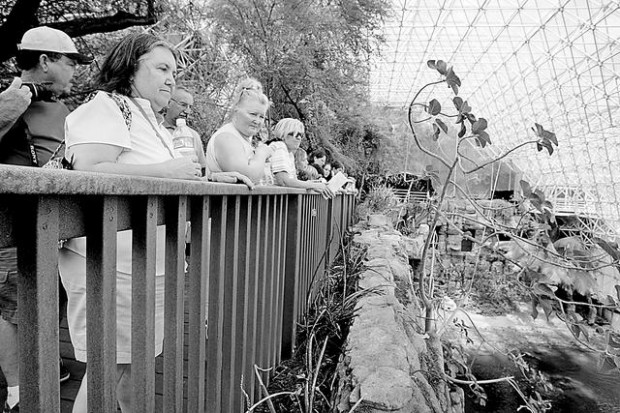
UA officials at Biosphere 2 are working to mold the site of the controversial experiment into a premier scientific hub that gives the public unprecedented access to climate and ecological research.
After taking over the glass and steel structure a year ago, University of Arizona officials have sought to establish the Biosphere as both a tourist attraction and a serious lab, where scientists from around the world can collaborate on important issues such as renewable energy, water conservation and climate change.
So far, the UA's Biosphere experiment seems to be working, officials said.
In the last year, visits to the facility have increased by roughly 35 percent compared with the previous year, for a total of close to 55,000 visitors, said Hassan Hijazi, director of external affairs for the Biosphere.
Also, a number of experiments have begun inside the Biosphere's distinct climates, including a study of the rain forest funded by a $2.5 million federal grant.
People are also reading…
But the one aspect of Biosphere's latest incarnation that has scientists excited is the ability for the public to witness research firsthand.
Too often, breakthroughs in science occur in laboratories, and the public learns of them only through published reports, said Pierre Meystre, director of the B2 Institute, which seeks to collaborate with researchers around the world to conduct experiments at the Biosphere.
Unlike a secluded lab, experiments at the Biosphere are conducted in the open where the public can interact with scientists as they work.
"We want to eliminate this kind of ivory-tower way of science, where people are doing things in the lab," said Meystre, a regents professor in physics and optical sciences.
Given growing public interest in issues such as climate change and sustainability, Biosphere allows visitors to question scientists and increase their own knowledge, said Matt Adamson, the Biosphere's program coordinator for outreach and education.
"The average person is taking a keener interest in science because they're understanding how it impacts them," he said. "We would like people to leave here with a better understanding of how science works, and we want taxpayers to actually see the fruits of their investment."
Besides connecting with the public, science experiments at Biosphere also will allow the UA to collaborate with researchers around the world to help answer questions such as how changes in climate can affect vegetation, Meystre said.
The Biosphere seems to be moving away from the controversy that has plagued it for years, from the compromised experiments of the '90s to Columbia University's undertaking research at the site only to back out in 2003.
The UA is leasing the 3.14-acre model Earth for $100 a year as part of an agreement with Biosphere founder Edward P. Bass, who gave the university $30 million to operate the structure and conduct experiments for 10 years.
The UA's receiving the full funding or possibly acquiring the Biosphere is contingent on its ability to attract outside research dollars for experiments in the facility.
Given that the Biosphere allows for unique experiments while giving scientists from several fields the opportunity to work together to solve problems, the goal of creating a world-class research facility is not far off, said Joaquin Ruiz, dean of the UA's College of Science.
"The beauty of the Biosphere for the UA is that it can really crystallize and focus all of the Earth sciences that we do so well," he said. "It just fits us perfectly with our strengths."
DID YOU KNOW
Biosphere 2 was built in 1986 to research whether the Earth's environment could be re-created to allow for the colonization of other planets.
Funded by Texas billionaire and philanthropist Edward P. Bass, the glass and steel structure contains 6,500 windows and a 500-ton welded stainless-steel liner that makes the structure airtight.
The 3.14-acre Biosphere was the subject of international attention during two human experiments in the '90s, when scientists attempted to live independent of the outside world.
The structure also was the subject of a less-than-comical 1996 comedy titled "Bio-Dome," in which two half-wits played by Pauly Shore and Stephen Baldwin are sealed inside the Biosphere along with a team of scientists. Non-hilarity ensued.


