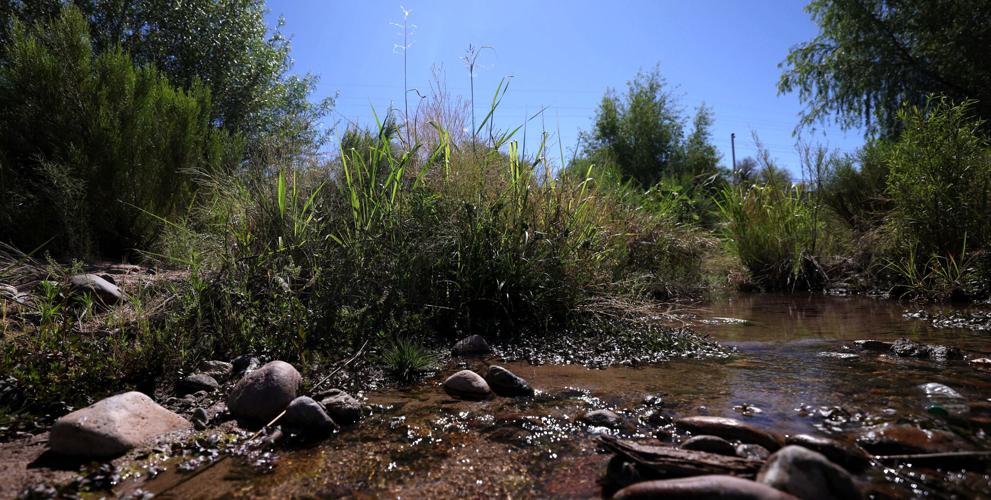
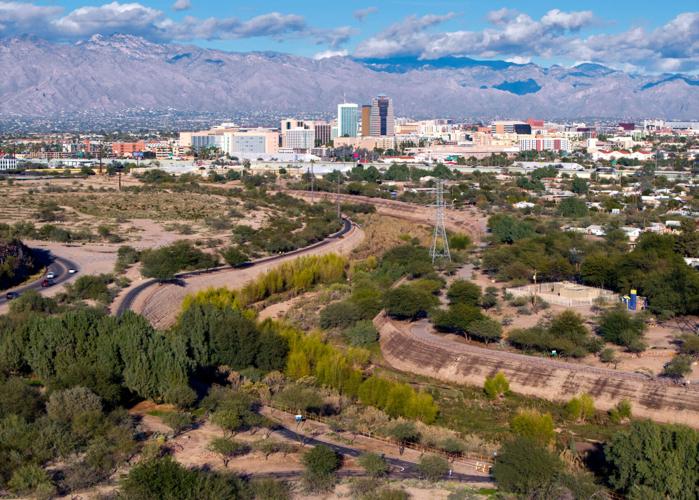
Everywhere you look for almost a mile along the Santa Cruz River on Tucson's south side, you see Gooding's willows. Short ones, tall ones, fat ones, thin ones, sometimes spread apart, sometimes packed together almost wall-to-wall in style.
Once a fixture up and down the Santa Cruz before it was mostly dried up by groundwater pumping, these willows have now returned in fine fettle along the Santa Cruz just downstream of Irvington Road. Surveyors reported finding about 200 of them this past week along the river, just about halfway down the 1.1-mile stretch of the Santa Cruz linking Irvington Road and Ajo Way. Many towered 20 to 30 feet tall.
These willows have appeared alongside the river, along with a big flock of cattails and a host of other wetland plants and a handful of cottonwood trees, over the past four years, turning what was a dry ditch into a bountiful if short stretch of riparian forest.
People are also reading…
The trees and other plants arrived in large part because Tucson Water started releasing cleaned-up groundwater into the river from its water treatment plant near Irvington and Interstate 10 back in November 2021.
Their appearance is also a product of a sharp, rapid rise in the underground water table underneath the river — an increase triggered by a variety of forces occurring inside and outside of Tucson.
The riverfront scene near Irvington closely resembles that of the plant life downstream of the city's separate Santa Cruz River Heritage Project, lying several miles north of the Irvington site near 29th Street. There, the city has been releasing water into the river since the summer of 2019.

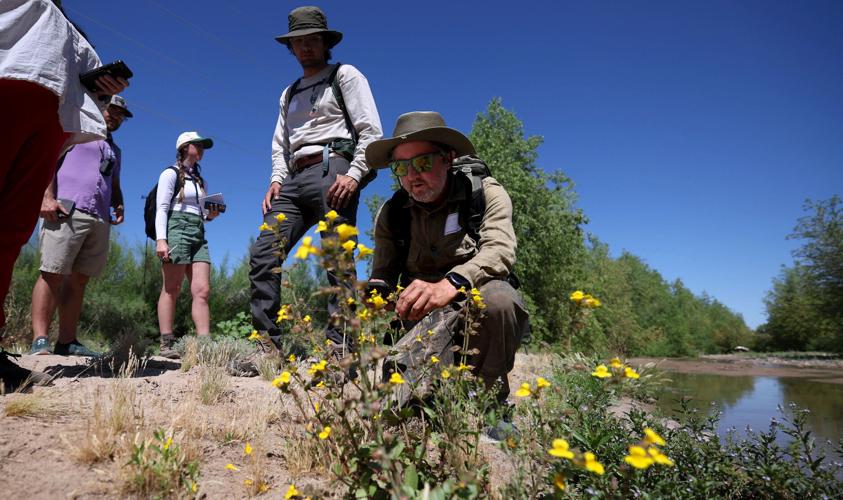
Jeff Wirth checks his app to confirm he is looking at a monkey flower bush while participating in a survey of riparian health, including the trees behind him, inside the Santa Cruz riverbed along South Calle Santa Cruz, north of Irvington Road.
But there is an important difference between the two water release sites. The Heritage Project was a deliberate effort on the city's part to bring life to what had been a long-dead stretch of river by releasing water into it — first treated effluent and later groundwater.
By contrast, the formation of the riparian grove adorning the river north of Irvington was accidental, and clearly unintentional. The water source there was once-contaminated groundwater from Tucson's long-polluted south-side aquifer that was treated by the city's Tucson Airport Remediation Project treatment plant, known as TARP.

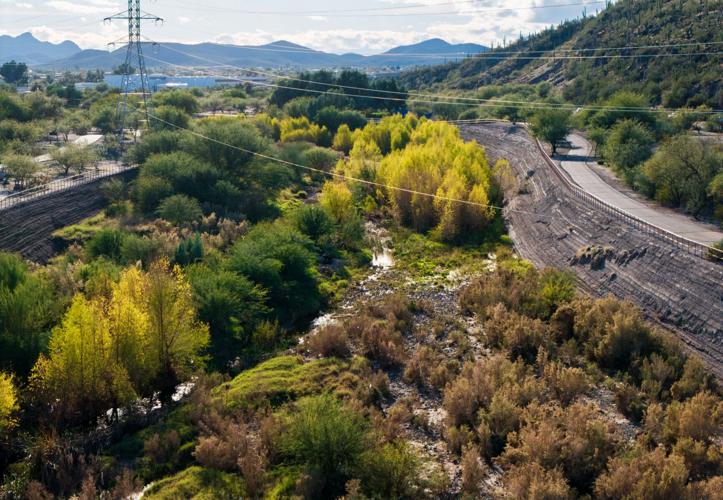
This is an aerial shot from January 2026 of the willow-centered riparian forest on the Santa Cruz River, lying downstream of where water from Tucson Water's Santa Cruz River Heritage Project enters the river north of 29th Street and south of downtown Tucson.
The city decided to start discharging some of that treated groundwater into the river, not to create another riparian grove, but because it no longer wanted to keep serving it to utility customers as drinking water due to past contamination. The decision, made in 2021, was driven by the fact that levels of "forever compounds" commonly known as PFAS compounds were rising in the south-side groundwater, and city officials were concerned they might eventually render its current treatment plant there unreliable or even inoperative.
But in fact, the city's tests of the water since then have found it to be almost always pollution-free, Tucson Water says.
Another important difference is that Tucson Water releases water from the Heritage Project continuously, but it releases water at Irvington more than 300 days a year, but never continuously.
The Heritage and Irvington releases are roughly similar in size, when the discharges are occurring, totaling about an acre-foot a day. An acre-foot is enough to serve four typical Tucson households with drinking water for a year.
On Wednesday, about 60 environmental activists, tribal leaders and city and county officials from the water and wastewater departments gathered near the river and Irvington to observe and celebrate the river's recovery and to monitor its riparian health.
The event was organized by the nonprofit Santa Cruz Watershed Collaborative, which seeks to promote a healthy watershed across the entire Santa Cruz River Basin here.
While final results from a monitoring effort along the river won't be available for up to a month, various organizers of the event and other activists were clearly overjoyed at what they saw as they walked downriver from Irvington to Ajo Way (the river runs south to north).

Plants grow and wildlife roams freely inside the Santa Cruz riverbed along South Calle Santa Cruz and north of Irvington Road on Tucson's south side.
"To me personally, it represents a little bit of a window into the past and into the future," said Angel Breault, an official with Tucson Clean and Beautiful, a nonprofit group that specializes in planting trees, and a member of the watershed collaborative.
"I had no idea that anything like this could happen in the Santa Cruz River," Breault said. "I had just looked at it as a wash, as a dry ditch. But now, we're seeing more islands of urban forestry.
"This is what happens when there is in fact an accident. This happened with volunteer trees, and minimal management," he said.
"What could happen if there was an intention to (mobilize) resources and to restore the watershed?" Breault mused, adding that he does give the city credit for creating the Heritage Project and the birdwatching mecca of the Sweetwater Wetlands lying farther downstream near the Aqua Nueva sewage treatment plant.
To Lisa Shipek, an activist who helped organize Wednesday's event, the recovery of the Irvington Road area riparian forest demonstrates the Santa Cruz River is already in the process of being restored.
"It’s proof that groundwater levels can come back up and we can see return flows coming to the river," said Shipek, director of the nonprofit, activist Watershed Management Group. It seeks to protect and promote the recovery of riverfront vegetation in areas all over Tucson.
"The significance is that we need to be proactively figuring out how to manage the river as a river," she said. "We're seeing a riparian ecosystem come back in an area that’s been treated as a storm drain. We need to recognize that the river is a river, not just a stormwater function.
"The river is currently managed as a flood channel for floodwaters instead of seeing it as an integrated riparian ecosystem. The forest is showing us we need to start thinking differently," Shipek said.
Shipek and Brealt both agreed that the riverfront trees also have value in cooling a city already overheated during the summer.
"If we want to cool Tucson, we want to expand the forest. It's happening naturally and it asks, how do we work with the forest instead of working against it?" Shipek said.
Water table rebounds
Other factors have been at play in the creation of the Irvington Road-area riparian grove, some lying well south of the city limits.
The willow forest has clearly been enhanced by Central Arizona Project water from the Colorado River that entered the river as irrigation runoff water from the Tohono O'odham reservation's San Xavier District, which lies many miles upstream of Irvington.
That water had been first sprinkled onto crops on the reservation, and what wasn't absorbed by the crops ran into the river, several outside water experts said. While that water didn't flow above ground downriver, it was at high enough levels underground to nourish not just willows, but thick groves of native mesquite trees both inside and directly above the river channel near Irvington.
In addition, the riverbed contains very thick stands of very tall mesquite, some 30 to 40 feet tall, as far north as Ajo Way, in an area where the river doesn't carry much, if any, running water, meaning their presence is likely due to a high water table.
The area's water table has also been boosted by the human-directed recharge of CAP water into a massive set of recharge basins lying south of the city along Pima Mine Road near Interstate 19. Those basins take CAP water belonging to the city and to the San Xavier District.
"Probably more than half of our total allocation of CAP water is being recharged, raising the water table," because the tribe still hasn't come up with ways of using it," said Austin Nunez, the San Xavier District's chairman. He was one of several San Xavier District and other tribal officials attending Wednesday's gathering.
Finally, the water table inside Tucson has also risen dramatically since the turn of the century, after Tucson Water started using Colorado River water and severely limited its groundwater pumping.
Together, all these forces raised the water table in the vicinity of Irvington Road and Interstate 19 near the river by 140 feet from 2000 to 2023, a city of Tucson map shows.
Wildlife returns along with trees
Statistically, the Irvington Road area's tree count is running ahead of or at least even with that of the Heritage Project downstream, said Michael Bogan, a University of Arizona associate professor who has monitored the ecological health of these stretches of river since the city started releasing water into them.
Until this year, "I think there were more willows at Irvington than downtown," Bogan told the Star. "However, the willow growth downstream of 29th Street has really accelerated in the last year, with the shallow groundwater levels, so it may be approaching the same number at both sites now," said Bogan, of UA's School of Natural Resources and the Environment.
"I'd have to do a survey to be sure, which we're not scheduled to do until late June," he said.

An aerial view of the Santa Cruz River, taken in December 2025 near where a Tucson Water pipe directs treated groundwater into the river at the Santa Cruz River Heritage Project north of 29th Street.
On wildlife species and wildlife diversity, however, the Heritage Project area is running well ahead of the Irvington Road area, according to a group of surveys Bogan provided to the Star.
For breeding birds, for instance, surveyors have found 99 species in the Heritage Project area compared to 66 species near Irvington Road and 40 species at a dry stretch of river at Drexel Road to the south. Twenty-two species of wetland plants have been found at Heritage compared to 15 found near Irvington.
For aquatic invertebrates, 174 species have been found near the Heritage area compared to 130 near Irvington. Seven species of aquatic reptiles and amphibians have been found near the Heritage release area compared to 3 at Irvington. Not surprisingly, few or none of any the aquatic species have been found near Drexel.

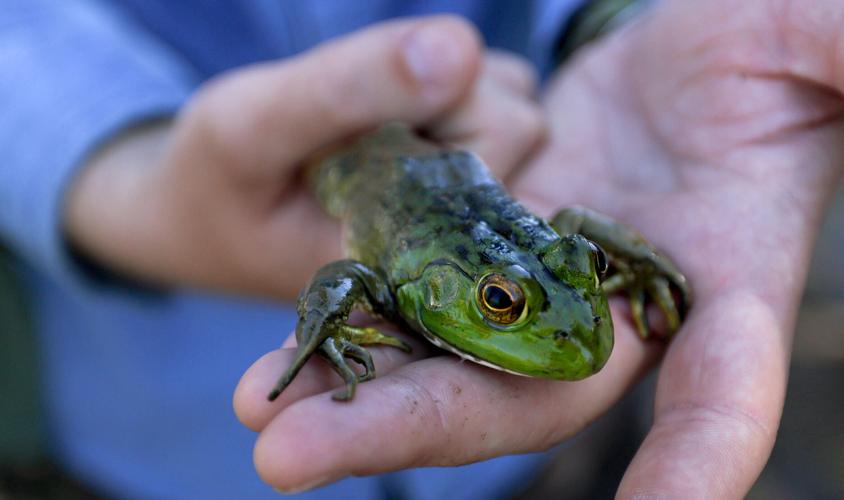
A volunteer holds a bull frog, an invasive species, during a survey of riparian health on Wednesday, inside the Santa Cruz riverbed along South Calle Santa Cruz near Irvington Road on Tucson's south side. Because the bullfrog is non-native, organizes of the survey plan to remove it from the river.
Bogan credits the disparity of wildlife between the Heritage site and Irvington to the fact that Tucson Water releases water into the Heritage site continually, whereas it releases water at Irvington many days a year but with periodic shutdowns for various reasons.
"If the releases at Irvington were stabilized, so that no short-term or long-term flow shutoffs occurred, I believe that the diversity of plants and animals would catch up to what we see at Heritage," Bogan said.
Tucson Water officials told the Star they're pleased by the riparian tree growth along the river north of Irvington Road. Utility Director John Kmiec called that occurrence "awesome."
But in an interview Thursday, Kmiec sought to make it clear that utility officials had never planned the Irvington-area water releases to be continuous, and that they had told environmental activists from the start that the releases would produce an intermittent stream, one that runs periodically but not continuously.
"There were always projections for shudowns, and we made it very clear to people not to rely on it like the Heritage reach. It would be interrupted at times," Kmiec said.
Later this summer, a new treatment plant is supposed to go online at the TARP site that will be more effective at removing PFAS compounds from the water than is the current plant, Kmiec said.
But the city has made no decision to resume serving the TARP water to people for drinking, he said.
"We would probably want a couple of years of data, and also have conversations with the mayor and council," he said. "There is an intermittent riaparian habitat there and we intend to keep that."
Contact Tony Davis at 520-349-0350 or tdavis@tucson.com. Follow Davis on Twitter@tonydavis987.

Tony Davis
Reporter


 Water levels in imperiled San Pedro River fall below court-set minimums