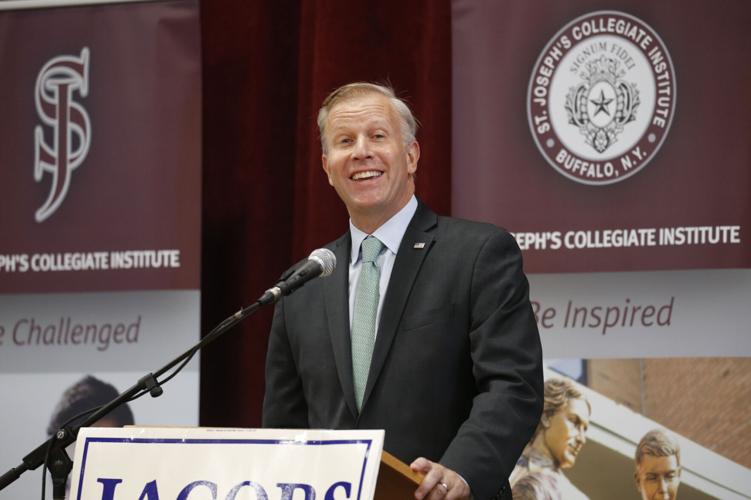
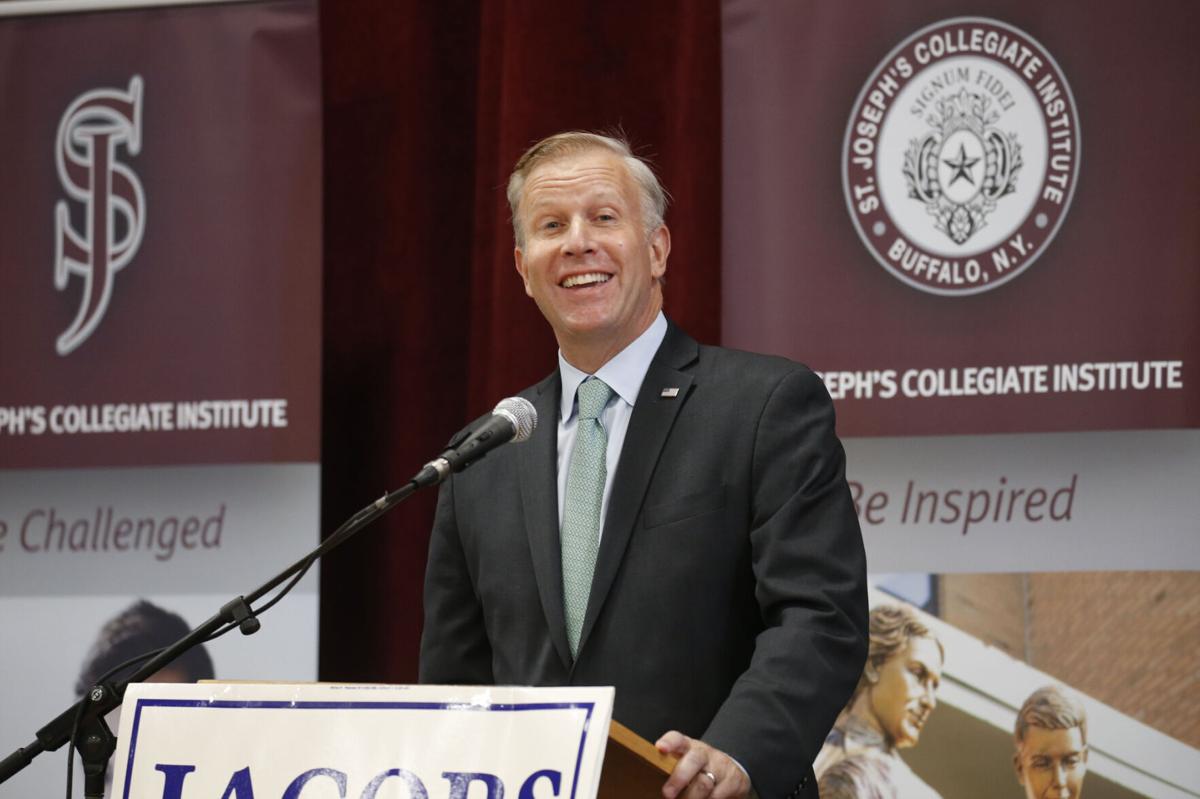
WASHINGTON – After three months in Congress, Rep. Chris Jacobs is shaping up to be largely what he promised to be: a soft-spoken defender of Trump's policies.
In a recent debate and in interviews with The Buffalo News, the Orchard Park Republican uttered not a single harshly critical word about the president. On the House floor, he's strayed only occasionally from the party line. And while he's done only one debate since his July swearing-in, he's used the time running up to the Nov. 3 election traveling the many parts of New York's conservative 27th District .
To Jacobs, who joined the House after winning a special election in June, all of this is just what voters wanted.
"It's no secret that I support the president and his major policies, which I think have been getting this country on the right track," Jacobs said in an interview on Friday.
People are also reading…
Nate McMurray – Jacobs' Democratic opponent in the June special election and again in November – isn't impressed with such talk.
"For months now, Mr. Jacobs has been making excuses for President Trump," McMurray said at a debate at St. Joseph's Collegiate Institute last Wednesday.
But that's not how Jacobs sees it.
"The overarching national policies – the tax reform act, standing up for the United States on the international stage in new trade deals, raising awareness of the threat we have with China – I think those major policies that are the ones that are the reason I'm supporting this president," Jacobs said.
Read the full story from News Washington Bureau Chief Jerry Zremski
A loyal Trumper
Long seen as a moderate Republican, Jacobs doesn't talk like Trump. In a debate last week, he's spewed no venom, and his insult-free Twitter feed reads like one long prosaic ode to the workaday life of a lawmaker checking in on the far-flung corners of his district.
But when asked about Trump, Jacobs soberly defends him.
Regarding the president's response to the pandemic, Jacobs told The Buffalo News' Editorial Board: "You know, he early on stopped travel from China, he did a lot of good things for New York when we were in the belly of the beast in New York City with Covid."
Asked about the fact that Trump told journalist Bob Woodward that he minimized the dangers of the virus early this year so that the country wouldn't panic, Jacobs said in that Friday interview: "What I gather is that he was trying to keep people calm."
And when asked whether Trump should have used his bully pulpit to promote mask use, Jacobs – a proponent of mask-wearing – simply said: "I think we all should do more."
Jacobs also refused to criticize the now-abandoned Trump administration policy of separating families at the southern border. That policy left 545 children in the custody of the federal government, which now can't locate their parents.
"I think it was a very, very difficult scenario," Jacobs said. "And if people could have anticipated how that was going to happen, they would have done it differently."
When asked to name Trump's biggest mistake over four years, Jacobs said: "I think that, you know, no one does anything perfectly. ... He wasn't going to provide aid to the forest fires in California, you know, and I'm glad he changed his mind on that."
Jacobs' votes
Jacobs has shown himself to be a loyal Republican on the House floor, too – most of the time.
Out of 19 key votes identified by Project Vote Smart since Jacobs took office on July 21, he voted the party line on 16 of them. He sided with his party against a major Democratic coronavirus relief bill. He's voted against spending bills that his party saw as too loose with federal dollars, but for a bipartisan measure to keep the government open. He's voted against Democratic legislation aimed at making it easier for students of color to file discrimination complaints, and against a Democratic measure targeting discrimination against Asian Americans.
But Jacobs broke with his party to support two bills aimed at boosting child care during the pandemic, as well as a measure aimed at removing statues of Confederate heroes and Supreme Court Justice Roger Taney from the Capitol.
"I think that I've had 21 legislative days thus far, so I think it's very early, but I will vote my district," Jacobs said. "I stand by my votes. I thought they were all good for my district and aligned with where my voters wanted me to be."
Jacobs, along with all but five of his House Republican colleagues, voted for a measure calling for an orderly and peaceful transition of power after the election – something Trump on occasion has refused to commit to.
Similarly, Jacobs joined most of his GOP colleagues to vote for a measure condemning QAnon, a false conspiracy theory that claims that a mysterious figure named "Q" is helping Trump rid the nation of a Democratic child sex trafficking ring.
"They are a dangerous organization, conspiracy theorists," Jacobs said.
Jacobs has introduced only one bill so far, resurrecting a proposal that his predecessor, former Rep. Chris Collins, pushed along with then-Rep. John Faso, a Hudson Valley Republican who introduced the measure. For federally funded projects, that bill would undo a state liability law that makes it easy for workers to sue even if it's their own fault they got injured on the job.
Explaining why he introduced that bill, Jacobs said: "We need to do everything we can to get New York State competitive."

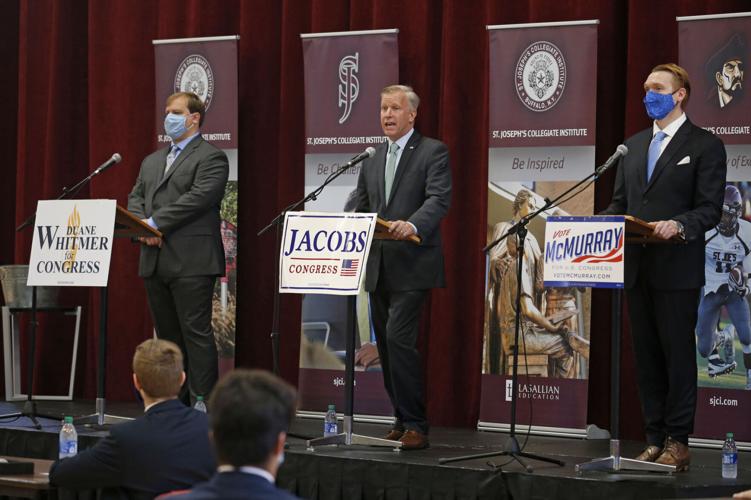
Duane Witmer, left, Chris Jacobs, center, and Nate McMurray answer questions during a debate between candidates for the 27th Congressional District at St. Joseph’s Collegiate Institute on Kenmore Avenue in Buffalo on Wednesday.
On the road
Jacobs said Friday he's been busy acquainting himself with a district that was without representation since Collins resigned more than a year ago while pleading guilty to felony insider trading.
Recently, Jacobs said, he's met with local officials in Erie County, the boards of supervisors in Wyoming, Orleans and Livingston counties and all the local sheriffs. He's been to heroin treatment centers and rural hospitals and local businesses and plenty of farms.
"I am everywhere I can be, because that's going to make me a better congressman," he said.
But one place he has not been frequently is on stage with McMurray and Whitmer. Their Buffalo event was the only full-fledged debate of the fall campaign.
Jacobs declined several media debate invitations as well as an event last week at SUNY Geneseo where McMurray and Whitmer appeared.
"It was unfortunate" that Jacobs said he had a conflict and could not attend the Geneseo event, said Nicholas Palumbo, assistant dean for leadership and service at the college, who organized the event. "I think it would have made for a much richer experience for the students and the community members that we use this program to serve."
Whitmer, for one, isn't happy that Jacobs has been declining debate invitations. "It's eerily similar" to Collins' refusal to debate or to partake in town halls, Whitmer said.
Jacobs begged to differ. He said his opponents haven't shown up to some events where he's appeared. What's more, Jacobs noted that more than 10,000 people signed on to a virtual town hall he had shortly after taking office.
Asked if he would hold in-person town halls if he's in Congress after the pandemic passes, Jacobs said: "I want to find every way I can to engage with the community. If anybody knows me, I've been a very accessible member of either the state Senate or county clerk or school board member. So I always try to find ways to do it. So wherever I can do that and do it safely in a productive manner, I'm game to do it."
Coming this week: A look at Democrat Nate McMurray’s positions on the issues.