

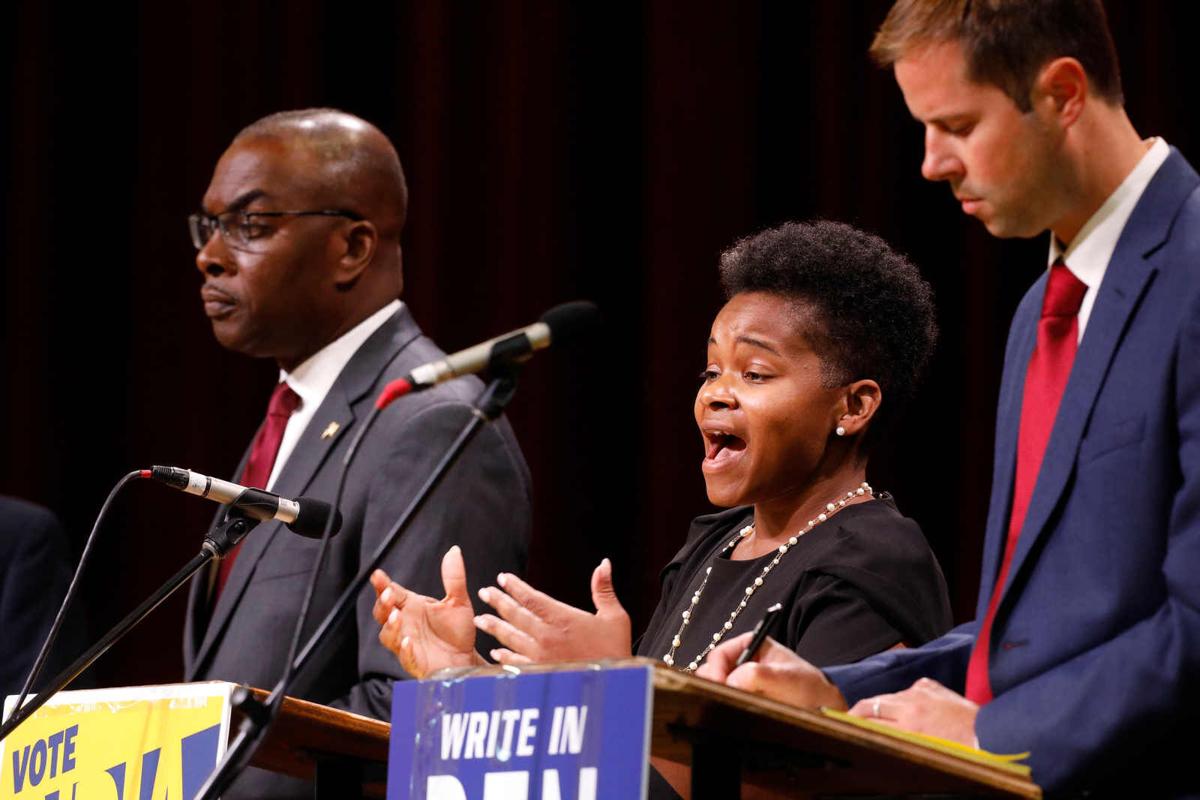
In a civil and poised debate Wednesday, Democratic Party nominee India Walton and incumbent Byron Brown reinforced their differences over policing, poverty and their qualifications six days from Election Day.
The mayor presented himself as steady, experienced and reliable, having steered the city through a pandemic without laying off workers, reducing city services or raising taxes. Walton offered her background as a nurse and nonprofit executive with a plan to redirect resources to lift up large swaths of the city on the East Side and elsewhere, areas she said have been neglected by the mayor.

The debate at St. Joseph's Collegiate Institute didn't allow candidates to question each other. A panel of students and Ted Lina, a government teacher and the debate moderator, asked the questions.
Benjamin Carlisle, a write-in candidate, also participated. Carlisle, best known for organizing a downtown rally in September opposing vaccine mandates, offered muted criticism of Brown and repeatedly criticized Walton over her qualifications and for identifying as a democratic socialist.
People are also reading…
St. Joseph's Collegiate Institute hosted mayoral candidates, incumbent Mayor Byron Brown who is mounting a write-in campaign for re-election; challenger India Walton who defeated Brown in the Democratic Party primary and is the only candidate on the ballot; and Ben Carlisle who is also waging a write-in campaign. These are their opening statements.
The major candidates differed on key issues.
Policing and crime
Crime and homicide rates in Buffalo are on the rise. Some 287 people were injured or killed in shootings in Buffalo between January and September this year, 33 more than the city's annual average over the last decade with three months still to be recorded.
The mayor called the increase partly a result of pulling back community policing programs because of Covid-19, one of many police reforms he said he has instituted during his four terms.

Walton, Brown said, wants to "defund the police," and she spent months "screaming through a bullhorn demanding that our police be defunded" during Black Lives Matter protests.
He said her intent to cut $7.5 million from the police budget would result in the loss of 100 police jobs.
"She is an attacker of the police in the City of Buffalo, and someone who has been an apologist for criminals," Brown said.
Walton said nothing in her plan calls for eliminating 100 police officers. She said the savings she's seeking would go toward employing mental health professionals and others to handle cases of domestic violence, mental health crises and traffic stops.
"Those are things we are asking our officers to do that is slowing response times, and distracting them from crimes like burglary and homicides," Walton said.
India Walton makes a closing statement during the mayoral debate at St. Joseph's Collegiate Institute. Walton, the endorsed democrat, is the only candidate on the ballot after defeating incumbent Mayor Byron Brown in the democratic primary. Brown is waging a write-in campaign.
She also said her administration would work to improve relations between the police and the communities they serve.
"When I'm mayor we will finally get serious about public safety, and administer evidence-based, data-driven programs that address the root causes of violence and curb the current administration's skyrocketing homicide rate," Walton said.
Poverty
Buffalo ranks as the third-poorest big city in the nation, with a poverty rate at 30.1% in 2019, according to the U.S. Census Bureau. Some 43.4% of children in Buffalo lived in poverty that year, also one of the highest levels in the country.
A study released last week by the University at Buffalo concluded the socioeconomic conditions for Blacks in Buffalo have changed little over the past 31 years, which Walton referenced during the debate.

"When I'm mayor we will finally pull our city out of the poverty that has plagued us for the last 16 years under failed leadership," Walton said. "We will finally remediate a lead paint crisis that is worse than Flint, and we will finally make sure communities have high-quality roads and sidewalks, city parks and livable neighborhoods.
"When I am mayor, we will finally stop padding the windfall profits of downtown developers and instead prioritize healthy communities with safe, stable affordable housing for all," she added.
Walton's plans include encouraging developers to create housing on many of the vacant lots that pockmark parts of the city.
She wants to promote micro-mortgages for homeowners, community land trusts and have abandoned homes placed into receivership for development by nonprofits or first-time home buyers to strengthen communities and grow the tax base.
Walton said she would also make carrying fresh fruits and vegetables a requirement for the licensing of corner stores, many of which exist in areas far from grocery stores.
Brown said he's already doing much to address affordable housing needs.
He cited 2,200 units of affordable housing built under his administration, with an additional 1,000 apartments in the pipeline.
Buffalo Mayor Byron Brown makes a closing statement during the mayoral debate at St. Joseph's Collegiate Institute. Brown is waging a write-in candidacy after losing the Democratic primary to India Walton.
The city demolished more than 8,000 blighted properties during his tenure as mayor, he said. Neighbors clamored for the demolitions, fearful of crime and the affect the abandoned homes would have on their property values and the costs of obtaining home insurance, he said.
Brown touted $8 billion in economic development and thousands of jobs created.
He said his administration was "spending the most money in the history of our city" on youth unemployment opportunities, including the Northland Workforce Training Center, which opened in 2018 on the East Side.
Qualifications
Brown, as a four-term mayor and former state senator and Council member, has a long record to run on.
Walton, a self-described political novice, has been a nurse and executive director of the Fruit Belt Community Land Trust.
"This is a time that experience matters," Brown said.
He said he has led the city through some of its worst crises, including the Great Recession not long after he came into office; the October Storm, which knocked out electricity and knocked down trees throughout the city; and the current pandemic.
"We've cut the tax rate to the lowest level in 30 years," Brown said. "For the first time in 70 years we have seen the population of Buffalo grow."
Brown blasted Walton for being a "dangerous socialist" and said her claims of accomplishment were false.
"We have to recognize that part of Miss Walton's narrative just isn't true," Brown said. "She said she was a successful not-for-profit housing executive when she didn't build a single house. She is a failed nonprofit executive."
Walton noted she is the Democratic Party nominee for mayor and has the endorsements of Sens. Charles Schumer and Kirsten Gillibrand and the Erie County Democratic Party.
Walton is vying to become the first socialist to be the mayor of a major city since 1960, while also following in the footsteps of Vermont Sen. Bernie Sanders, who was mayor of Burlington prior to coming to Washington and has endorsed her.
"I am the endorsed Democratic nominee. I am a Democratic socialist," Walton said. "What socialism means is that I want the same things that most of us want."
She presented herself as "a bridge" between progressive and moderate Democrats.
Walton said her refusal to accept contributions from corporations and large developers – unlike Brown – ensured she won't be influenced by campaign contributors.
"I want safe, stable affordable housing. I want quality education for my children. I want people to have access to health care and for folks to be healthy, happy and whole, and I don't think there is anything irresponsible or radical about that idea."
She added that she wants "good-quality, living-wage jobs" and to "take care of the environment and the planet."
Brown said he has big plans for the city. He foresees transforming Buffalo with close to $2 billion in federal, state and city funds over the next two years if the infrastructure bill now before Congress passes.
He plans to spend hundreds of millions to upgrade city streets and sidewalks, streetlights and replace lead water lines.
"Unquestionably the city has gotten better under Mayor Brown's leadership," Carlisle said. "The problem is, he's been there for 16 years and that is just too long for anybody to hold the same position of power. "After 16 years you get complacent, and you start going through the motions instead of shooting for the stars."
Brown, in answer to a question, said the lackluster primary campaign he ran, in which he never mentioned Walton's name, was because he was dealing with the pandemic and Black Lives Matter protests, and not because he didn't have plans for the city.
Walton wasn't buying it.
"I think every politician has a shelf life, and that at a certain point it's time to make room," she said.
Mark Sommer covers preservation, development, the waterfront, culture and more. He's also a former arts editor at The News.


