Before the June 22 Democratic primary for mayor, few predicted the bitter election now gripping Buffalo.
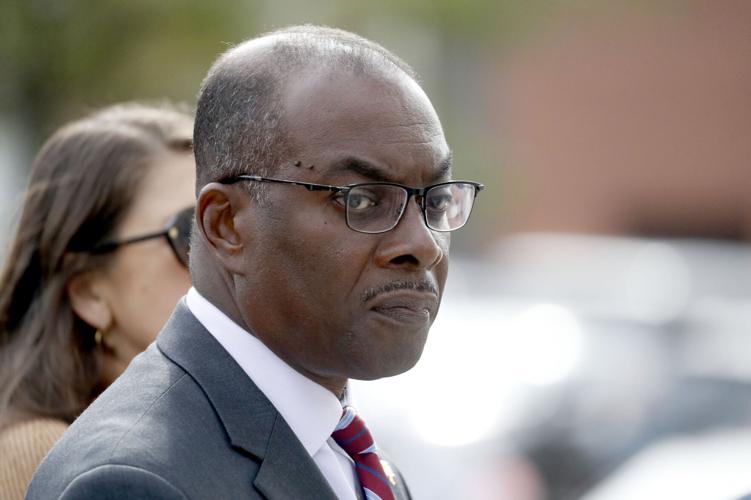
Byron W. Brown – the four-term mayor of New York's second largest city, former chairman of the state Democratic Party, and the face of Buffalo's renaissance – was viewed almost everywhere last spring as a Democratic primary shoo-in. Indeed, not one of Buffalo's establishment Democrats even considered a challenge to the mayor and his vaunted City Hall machine.
But everything changed when little-known and underestimated India B. Walton – a self-proclaimed democratic socialist – stunned a complacent Brown, who refused to debate and never even mentioned her name. And as a result, Brown now mounts an unprecedented write-in campaign in the toughest challenge of his career.
People are also reading…
Whether anyone wanted it or not, Brown has sparked an election defining Buffalo's political soul.
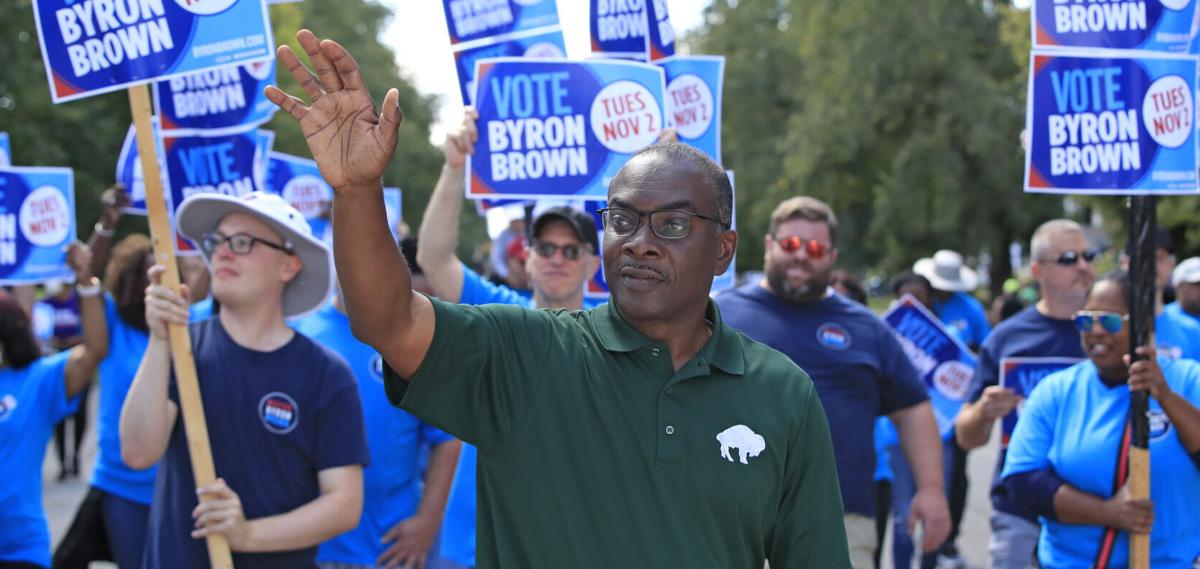
Brown, a former Masten Council member and state senator, acknowledges that he and his team misread Walton's spirited challenge, that he thought her socialist views would never prevail in a city of "ethnic, conservative Democrats." Now, he is furiously striking back, spending hundreds of thousands of dollars in advertising and mobilizing an army of volunteers – even as Walton's supporters remain as committed as ever.

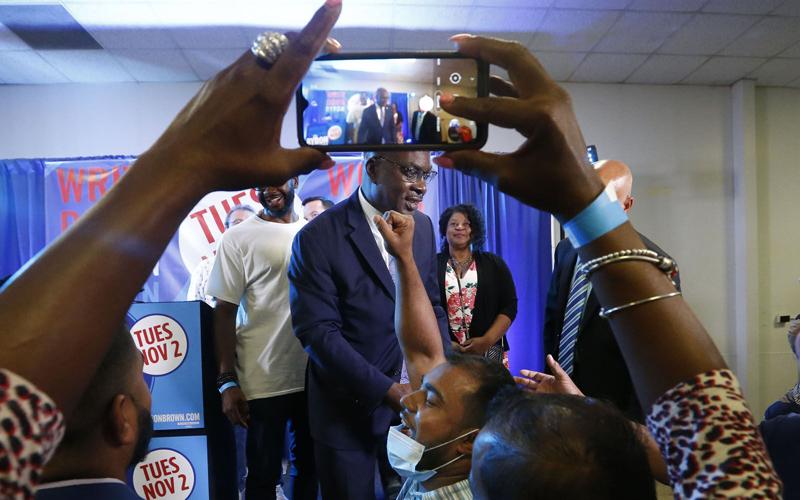
Mayor Byron Brown holds an event at his new headquarters at 701 Washington Street to kick off his write-in campaign for mayor in August after losing the Democratic primary.
"It might be a blessing in disguise," Brown said Friday of his write-in effort. "I'm energized by it. And I believe that members of the community who might not have paid attention to the election and to what is at stake are paying closer attention.
"Many see the 'Write Down Byron Brown' campaign as ... uniting the city," he added, "and getting people involved who were never involved before."
Plans for a fifth term
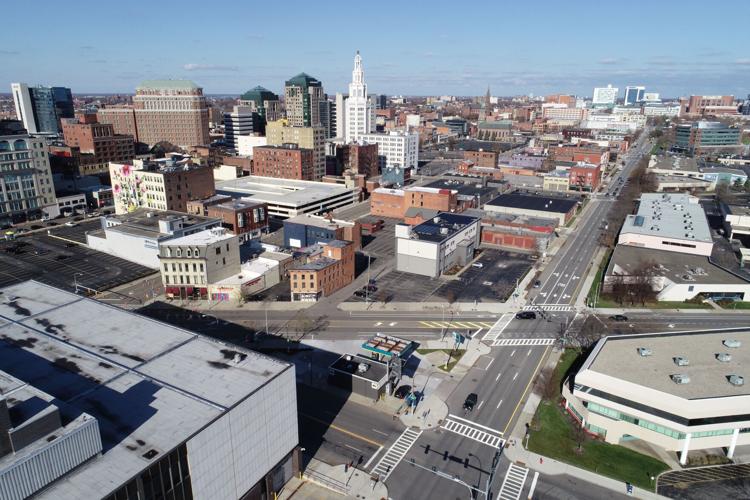
At 63, Brown seeks to accomplish what no other mayor has ever achieved in the city's 189-year history – a fifth four-year term. He approaches the task boasting of a vibrant waterfront with more development planned; his claim of $6.5 billion in development and 12,000 new jobs; reducing property taxes by 16%; and an increase in population for the first time since 1950.

Buffalo Mayor Byron Brown boasts a an increase in population for the first time since 1950 as he seeks a fifth term.
And if the city is beset by problems – such as its ranking as one of the poorest in the nation – then Brown sees opportunity. The low tax rate and housing costs attract immigrants. That, in turn, increases the population, bolstering federal aid based on the census.
He points to future priorities like a $250 million program to rehabilitate three Buffalo Municipal Housing Authority complexes. He seeks to label 40% of the city's housing stock as "affordable" in the years to come. And he looks to implement in Buffalo the federal government's $331 million American Rescue Plan to "build a local economy with a focus on inclusion and equity."
"My goal, going forward, is make every neighborhood a neighborhood of choice where people want to live," he said.

The Buffalo Urban Renewal Agency has also sold property or awarded exclusive development rights to campaign contributors without public bidding, though the Brown administration says campaign cash has nothing to do with getting city contracts.
Problems put Brown on defensive
But a host of problems also put Brown on the defensive, including several investigations focused on City Hall and his inner circle. The consulting firm of his former deputy mayor and political strategist, Steven M. Casey, pleaded guilty over the summer to wire fraud charges. Another one-time top ally, former Erie County Democratic Chairman G. Steven Pigeon, is slated for sentencing in December on bribery charges.
In addition, The Buffalo News reported last year that a federal grand jury was probing campaign donations to Brown and a Lewiston company’s waste disposal contracts with the City of Buffalo. But the mayor has always insisted he has no knowledge of why the FBI raided City Hall and took records, that he has not retained a lawyer and that nothing ever came of the probe.
It all allows new Walton allies to join the onslaught, like the Working Families Party, which Friday reported spending another $173,000 on her behalf, in addition to earlier donations.
"Another friend of Byron Brown being federally charged speaks to the kind of company he keeps," Working Families spokesman Ravi Mangla said after Casey's firm entered its guilty plea.
But if one problem haunts Brown more than any other, it may be "shelf life" – the political axiom holding that all politicians eventually lose their appeal with voters. Brown encountered the phenomenon during his last election in 2017, and even more in 2021.
"It all goes back to shelf life," said Gregory B. Olma, a Democratic zone chairman and Walton supporter. "It's not an inventive administration, and that's where shelf life kicks in.
"People's expectations get lowered, and you see that when parks get vandalized and nobody fixes them," Olma added. "At some point, you have to move away."
State Sen. Sean M. Ryan of Buffalo backs Walton as the "fair and square" primary victor. Never close to Brown and often mentioned as a future mayoral candidate, Ryan points to 16 years in office without a serious effort to address poverty – despite the incumbent's claims.
"When the big developers' projects sail through seamlessly, but it takes a homeowner in North Buffalo five to six months to get approval for a kitchen addition, that tells you he's lost touch," Ryan said.
"It's still one of the poorest cities in the country, child poverty is even worse, and we spend our scarce resources for big tax abatements for high-end apartments," he added. "You take for granted that the job is yours forever. People wanted change."

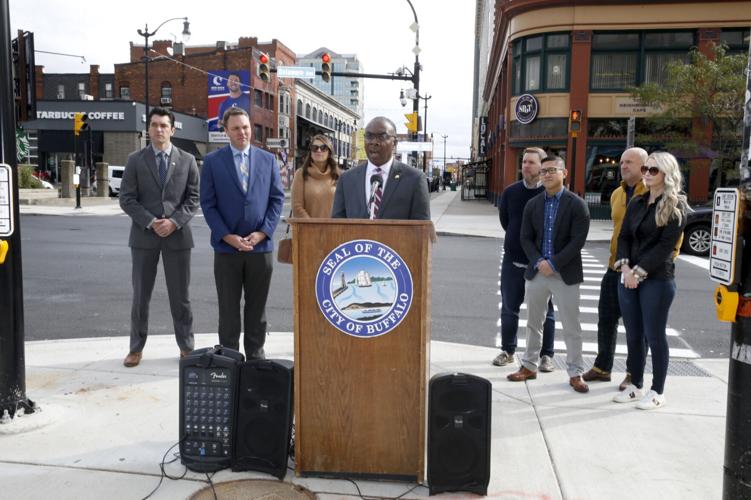
Buffalo Mayor Byron Brown and members of the Chippewa Alliance cut a ribbon and officially announced the completion of the Chippewa infrastructure and street scape project. This was on Friday, Oct. 22, 2021.
Others say Brown’s predicament stems from alienating longtime supporters. Back in the 1990s, Rev. Charles Walker of Mount Hope Community Church on Broadway joined Grassroots, the East Side political movement that spawned Brown. During the mayor's first campaign, Walker thought Brown was just what the long-impoverished part of the city needed.
“I voted for him, I campaigned for him – the whole nine yards,” Walker said.
But to hear Walker tell it, Brown didn’t return the favor – or the favor of any residents of the far East Side who backed his first bid for mayor in 2005.
“He’s never come down this way in the last three terms,” Walker said. “He comes to the Broadway Market and Central Terminal, but that’s as far as he went.”
The same can be said for the city’s redevelopment efforts and city services under Brown, said Walker – a Walton backer who has hosted her twice on his radio show.

With one of the nation's most watched local elections less than two weeks away, on the day before early voting was set to begin, the two people who want to lead Buffalo as the city's mayor for the next four years continued to highlight their differences and gather support they hope will carry them to victory.
“Byron hasn’t done a damn thing for the neighborhood,” Walker said. “This is the forgotten city here.”
Supporters point to changing neighborhoods
Still, Brown enjoys solid support in many sections of the city, even if few elected Democrats have endorsed his candidacy (many have not endorsed Walton either). Masten Council Member Ulysees O. Wingo Sr., representing Brown's home district, passionately defends the mayor against charges that City Hall ignores the East Side.
"If you say the East Side is neglected, then you don't remember what it looked like 16 years ago," he said, pointing to the Northland Workforce Training Center preparing many neighborhood residents for good jobs, as well as new playgrounds and sidewalk repairs.
"All these businesses coming to Buffalo would not have come without seeing this resurgence," he said.

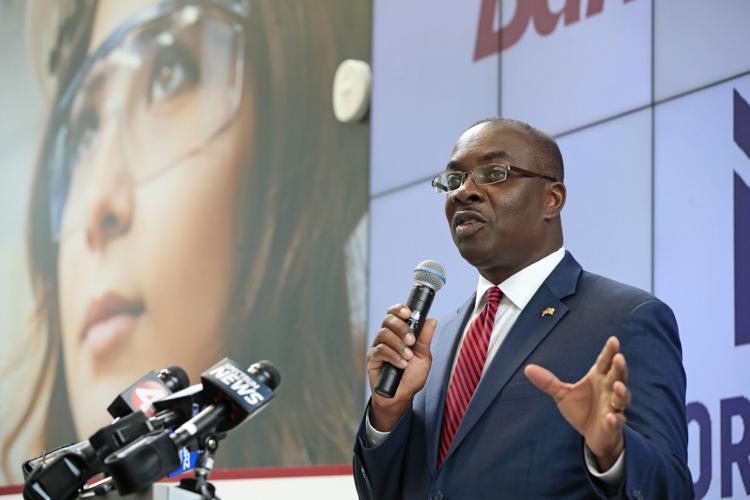
Mayor Byron Brown speaks during a news conference where BankOnBuffalo announced a corporate investment of $100,000 in the Northland Workforce Training Center in July 2019.
Then why did Buffalo Democrats reject him in the primary?
"What I saw was emotional voters, rather than educated voters," Wingo said. "Now that the race is being intensely covered by the media, we'll see how many are still emotional."
North Council Member Joseph Golombek Jr. says his constituents are treated fairly. He sees the $21 million redevelopment of the former School 60 and a proposed rails to trails project, and believes the mayor may have lost the primary by avoiding Walton's "divisive politics."
"Byron has been good for my neighborhood. I know what I can get with Byron," he said. "I don't believe Walton will be worried about my neighborhood based on the rhetoric I've heard."
And though pilloried in some quarters for his support of developers and their projects, the business community wants Brown to continue the progress they see. Jonathan A. Dandes, a Rich Products executive and vice chairman of the Buffalo Niagara Partnership, calls the mayor "honest, straightforward and accessible."
Brown helps the business community "navigate through the patchwork" of regulations, he said, ultimately resulting in jobs. And he has made the business community understand that his terms of "diversity and inclusiveness" must be part of the deal.

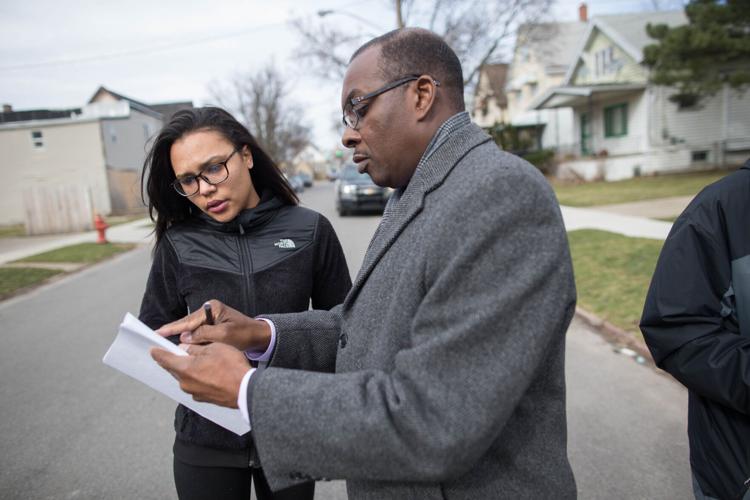
Buffalo Mayor Byron Brown talks to Danielle Simpson while going door-to-door on Eller Avenue as part of a campaign to solicit potential witnesses to come forward with information after a triple shooting in 2017.
"I've seen him stand in board rooms and point to the needs of minorities," Dandes said. "That has raised the awareness of the business community."
'I'm prepared to win'
Brown enters the last days of the 2021 campaign with plenty of money, universal name recognition and the trepidation of some voters fearful of a "democratic socialist" running their city. Indeed, Brown never misses a chance to call attention to the term. He refers to images of Walton with bullhorn in hand "calling for defunding the police and shouting profanities at police officers trying to do their jobs."
"With Ms. Walton, I use the term 'radical socialist,' not 'democratic socialist,' " he said.

Buffalo Mayor Byron Brown and members of the Chippewa Alliance cut a ribbon and officially announced the completion of the Chippewa infrastructure and street scape project on Friday.
But he must also deal with a Democratic establishment, some of them old friends, supporting Walton or remaining neutral – including former allies like Gov. Kathy Hochul and State Sen. Timothy M. Kennedy. Assembly Majority Leader Crystal D. Peoples-Stokes on Saturday endorsed the mayor.
Following Senate Majority Leader Charles E. Schumer's endorsement of Walton on Thursday, Brown accepts the realities of politics and realizes more old friends may leave in the days ahead. He says he will go it alone if he must.
"I knew from the beginning that when you lose a primary, much of that institutional support will go away," he said. "I knew what I was in for. I'm prepared to win without it."
News Washington Bureau Chief Jerry Zremski contributed to this report.