The U.S. government needs to launch a massive federal public works program to build more infrastructure to help Arizona and other Southwestern states cope with impending Colorado River water cutbacks, said U.S. Sen. Ruben Gallego and Tucson Mayor Regina Romero.
"We’re going to have to have a massive government works program like what created the CAP, to help towns update their water systems ... to create and conserve water, to make up for the loss we are going to end up taking," Gallego said Friday at a "Water Summit" panel discussion in Tucson.

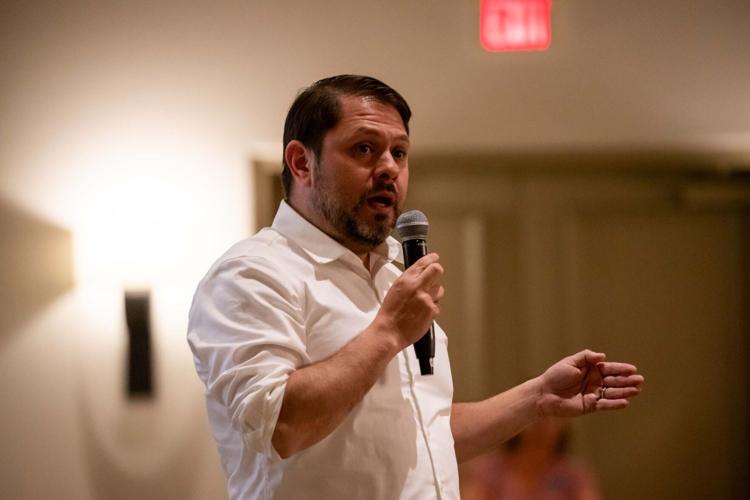
Gallego
He was talking about the construction of the 330-mile-long Central Arizona Project canal system that delivers drinking and irrigation water to the Tucson and Phoenix areas.
The CAP was built over more than two decades using $4 billion in federal funds appropriated mainly in the 1970s and '80s. But it is now facing possible extinction due to federal approval this month of a new plan to cut deliveries to Arizona, California and Nevada from the Colorado River, which supplies the CAP, by up to 3 million acre-feet of water.
People are also reading…
The new plan was approved by the U.S. Bureau of Reclamation, which manages the river and its reservoirs. A cut of that size would essentially wipe out the CAP, Arizona leaders fear, because the project has very low legal priority for access to Colorado River water during shortages.
Besides building more public works, Gallego said, "We need to buy up farmland, put regenerative growth on it and put houses on farmland because they use less water — a combination of a lot of things. We need tech to desalinate water, create water, move water. It's going to be billions and billions that we're going to have to do."
This must be done "if we're still going to be living in Arizona, have high GDP growth in Arizona and at the same time feed the country when the country desperately needs it," said Gallego, referring to gross domestic product, a major statistical indicator of economic activity.
Gallego was responding to a request from the panel's moderator to give his opinion on "what Arizona's water future depends on."
Gallego "hit the nail on the head," Tucson Mayor Romero, his fellow Democrat, told the Star in an interview after the session, which she also took part in. It was sponsored by the Southern Arizona Hispanic Chamber of Commerce.
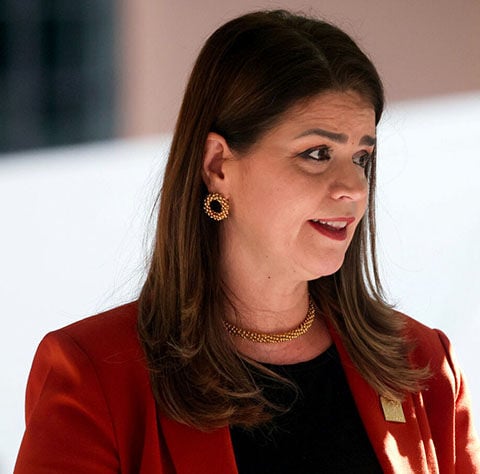
Romero
"We need a massive public works program from the federal government, in collaboration with the state and water providers in Arizona, so we can do huge conservation projects and remediation projects for TCE and PFAS in our groundwater," the mayor said.
She was referring to trichloroethylene and "forever chemicals" typically called PFAS compounds that have contaminated drinking water in the aquifer on Tucson's south side.
Noting that Phoenix is building or preparing to build three "direct potable reuse" plants to treat wastewater for drinking and Tucson is designing one, she said, "Every city in Arizona should have a pure water plant."
She also noted that Phoenix and Tucson are collaborating with the state and other cities on a water-sharing program known as the Secure Water Arizona Program, under which cities with more water than they need today could provide it to cities that need some, over either a short- or long-term period.
"We've gotta make sure we're taking care of each other. There are towns much less prepared. We cannot, as one with the biggest allocation in the state of CAP water, we cannot see our smaller cities and towns perish," Romero said.
"We have a responsibility we have to each other. If there's a problem in one place, if we start seeing national stories about Arizona being out of water, we are all affected," she added.
'Do something for the next 50 years'
Romero stressed that "the city of Tucson is in a really good position, when it comes to water resources."
Tucson has long been diversifying its water supplies by using recycled wastewater on grassy turf in parks and on golf courses, is a leader in conservation, and "we're doing green infrastructure" such as trees and shrubs to capture stormwater, she said.
If CAP water goes away permanently, the city still has more than 50 years’ worth of water supplies either stored underground or in native groundwater that it can use, she noted.
But now "we have to do something for the next 50 years" in case those supplies become exhausted, she said, recognizing that state law requires cities to show they have an assured, 100-year water supply if they are to keep allowing new subdivision growth.
Tucson Water, which delivers CAP water to city residents and some living in the suburbs, isn't ready to say how it would react to a worst-case federal CAP cut of 3 million acre-feet a year.
"In the short term, and even for the purported 10-year duration of the (federal decision), Tucson has significant in-ground and available water resources to respond to any shortage, and these resources are of such immense volume and variety that it would be impossible to predict exactly how we would respond," wrote Chris Avery, an assistant city attorney for Tucson Water, in an email to the Star.
In any scenario, especially the worst-case cuts mentioned in the bureau's decision last week and in its operating guidelines for the river, "our values would remain the same," Avery wrote.
"We will avoid unnecessary groundwater depletion in the Tucson Active Management Area (a state-run area in which groundwater use is regulated), we will cooperate with other municipalities and water users to form a coherent statewide response to the most severe cuts, and we will communicate with our customers about how they can assist in that effort," he said.

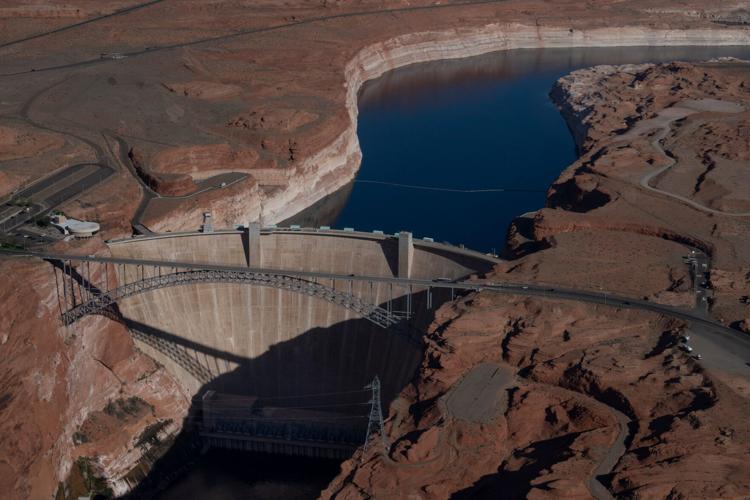
Glen Canyon Dam on the dwindling Colorado River near Page, Arizona.
Large public works projects out of favor
For the most part, large federally financed public works projects have fallen out of favor politically, in the decades since Congress authorized CAP's construction back in 1968. Such projects' huge costs and environmental impacts have made them politically untenable on many fronts.
President Donald Trump, most recently, has shown little interest in federal public works projects. During his first term, he spoke regularly about the need for more infrastructure development in the U.S., but urged that it be largely financed by private sources.
After Trump's first term, President Joe Biden pushed through a major infrastructure bill that authorized numerous kinds of public projects such as roads, bridges, transit systems and electric vehicle charging stations. But when Trump returned to office in 2025, he sought to freeze funding for even already approved projects, although many of those efforts were stopped in the courts.
Sarah Porter, director of an Arizona State University water research center, said she couldn't speculate on whether a new public works effort to bring Arizona more water and to clean up pollution could succeed today.
But she said the state has other alternatives for bringing in more water supplies and improving water security that don't involve massive federal outlays of tax dollars.
But "they all involve higher water rates for ratepayers," said Porter, director of ASU's Kyl Center for Water Policy.
Most immediately, the San Diego County Water Authority is negotiating with Arizona and California officials to sell water rights to some of its surplus water to the states.
"And that doesn’t require a big New Deal style project, it just requires legal aggressiveness," said Porter, although the states will have to potentially spend big bucks to obtain such water rights.
Second, the Colorado River Indian Tribes, which own the largest single share of river water rights of any Arizona entity, have in recent years won congressional approval to lease their water to parties outside of the reservation, which they didn't have before, she noted.
There are still possibilities of water rights transfers from users along the main stem of the Colorado River at the Arizona-California border, she said, although many of those communities have been hostile to that idea.
"That water has higher priority than CAP water during shortages," she said, adding, "Those are things that would only need lawyering."
Another possibility is transferring groundwater to major cities that's pumped from rural counties in central and western Arizona where that practice is legal, said Porter, adding "it is increasingly controversial."
Many rural residents say such transfers would wreck their communities' economic futures, amounting to the practice of "buy and dry."
Such transfers would require tax outlays for infrastructure to get the water to cities and, in many cases, for treatment of the water because it fails to meet some important drinking water standards, Porter said.
Finally, there is "advanced water purification," or treating wastewater to drinking quality, she noted. It is expensive, and Tucson and Phoenix have benefited from federal money for such projects. But cities could raise the money by selling bonds, she said, although that often requires raising water rates to repay them.
"It would help to have federal support for sure," Porter added.
Contact Tony Davis at 520-349-0350 or tdavis@tucson.com. Follow Davis on Twitter@tonydavis987.

Tony Davis
Reporter


 Collapse of Colorado River reservoirs: A wake-up call and a flashing red light