The federal government has laid out a path by which it could drastically cut deliveries to the Central Arizona Project that brings drinking water to Tucson and Phoenix.
But in its final environmental impact statement on the Colorado River, released Friday, the U.S. Bureau of Reclamation makes it clear that such drastic cuts will happen only if water supply conditions in the river stay bad or continue to deteriorate next year as they have this year.
That means the worst-case cuts most likely wouldn't happen starting this October, when Reclamation is supposed to introduce revised rules for operating the river and its reservoirs. Most likely, "they will wait and see what the winter snowpack brings," said David Wegner, a retired bureau official living in Tucson.
People are also reading…
But in the long run, the final environmental report raises the possibility of cutting water deliveries to the Lower Basin states of Arizona, California and Nevada by 3 million acre-feet a year. At the same time, it proposes no mandatory cuts to the Upper Basin states of Colorado, New Mexico, Utah and Wyoming.
That stance raises the very real possibility of litigation from Arizona and the Lower Basin states.
The federal report proposes up to 200,000 acre-feet in annual, voluntary cuts for the Upper Basin states, whereas the Lower Basin cuts would be mandatory.
Arizona officials have said that such a division of cuts is completely unacceptable. They have made it clear they'll take legal action if necessary to prevent it from happening.
The Upper Basin states have countered that first, they use a lot less water than the Lower Basin states, and second, they're already taking unofficial but very real cuts because the Colorado River tributaries that supply their farms and cities are already running short, draining their supplies.
The bureau's new statement doesn't spell out any rationale for not cutting Upper Basin releases.
But some observers have said the bureau is less certain of its authority to cut water deliveries to Upper Basin states than to Lower Basin states because it has contracts spelling out how much it will deliver to Lower Basin states. No such contracts exist for Upper Basin water deliveries. They mainly occur by farmers and cities diverting water from the river's tributaries.

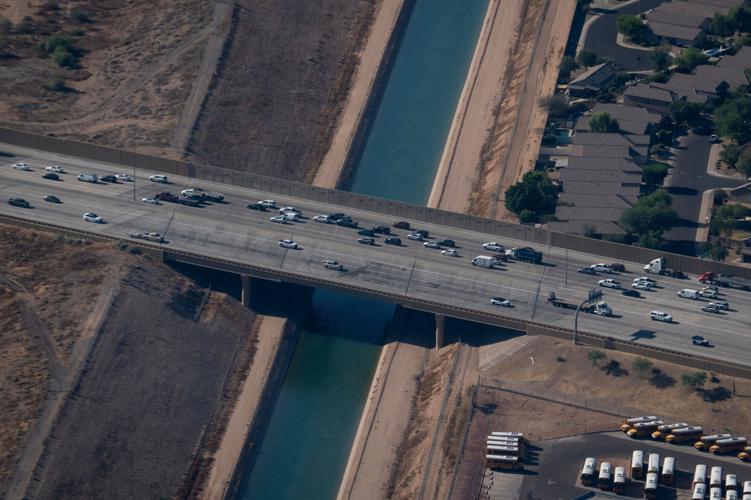
The Central Arizona Project canal, which brings Colorado River water to Phoenix and Tucson for drinking, runs under the Loop 101 in Phoenix.
The bureau's proposal for 2027 and 2028 would be the first two years of a 10-year plan. That plan would be revised every two years, following extensive negotiations between the bureau and officials of the seven river basin states. Friday's environmental report will be followed later this summer by a final record of decision and the bureau's release of a set of operating guidelines for the next two years.
University of Arizona water scientist Sharon Megdal told Reuters the river’s condition is a "natural disaster" that will require extraordinary actions to sustain livelihoods in the Colorado River Basin, which supports an estimated $1.4 trillion in gross domestic product and 16 million jobs.
"This does not look good for Arizona," Megdal, director of UA's Water Resources Research Center, said of Friday's plan. "This does suggest that legal action may be taken."
The report says the federal government's preferred alternative would be to accept a proposal from the Lower Basin states to cut 1.5 million acre-feet a year for the next two years. Arizona officials have said they could live with those cuts, which they say will reduce Central Arizona Project deliveries by only 14% a year to cities and 10% a year to tribes.
But if conditions on the river get bad enough that more cuts are needed to keep Lakes Powell and Mead from falling to "critically low" elevations, the bureau will make additional reductions based on which water users have higher legal priority to the water. The cuts could be as much as 3 million acre-feet a year for the Lower Basin, plus another 600,000 acre-feet of cuts for Mexico.
‘Such reductions would devastate Arizona’
Under a 3 million acre-foot cut, the CAP would suffer major cuts and possibly lose most of its supply. That's because under the 1968 federal law that authorized the CAP canal system's construction, CAP would have to give up all of its water in times of shortage before California loses any of its river water supplies.
In recent years, California officials have shown some flexibility regarding the legal priority system, as it has agreed to take some cuts in its river supplies even before the CAP loses all of its water. But under the bureau's preferred alternative, CAP would still take the brunt of any cuts beyond the first million and a half acre-feet.
Exactly how this alternative would work in real time isn't spelled out in the final environmental impact statement. The details will become clearer once the bureau releases its decision and new operating guidelines.
The Arizona Department of Water Resources noted that the bureau's preferred alternative accepts many of the "core elements" of the Lower Basin proposal. But that alternative also contains provisions, such as the very large potential annual cut to the Lower Basin, that Arizona officials find unacceptable, the department said in a news release.
"Such reductions would devastate Arizona water users and its economy," the department said.
The "triggers" for the agency to decide on how severe its cuts will be to the Lower Basin states will be how close Lake Mead and Lake Powell get to the water elevations the bureau has been trying to protect — 1,000 feet at Mead and 3,500 feet at Powell, said Wegner, who today is a National Academy of Sciences board member.
"If Reclamation sees those limits being approached, they will initiate additional actions to restrict releases," Wegner said. "There are any number of reasons why this could happen, and Reclamation is trying to be situationally aware and create flexibility in how they address and act.
"It could be flash drought. It could be infrastructure issues. It could be continued drought. The elevations are the key," Wegner said.
As of Friday, Lake Mead stood at 1,041 feet elevation. Lake Powell is at 3,522 feet. Both reservoirs have fallen steadily this year due to record low winter snowpack levels in the mountains that feed the river with runoff, and record heat in the late winter and spring.
If Mead falls to 1,035 feet, Hoover Dam — which formed Lake Mead when it was built in the 1930s — would have to shut down turbines that generate 70% of its total electricity production.
If Powell falls below 3,490 feet, Glen Canyon Dam would have to shut down all of its turbines and stop generating electricity altogether.
"The preferred alternative strikes a balance between flexibility and predictability given unprecedented hydrologic and system conditions and the potential for considerable impacts on water users," the final environmental report said.
While that alternative contains tradeoffs affecting various resources based on factors such as water releases from dams, river flows and water deliveries, the preferred alternative "appropriately balances the tradeoffs and achieves more robust performance than previous operations," the new report said.
Arizona elected officials decry the plan
Arizona Democratic Gov. Katie Hobbs said the report contains "unacceptable options that include the federal government forcing Arizona to take the majority of draconian water cutbacks."
But implementing the Lower Basin proposal would protect Arizona from massive water cuts, distribute reductions more fairly across the Lower Basin States, and provide stability and protection to the water supply that communities rely upon, Hobbs said in a written statement. "I remain steadfast in my commitment to a long-term Colorado River solution that ensures every state in the system shares in its conservation."
Hobbs' Republican opponent in the November election, U.S. Rep. Andy Biggs, also spoke out against the bureau's proposal.
"While I am grateful for the cooperation of California and Nevada and the federal government's willingness to listen to the concerns of the Lower Basin States, I am extremely disappointed that the Upper Basin States have continuously refused to come to the table to help bring relief to the entire basin," Biggs said. "Over many previous years, Arizona has drastically cut its water usage to prove its responsible partnership with both the Upper and Lower Basin States. We cannot afford to take on more cuts, yet here we are with another framework that puts Arizona last."
Arizona's Republican legislative leaders spoke with equal vehemence against the bureau proposal.
"Arizona recognizes the serious condition of the Colorado River, and we are prepared to be part of a responsible solution. What we will not accept is a federal plan that protects some states while placing a devastating and disproportionate burden on Arizona," said Senate President Warren Petersen.
"Our state has already conserved enormous amounts of water and made difficult sacrifices to protect this river," he wrote in a statement. "The final decision must respect the Law of the River, recognize Arizona's contributions, and protect the water our families, farmers, tribes, and businesses depend on."

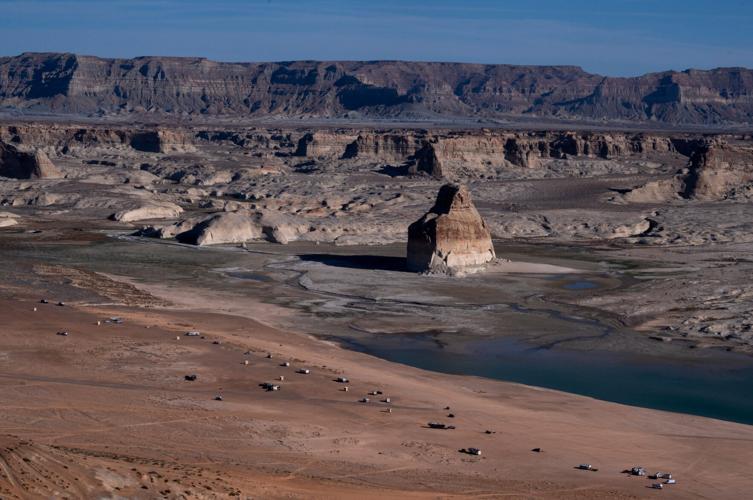
Lake Powell’s Lone Rock Beach, north of Page, Arizona, is seen on March 27, 2026.
Arizona's Colorado River use in 2025 was its second lowest since 1992. Despite that record of conservation, the state remains particularly vulnerable because much of the water delivered through the Central Arizona Project holds junior legal priority, Petersen and Senate President Pro Tempore T.J. Shope said.
Arizona's U.S. Senators Mark Kelly and Ruben Gallego, both Democrats, also took exception to the bureau's proposal.
"Arizona, California, and Nevada have already put forward a fair, practical proposal to stabilize Lake Mead and Lake Powell through shared conservation, and that proposal should serve as the foundation for the next set of Colorado River operating guidelines 2027 and 2028," the senators said in a joint statement.
“We remain committed to working with all seven basin states, tribal nations, water users, and the federal government to reach a durable agreement that protects Arizona's water future, strengthens the Colorado River system, and ensures every basin partner does its part," Kelly and Gallego wrote.
U.S. Rep. Adelita Grijalva, a Tucson Democrat, said "any proposal that imposes the vast majority of cuts on Arizona is unreasonable and unacceptable — especially while Upper Basin states continue to hide behind an outdated legal framework that is disconnected from today’s hydrologic realities."
Environmentalists' reactions
A number of environmental and conservation groups took shots at the bureau's proposal, saying it didn't go far enough to reduce water use or ensure long-term stability for the beleaguered river.
Gary Wockner, director of the Colorado-based group Save the Colorado, predicted that Reclamation will continue past practices of paying farmers and cities to not use river water, "while trying to save Glen Canyon Dam and refusing to face the science of climate change that is making the dam obsolete."
"Further, it will potentially diminish flows even more through the Grand Canyon in a desperate attempt to keep Glen Canyon Dam functioning — the river that carved our nation's most beautiful and iconic National Park is being sacrificed to save a doomed dam," Wockner wrote in a news release. "The Colorado River needs consequential and systemic change that confronts the ecological, political, and legal chaos caused by climate change and Glen Canyon Dam, but Reclamation's plan is just 'lather, rinse, repeat' of past failed policies."
Kyle Roerink, senior a

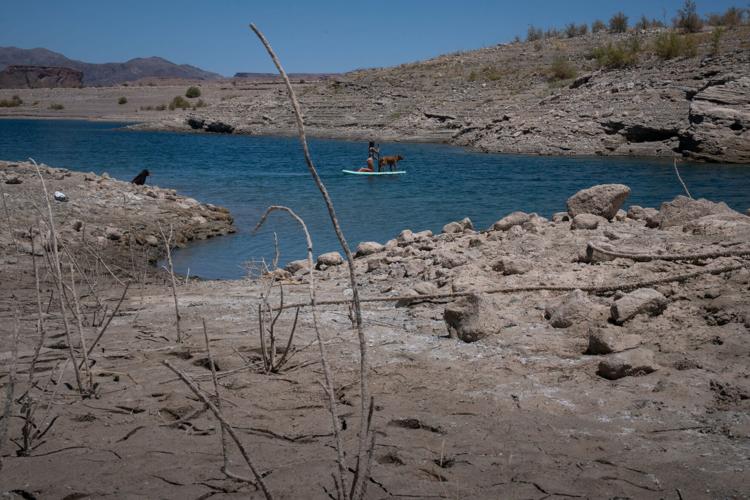
A paddleboarder and her dog at Temple Bar Marina in Arizona. The U.S. Bureau of Reclamation's final environmental impact statement on the diminished Colorado River says Arizona may face drastic cuts to its water supply if the river conditions stay bad or continue to deteriorate next year as they have this year.
dvisor for the Nevada-based Great Basin Water Project, said, "The preferred alternative offers some shorter-term stability as we navigate the threats of minimum power pool, dead pool and infrastructure failures at reservoirs like Powell and Mead. But we have a lot of work to do to better prepare for deep uncertainty," Roerink said, adding that the report takes the region only "a few steps away from failed 20th Century management regimes."
While water users in Lower Basin states and Mexico endure cuts, Upper Basin interests will likely increase their use because the proposal does not limit new permits for groundwater or surface water development in the Upper Basin, Roerink said.
But Jennifer Pitt of the National Audubon Society said "it's a good thing" the bureau was able to get this document out to the public at all, given the challenging conditions hydrologically on the river, and the lack of consensus among the seven basin states as to what to do about them.
"Interior has defined a preferred alternative that gets the basin out of emergency decisions we've been lurching to from one year to another over the past few years and that’s a good thing," said Pitt, who directs Audubon's Colorado River program. "The bureau's framework appears to leave the door open for the states to keep working together to find consensus and that’s also a good thing."
"Flexibility to adapt to changing conditions"
The new report's 10-year plan represents a radical change from the bureau's earlier, recent proposals for the river, including its draft environmental impact statement from January 2026, and the previous federal operating guidelines for the river, all of which ran or would run 20 years.
The draft environmental report early this year, however, assumed that a consensus could be developed among the seven river basin states on a long-term fix for the river's problems.
But that never happened, and "In the absence of such consensus, and given the uncertainty facing the basin," the bureau's parent agency, the Interior Department, determined that rather than impose prescribed operating guidelines for 20 years, a different approach was needed, the final environmental statement said.
"Thus, the department selected a 10-year decision framework that provides certainty regarding the decision process while preserving flexibility to adapt to changing conditions," it said.
Contact Tony Davis at 520-349-0350 or tdavis@tucson.com. Follow Davis on Twitter@tonydavis987.

Tony Davis
Reporter




 Collapse of Colorado River reservoirs: A wake-up call and a flashing red light