The collapse of the country's two biggest reservoirs to record low levels is both a clarion call, driving home the Colorado River's water crisis, and a warning signal for how much worse the crisis will get, experts say.
With Lakes Mead and Powell falling to record low levels only 8 days apart, the need for Southwest residents, farms and businesses to find ways to use less water is more urgent than ever, experts said. And the real likelihood of litigation over who will have to cut their water use to balance supply and demand on the river looms larger over the entire river system every day.
This continued run of record-low water flowing from the Colorado River into the nation's two biggest reservoirs has major ramifications for water supplies in Tucson and across the entire Southwest.
People are also reading…
Every major Southwestern city lying within or just outside the Colorado River Basin, including Tucson and Phoenix, depends on this water for drinking. And farms from Yuma and Southern California's Imperial Valley to Colorado and beyond in the basin depend on it to grow their alfalfa, cotton, fruit and vegetables.
But even as the reservoir levels plummet, the fate of the region's water supplies will depend as much on legal and political battles as on climate, and those are not remotely close to being resolved.
Litigation is looming over a proposal by the U.S. Bureau of Reclamation to cut river water supplies to Arizona and neighboring states by 40%, and resolving the legal issues will take a decade, said Sarah Porter, director of Arizona State University's Kyl Center for Water Policy. Last week, Arizona Department of Water Resources Director Tom Buschatzke sent off a detailed letter laying out six legal violations he says the bureau's plan will cause, only weeks before the bureau is scheduled to adopt its plan.
Here are six takeaways from the current crisis unfolding across the river basin and its reservoirs:
1. Another record low flow
Continued warm, dry weather has brought record low annual flows over two consecutive years through the Colorado River at Lee Ferry, lying just downstream of Glen Canyon Dam and Lake Powell, said Eric Kuhn, a longtime Colorado River researcher and author.
About 8.5 million acre-feet flowed in the river in water year 2024-25, running from October 2024 through September 2025. But only 7.15 million acre-feet is likely to run past the same point in water year 2025-26, ending this coming Sept. 30, Kuhn said.

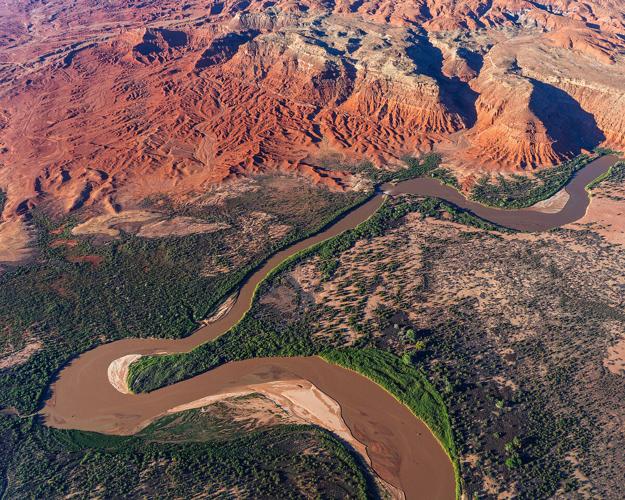
The San Juan River, which feeds into Lake Powell, in an aerial photo taken in April. The lake fell Saturday to its lowest level ever.
Kuhn cited U.S. Bureau of Reclamation data, which remains provisional and is subject to revision, he said.
2. Crisis will get worse before better
The latest federal forecast shows the "most probable" scenario has Lake Mead dropping for all but two of the next 24 months, hitting a low point of 1,009.69 feet at the end of June 2028.
The forecast's "minimum probable" scenario — the one that federal forecasters think has a 10% chance of occurring — has Mead tumbling much farther, bottoming at 990.65 feet by the same date. That's only 95 feet above "dead pool" level, at which no water can be taken out of the lake.
Either scenario has Mead falling below 1,035 feet — the level at which 70% of Hoover Dam's generators must shut down — in April 2027 and staying there for the next two years.
Lake Powell's outlook for the next two years is also bleak, the latest forecast from Reclamation shows. The most likely forecast shows Powell staying above 3,490 feet elevation, the lowest level that keeps Glen Canyon Dam's generators running, for the next two years.
But the "minimum probable" forecast, which is often more accurate, shows Powell falling below 3,490 starting in February 2027 and staying there through June 2028.
Another two bad years, even if they're not quite as bad as these two have been, would spell disaster for the river, said Brad Udall, a water and climate researcher at Colorado State University.
In 2012 and 2013, the river received only 8.5 million and 9.1 million acre-feet annually, said Udall — barely half of the 20th century average annual flow of about 15 million acre-feet, he said. That didn't put the reservoirs in the critical condition they're in now, because they were at much higher levels than today, he explained.
But if that little water flows downriver in the next two years, "all hell would break loose," he said.
"All hell breaks loose means dead pool at both reservoirs, without massive cuts in Lower Basin water use," said Udall, referring to the Lower Colorado River Basin states of Arizona, California and Nevada. At dead pool, the reservoirs would not be able to release any water downstream to cities and farms in the Lower Basin.
The cuts would have to be "well in excess" of the 3 million acre-feet annually that Reclamation has proposed as a maximum cut in its recent final environmental impact statement for the river, Udall said.
The best case scenario for the river in the short term would be a rerun of 2011, in which more than 20 million acre-feet of water roared down the river — about 33% more than the river's average annual flow in the 20th century, Udall said. That was the river's highest annual flow in the 21st century so far.
The bureau has vowed to keep Lake Powell levels at at least 3,500 feet to ensure the reservoir doesn't fall below levels at which electricity can be generated at the dam. But if the lake did get that low, it would be at a "dead pool lite" level because we still couldn't take any water out of it, Udall said.
3. Low-cost rural electric power goes away
Estimates are that power cutbacks at Glen Canyon and Hoover dams could either strip electric supplies or raise electric bills for 13 million people living in Arizona and most of the other six Colorado River Basin states, which also include Upper Basin states of Colorado, New Mexico, Utah and Wyoming.
The biggest impacts will be on power to rural residents who are heavily dependent on the lower-cost power generated by the federal dams.

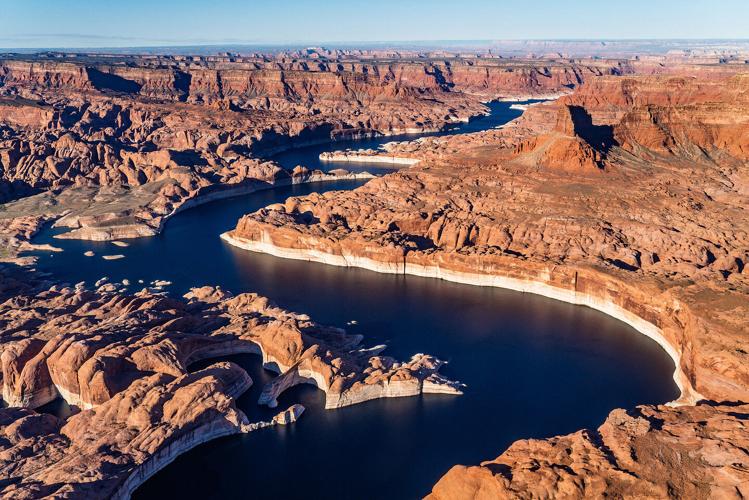
Lake Powell, at the Colorado River and San Juan River confluence, in an aerial photo taken in April.
Officials have already said that if Hoover Dam power supplies are significantly cut — which could commence as early as next April — electricity prices for the dam's customers, led by irrigation and electrical districts statewide in Arizona, would rise to the point of being unaffordable.
Beyond that, less power or no power from Glen Canyon Dam will mean less federal revenue that's now used to protect endangered species and monitor Grand Canyon ecological conditions, said David Wegner, a retired Bureau of Reclamation official who now works actively on national and regional water issues.
The lack of funds will also hamper efforts by conservationists and federal agencies to combat the spread of invasive fish from Powell into the Grand Canyon as the lake's waters warm to a more hospitable climate for the invasives, Wegner said.
4. 'A management failure'
That's how longtime Colorado River researcher Jack Schmit of Utah State University sees the significance of the two reservoirs' record low levels.
"These record conditions are teaching moments that focus attention on the unprecedented severity of the present Colorado River water-supply crisis," said Schmidt, senior research scientist for the university's Center for Colorado River Studies.
"To date, we have collectively failed to meet the challenge posed by declining runoff caused by a warming climate. We have collectively failed to reduce our use of the river to sustainably match the declining natural supply.
"Lake Powell now continues to fall towards elevations where hydropower production will be jeopardized and environmental river management in Grand Canyon, downstream from Glen Canyon Dam, will be significantly compromised," Schmidt said.
The assessment of Arizona State University's Kathryn Sorensen, who has collaborated with Schmidt on a number of Colorado River reports, was significantly less harsh.
"I think that farmers, tribes and cities in the Lower basin are all trying very hard to use less water and leave water in Lake Mead and do their part. All sectors have come together on that," said Sorensen, research director for ASU's Kyl Center for Water Policy.
But, "the amount of water we’ve been able to save in the Lower Basin has not been enough," Sorensen added. "The reservoirs continue to decline.
"That bad snowpack bad and runoff have kind of overwhelmed our conservation efforts. I believe we need to find ways to use even less water collectively across the Lower Basin and the Upper basin as well, knowing full well how painful that will be."
Schmidt strongly agreed on the need for more conservation.
"In the present moment, there is no alternative but to reduce ... water use everywhere in the (Colorado River) basin. Every user, especially large agricultural users, must look themselves in the mirror and ask, “What can I do to reduce my water use?'" Schmidt said.
5. Tribal uncertainties
The lack of water in the river raises major questions about how the federal government will meet its obligations to deliver water and build pipelines and other infrastructure to meet its legal obligations to tribes, said Wegner.
Both the Colorado River Indian Tribes, which control the largest share of river water rights, and the Gila River Indian Community, which has the largest share of rights to water from the Central Arizona Project that delivers drinknig water to the state's midsection, have raised major concerns about a proposal from the Reclamation to make massive cuts in deliveries of river water to Arizona and the other Lower Basin states.
The tribes have either said or implied they would take Reclamation to court to stop cuts they feel would seriously damage their economies.
The lack of water also imperils the possibility of delivering river water to tribes such as the Navajo and others that have won legal rights to the water in court battles or through legislation, but haven't yet obtained the infrastructure needed to deliver all of it to all of their homes.
"There are 30 tribes in the basin," Wegner said, including 22 in Arizona. "They are being impacted with their legal settlements not being resolved or not physically getting water infrastructure delivered to them.
"The government is not interested in addressing this issue because of water supply problems, because of climate change, and because of challenges with funding. Not creating revenue from Glen Canyon Dam and Lake Mead makes it more difficult to invest in infrastructure so tribes will get more water," Wegner said.
6. El Niño bailout coming?
The atmospheric forces driving what looms as possibly the biggest El Niño season on record could bring good news to the river, but there's no guarantee.
Two big El Niño years in 1983 and 1998 brought major flooding and great snowpack that boosted reservoir levels. The 1983 flood was more than residents or public officials would want to experience again, as it damaged hundreds of homes built along the river and almost destroyed Glen Canyon Dam.
But in general, research has found no correlation between El Niño weather patterns and annual snowpack and runoff in the river, Udall noted.
If we do have a big El Niño winter, a changing climate could reduce its benefits for the Colorado, Wegner said.
"Global warming has caused a loss of ice in the Arctic. It’s causing changes to the climate system, which affects the jet stream," he said, referring to narrow bands of strong wind currents that blow from west to east across the globe and have major impacts on weather patterns. "Until we see where this El Niño goes with respect to the jet stream, it’s not clear if it will provide a big snowpack in the Rockies."
But that doesn't mean El Niño won't bring a lot of river runoff, because "this El Niño coming at us looks to be completely unprecedented," Udall said.
"There's no analog in the historical record to say how this El Niño will be. All bets are off."
Contact Tony Davis at 520-349-0350 or tdavis@tucson.com. Follow Davis on Twitter@tonydavis987.

Tony Davis
Reporter


 'Zero flow' recorded at key spot on Arizona's drying San Pedro River