Arizona communities that rely on Colorado River water could face higher water bills as a new federal plan cuts the state's allocation from the river by roughly 25% over the next two years.
A recently released federal plan to protect water stored in Lake Mead and Lake Powell would reduce Arizona's allotment from the river over the next two years by roughly a quarter, or about 760,000 acre-feet.
"Our water bill is going to go up. I know my water bill's going to go up next year, it may even go up the year after that," said Fred Schneider, president and COO of Arizona Water Company at a recent meeting of the Arizona Corporation Commission. "It's going to continue to go up as water costs more."
There are about a dozen private water companies regulated by the Arizona Corporation Commission that receive water from the Colorado River or the Central Arizona Project, according to an Aug. 25 presentation to the regulatory board about potential cuts. Public utilities, like the City of Phoenix, are not under the commission's jurisdiction, but have also been preparing for a Colorado River with less.
People are also reading…
Ben Ruddell, a Northern Arizona University professor, said shortages on the Colorado River are no surprise to the state's water professionals. Ruddell and other researchers evaluated several different water scenarios and how they would impact water vulnerability, resilience and cost in different cities in the Phoenix metro in a 2020 paper.

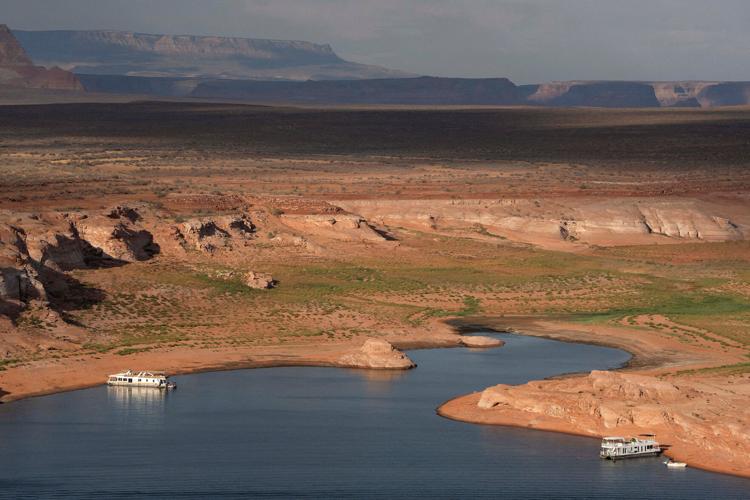
Houseboats sit in a quiet cove on Lake Powell, as the critical reservoir sits at its lowest ever recorded water level.
While the crisis is universally recognized, Ruddell said, not every community or utility is equally ready to weather it.
“They know that this is happening, and they’ve all planned for it,” Ruddell said. “However, that does not mean that they are equally well-prepared — and it does not mean that there are not consequences.”
When one water source dries up, it's critical to have additional supply streams. Some cities in the Phoenix metro can lean more heavily on their full Salt River Project allocations. Because the City of Phoenix, for example, has a diverse water portfolio, Ruddell said the municipality should be better positioned to handle Colorado River cuts.
But communities reliant on Colorado River water from the Central Arizona Project are going to be the hardest hit, he added.
“The first question people should be asking is: ‘how much has my city been depending on Colorado River water?’” Ruddell said. “That tells you a bit about how much trouble they’re in.”
Large and wealthy cities that can spread the cost of water investments to more customers and may have stashed excess water may end up selling to their smaller neighbors, Ruddell said. But as that supply shrinks further, leasing water will become more and more expensive.

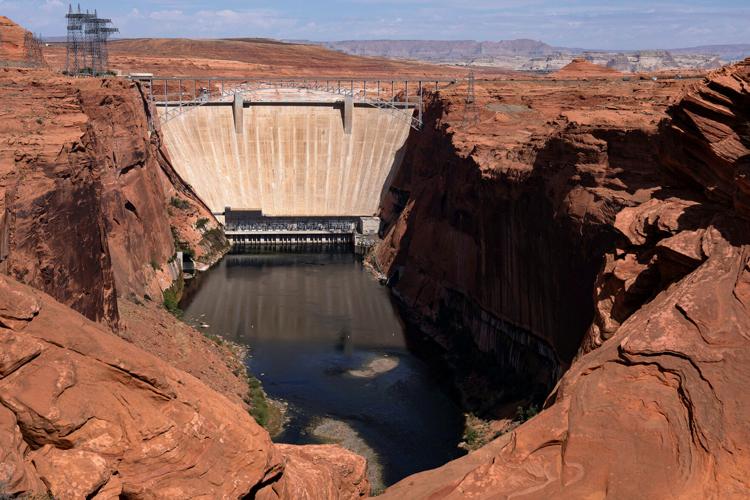
A view of Glen Canyon Dam as the critical reservoir, Lake Powell, sits at its lowest-ever recorded water level, in Glen Canyon National Recreation Area near Page.
“If you have a small city that was using mostly Colorado River water, and didn’t already have backup options they were paying for, you could see a huge increase in water prices — a several-fold increase,” Ruddell said.
Long-term solutions, like investing in desalination or direct potable water reuse, are costly and time-consuming.
“You can’t build those things in a day,” Ruddell said. “It’s slow and expensive.”
In an email to The Arizona Republic, Metro Water District general manager Joseph Olsen wrote that the water provider had discussed supply and demand on the Colorado River with ratepayers. A rate increase was approved in anticipation of cuts, given the water shortages.
"I informed our ratepayers that the question is not if we will have water to meet our customer demands over the next 100 years; the question is how much water will cost," Olsen wrote.
Olsen wrote that additional rate increases weren't planned during the term of the 2027-2028 operating agreement. Metro Water has been saving some of its Central Arizona Project water for the past few decades to ensure stability, Olsen wrote, and has voluntarily taken smaller allocations to shore up Lake Mead.
Heidi Lasham, director of Marana Water, said the proposed cuts were not a surprise.
"The town has been investing for many years, knowing that this day was probably coming," Lasham said.
The utility, which serves a growing community in southern Arizona, currently gets about 15% of its water from the Central Arizona Project. Lasham said the goal is to shrink that to 11% by adding additional, renewable water resources to reduce reliance on both the Colorado River and groundwater pumping.
In addition to shrinking supplies, Lasham said the utility is facing increasing costs for maintenance and supplies. Earlier this year, a 10.5% rate increase was put into effect to adjust for inflation.
"We're trying to position ourselves for the future demands that are coming and taking into account the cuts that we're going to get from the CAP," Lasham said.


 Collapse of Colorado River reservoirs: A wake-up call and a flashing red light