

Voters in District 4 will choose between a Democrat and a Tea Party Republican who both have a defensive strategy for governing.
As assistant minority leader, incumbent Lynne Pancrazi has spent most of her time last session fighting to get Democrats’ bills heard and trying to kill what she called bad bills.
She said she supported and shepherded good bills, like the expansion of the state’s Medicaid program.
Her challenger in the election, retired surgeon Connie Uribe, used to be a Democrat, “but I had shock treatments,” she jokes. She switched parties during the Clinton administration.
Uribe says she’d focus on keeping government out of people’s lives and try to block bills that extend government’s reach — like the expansion of the state’s Medicaid program. “They have expanded delays, denials and demands on the physicians,” Uribe said.
People are also reading…
She became involved in the Tea Party after giving a speech about wasteful spending on electronic medical records. She speaks with rage in her eyes as she talks about how Obamacare affected her patients, saying government “idiots” shouldn’t tell doctors how to treat patients.
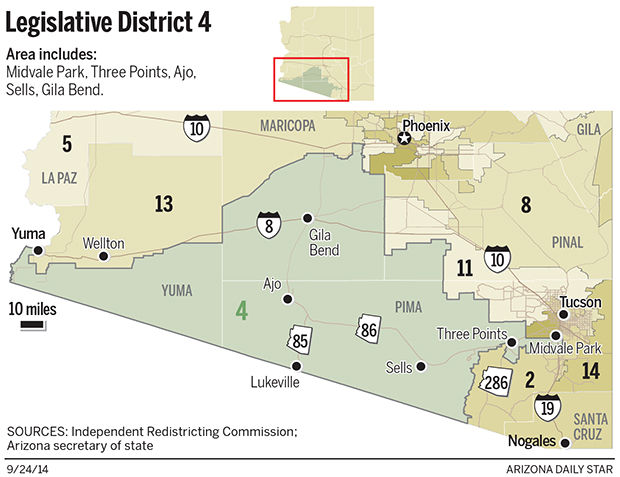
Although both candidates have made campaign stops in Tucson, the race is been contested mostly in Yuma, where half of the district’s voters, as well as both candidates, live. District 4 includes parts of Pima, Yuma and Maricopa counties.
On school funding
Pancrazi, a retired teacher, said the state should dip into its $455 million rainy-day fund to pay $317 million more to public schools this year. “We have starved our public schools,” she said.
A Maricopa County Superior Court judge ruled last month the state ignored a voter-approved inflation factor on school spending and owes the extra $317 million to schools this year.
Pancrazi said the Legislature should also reinstate the inflation factor and accept a settlement offer from the school districts that brought the lawsuit to avoid paying the $1.3 billion the state could owe in “back pay,” which would leave the state’s budget a mess.
Uribe said the Legislature should plan for any appeal to fail. Lawmakers don’t necessarily have to spend the rainy-day fund to fix the problem though, she said, adding savings could be found on the administration side of school balance sheets.
“I get a heartache every time I see a billboard that says donate school supplies,” Uribe said. She would support efforts to focus more of the spending on the classroom.
On border security
Pancrazi said she’s ready to support SB 1106, which called for spending $30 million to build a virtual border fence. She said a network of cameras “would make our borders extremely safe” and wouldn’t restrict legal trade, and this kind of security solution would allow the political discussion to move to immigration reform.
Uribe said border security is a federal issue and she has no plan for how the state should be involved in border security. However, “We know that we’re not safe,” Uribe said.
She said an ISIS group threw a flag over the border near Yuma on the anniversary of the 2001 terrorist attacks.
A Border Patrol account of the incident differs from Uribe’s. A fabric banner with Spanish-language writing was draped over the border fence in San Luis and discovered by agents around 5 a.m. Sept. 12, said Agent David Lines, a spokesman for the Border Patrol’s Yuma sector. The writing condemned the U.S. relationship with Israel and supported a free Palestine. It did not make any threats.

Connie Uribe

Lynne Pancrazi
Contact reporter Becky Pallack at bpallack@tucson.com or 573-4251. On Twitter: @BeckyPallack

Becky Pallack
Product manager


