


Zoo officials today are expected to defend a plan that will ultimately lead to the separation of elephants Connie and Shaba, who have been together for 29 years.
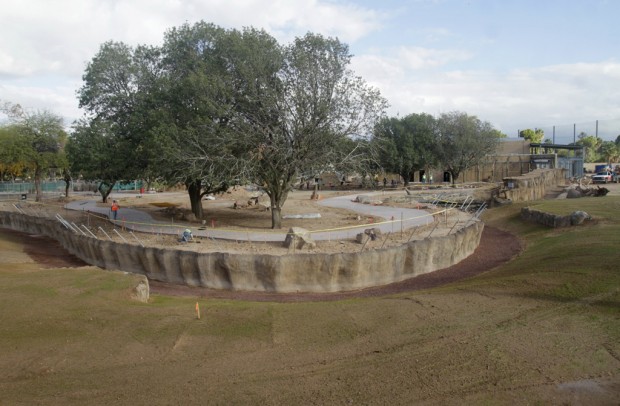
Reid Park Zoo officials hope that once a $9.7 million, seven-acre elephant exhibit expansion is completed after the beginning of the year, it will become the first zoo in the nation to receive a breeding herd of African elephants from another zoo, which are expected to come from San Diego Zoo Safari Park.
"This will put us on the map for elephant management and welfare," said zoo education curator Vivian VanPeenen.
Herein lies the tension: Zoo accreditation standards no longer allow mingling of species when zoos establish a new herd.
Thirty-one-year-old Shaba is an African elephant, but 42-year-old Connie is an Asian elephant. The two have been together since Shaba was 2 years old.
People are also reading…
The zoo plans to send Connie to a new facility at the San Diego Zoo, which has geriatric care and where she would be introduced to a herd of other Asian elephants.
Critics of that decision, who demonstrated at the zoo in Sunday, maintain it is inhumane, saying the animals will suffer a profound loss if they are separated after all this time.
"Most people can understand and grasp the concept of animal bonds," said animal advocate Tracy Toland, an office manager for a local investment firm.
"The zoo needs to answer: When did the moral commitment to these elephants change?" she asked, charging that the zoo is acting in an effort to increase its stature. "They don't seem to be doing what's in the best interest of these two animals. It seems they're doing what's in the best interest of their pocketbook."
The zoo's VanPeenen said the zoo is considering the animals' needs. If Connie were to die at the facility, she said, Shaba would be all alone. She would likely have to be moved to a new facility at that point, she said. Now - while the animals are both healthy and capable of making the transition - is the time to act, she said.
"We're not kicking Connie to the curb. Her welfare is of great concern to us," VanPeenen said. "We'd happily keep her here, but it's just not a choice."
The zoo also can't just ask for a waiver from the standard until Connie's death. "That's a nice sentiment, but not a well-informed sentiment," said Steve Feldman, a spokesman for the Maryland-based Association of Zoos and Aquariums, who noted African elephants tend to be more aggressive. "Being an Asian elephant with a whole new group of African elephants could be potentially more stressful than a move to San Diego, where she'll be very well cared for."
San Diego has worked closely with keepers here to minimize disruption, VanPeenen said. The management techniques are the same, the climates are similar and the routines are identical.
She said "animal extremists" who don't believe animals should be kept in captivity in zoos period are behind the effort.
Toland, who said she was not recruited by outside groups, said she found out about the plan while she was handing out fliers protesting the circus and its treatment of animals. "I do tend to agree that zoos really can't give them enough space," she said. "But each case is unique, and the zoo actually is the best home for them right now because they shouldn't be separated."
City Councilman Paul Cunningham, who scheduled the item for discussion, noted back in 2005, when zoo critics wanted the animals moved to sanctuaries, the zoo stressed the animals should stay together - a statement that now seems an about-face.
In a concern echoed by critics of the decision, Cunningham said the information to the public wasn't timely. "I think the zoo should have been more upfront about the plans, and that's why we're having a study session now."
VanPeenen said plans change. Five years ago, there were hopes to breed Shaba, but while waiting for funding to come together, Shaba's now no longer of breeding age. San Diego at the time didn't have the geriatric capabilities it now has for Connie. Plus, she said, zoo science evolves. "I hope I can contradict myself in five years once again."
The new exhibit - half of which was funded by the city, although not with general fund revenues - grows the exhibit from one-third of an acre to three acres, with amenities such as a mud wallow and a soaking pool.
Construction should wrap up in January, with an opening potentially around March.
DID YOU KNOW?
Connie, who was born in the wild, although zoo officials aren't sure where, was acquired as a rescue from a petting zoo in 1968, when she was about a year old. Shaba was orphaned in Africa in 1980 when her family was culled because of overpopulation. She came to the zoo in 1982.
Source: Reid Park Zoo
Contact reporter Rhonda Bodfield at rbodfield@azstarnet.com or 573-4243.


