
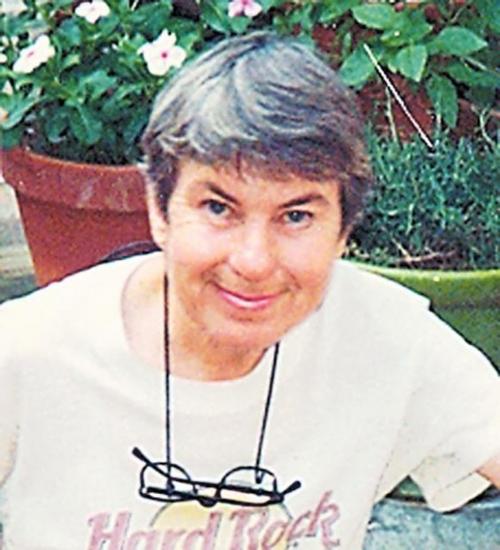
Hazel Ann McFeely Fontana could have been a prosperous artist.
She was talented in multiple media — making detailed pencil drawings of missions, re-creating lush landscapes out of vibrant opaque watercolors, infusing ink-and-paper sketches with Asian influences, silk-screening greeting cards and combining the styles of African tribal artists with the disjointed geometrics of Picasso when she painted self-portraits.
But she didn't need kudos or recognition or a fat check at the end of a successful gallery run to achieve fulfillment. Hazel's satisfaction came from creating art for herself. Her happiness came from caring for her husband and children — even when that meant working to put her spouse through school, scrubbing clothes on a washboard in a rustic Alaska abode, or climbing atop her Tucson house to re-shingle the steep-pitched roof.
"I'm not sure what there was that she couldn't do. She was literally a jack-of-all-trades," said one of her three children, Tucson attorney Nick Fontana. "She was a Renaissance woman."
People are also reading…
She even taught her family how to make do without her.
"One of the things that helped me cope with her death: she had no tolerance for people being in the pity pool, feeling sorry for themselves," her son said.
His mother died Feb. 18 from the effects of Alzheimer's disease. She was 77.
Hazel McFeely's work ethic was honed growing up in rural Northern California.
"She was a farm girl," her son said. "My grandfather McFeely was an orchard man. She grew up in Yuba City, Calif. — delta country out there. In those times, if you were a rancher or a farmer or owned an orchard, you did it yourself."
For several years, Hazel, one of five McFeely siblings, ran the orchard during summer breaks from college.
"She really had to step up to the plate because my grandfather was deaf and my grandmother was disabled," her son said.
Added her high school sweetheart and husband of 54 years, Bernard "Bunny" Fontana: "When you grow up on a farm during the Depression, everybody works. At an early age, she learned to do budding and grafting" on the fruit and nut trees.
Hazel was valedictorian of her high school class and graduated with honors from the University of California-Berkeley with majors in art and English. Though Hazel and Bunny had their first date on May 28, 1947 — they went to a high school production of "The Corn Is Green" — it took Bunny seven years to persuade Hazel to marry him. By then, Bunny was in the Army, stationed in Alaska.
"It wasn't for lack of my trying," he said of his courtship. "We corresponded. I proposed, and she said 'yes' by mail."
They wed on June 27, 1954, and hopped a plane to Alaska, where they spent a year before moving to Tucson so Bunny could attend graduate school at the University of Arizona. The money Bunny received through the GI Bill was enough to pay for his graduate studies in anthropology, but not much else, so Hazel went to work for internationally known Tucson orthodontist Charles Tweed. After five years, the couple's finances were stable, and Hazel quit her job to become what her husband called "a full-time household engineer."
The job of wife, mother and artist was demanding, but the former farm girl was up to it.
Hazel cooked all their meals from scratch, made their clothes, fixed their vehicles, repaired the roof, fixed appliances, painted the house, repaired the plumbing, kept the books, tended the garden, took on carpentry projects, helped found the Salpointe Thrift & Gift Shop and still found time to pursue her artistic interests, which included playing the piano, taking ballet and tap-dancing lessons, and painting and drawing. She even provided illustrations for several books and journals.
"Everything we did seemed like fun. It was never drudgery," Bunny said. "We had an absolutely great time."
The Fontanas had three children and raised them in the same 1917 adobe home they'd owned since 1956.
"Hazel did a wonderful job of building a strong and productive family," said longtime neighbor Loma Griffith. "She turned out a trio of wonderful kids."
Hazel taught her children the lessons she learned at a young age about hard work and responsibility.
"She was old enough to remember the Depression and the Okies coming to California and that crushing poverty," her son said. "My mom was very thrifty. She felt if you could make it yourself and do it yourself, that's the way it should be."
It was from his mother that Nick inherited his enjoyment of cooking, though he didn't always appreciate her efforts.
"My mom was a baker. When I was a kid, I would go to school and for lunch I had sandwiches on homemade bread and homemade cookies," he said. "It would just kill me because all my friends were having Rainbo Bread and Twinkies."
Hazel also made sure her children received a spiritual education.
"She took her duties as a Catholic mother seriously," Nick said. "She dragged us all to church every Sunday. She sent us to Sunday school and got us through confirmation. She said: 'When you're confirmed, you're God's problem. Until then, you're my problem.' "
Hazel was "remarkably unflappable," said her son, remembering the many times his father called late in the day to say he'd be bringing home dinner guests. Even though they were on a tight budget, raising a family on a junior professor's salary, Hazel pulled together wonderful meals and made guests feel like family.
Roberta Officer met the Fontanas when they moved to Tucson.
"When we went to her house, she always served good old beans, beans and tortillas. She was a good cook," Officer said.
Another friend, Velma Woods, met the Fontanas in the mid-1950s.
"There was always this quiet, joyful acceptance of each person. We always felt at home with them," Woods said. "I think every person felt like that with her. She wasn't a judgmental person. She simply took people for who they were right then.
"She was always Hazel. She never put on airs," Woods said. "She was more into the essence of things and the true meaning than the expense of it or the showiness of it, and it was refreshing. It was genuine. She was so many-faceted and had so many interests, and yet you always felt like she was true to herself."
On StarNet
Find a photo gallery of this Life Story at: azstarnet.com /slideshows
the series
This feature chronicles the lives of recently deceased Tucsonans. Some were well-known across the community. Others had an impact on a smaller sphere of friends, family and acquaintances. Many of these people led interesting — and sometimes extraordinary — lives with little or no fanfare. Now you'll hear their stories.

 Jim Click’s Tucson dealerships sell for $93 million