
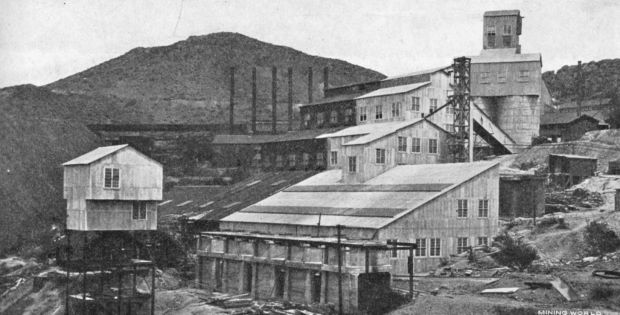
Early mining around Globe dates back to the Stowe prospects in 1864. The Globe and Old Dominion claims were established the following decade by Virginia prospectors, including B.W. Reagan.
Big Johnny Gulch was the site of the area’s first copper mine in 1878, the same year “Globe City” was established. It was renamed Globe two years later after the discovery of a nine-inch in diameter spherical silver nugget that resembled a globe.
By 1881, the Old Dominion Copper Mining & Smelting Co. assumed mining operations around Globe, erecting 30-ton water-jacketed furnaces near Bloody Tanks. They were later moved to Globe for ease of ore transport.
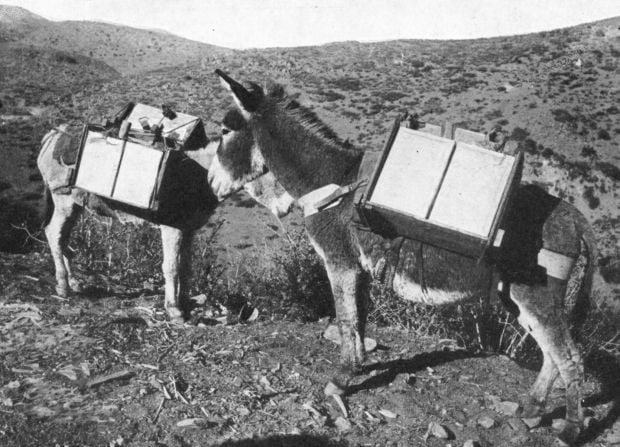
Early mining production included several 10-foot prospect holes and a 100-foot tunnel opening on Pinal Creek that provided access to the underground workings as a means of ore transport for both miners and mules.
People are also reading…
Later a 1,224-foot-long aerial tramway with 11 buckets was used to transport ore from mine to ore bins near the smelter. Although silver continued to be the primary metal mined in the Globe-Miami District for the next several years, by the end of the decade, copper gained supremacy, with Globe’s citizenry boasting that all U.S. copper coins had been produced from Globe copper.
Transportation costs proved excessive, including the cost of transporting coke essential for the furnaces — some acquired from as far as Cardiff, Wales. Fluctuating market copper prices also took their toll, temporarily closing the Old Dominion mine in 1886.
By December 1898, the Gila Valley, Globe & Northern Railway from the Southern Pacific line at Bowie was extended to Globe, lowering transportation costs.
In 1903, the Old Dominion Copper Mining and Smelting Co. and the United Globe Mines Co. were acquired by the Old Dominion Copper Co., a holding company organized by Phelps Dodge & Co.
The Old Dominion mine, like the Magma mine 30 miles to the west, is one of the few vein-type deposits that produced large amounts of copper, including 800 million pounds between 1882 and 1930.
Hundreds of Cornishmen, called “Cousin Jacks,” employed as hardrock miners at the Old Dominion Mine initiated the concept of collective bargaining, forming one of the most powerful unions in Arizona.
Notable strikes over reduced wages included those of 1896 and 1917. The latter involved the Western Federation of Miners and the Industrial Workers of the World.
Martial law was declared, and troops of the 17th Cavalry Regiment were called in to break up the strike, erecting a temporary barracks on the slag dumps in front of the Old Dominion mine.
The Old Dominion mine closed in 1931 due to declining copper prices — less than 10 cents per pound — and rising water levels in its shafts, which reached down 2,296 feet to the 27th level.
Although the mine never reopened, it is credited with having produced $134 million in copper, silver and gold. Attempts to reopen the mine using low-grade, block-caving techniques failed.
The Old Dominion mine property is currently owned by BHP Billiton, and its water has been pumped out for use in the company’s other mining operations.
Mines near Globe produced notable mineral specimens. The Apache mine or Defiance mine, five miles northwest of Globe, is credited for its amazing hexagonal, blood-red vanadinite crystals. Vanadinite, an important ore of vanadium, was used during World War II as a steel hardener.
Seven miles northwest of Globe is the Sleeping Beauty mine, renowned for turquoise of exceptional hardness and lacking inclusions and fractures. Also notable are the native silver specimens from the Stonewall Jackson mine, worked in the late 1870s, 18 miles northeast of Globe, near McMillenville.
William Ascarza is an archivist, historian and author. His latest book, “The Chiricahua Mountains: History and Nature,” is available at Barnes and Noble online. Email him at mining@azstarnet.com
Sources: A.J. Hardy, N.R. Lindstrom, E.L. Bingham, W.A. Fuller and R.C. Krohn. “Characterization and Design of the Old Dominion Remedial Action Plan,” paper presented at the 2003 National Meeting of the American Society of Mining and Reclamation and the 9th Billings Land Reclamation Symposium, Billings, Montana, June 2003; “Arizona: A State Guide,” compiled by workers of the Writers Program of the Work Projects Administration in the State of Arizona, 1940; Robert Bigando, “Globe, Arizona: The Life and Times of a Western Mining Town, 1864-1917,” 1989; F.E. Calkins, “The Globe-Miami District — Past, Present and Future,” Arizona Mining Journal, May 1, 1922; Wilbur A. Haak, “The Old Dominion Copper Mine,” History of Mining in Arizona, Vol. III, edited by J. Michael Canty, H. Mason Coggin and Michael N. Greeley, 1999.


 Analysis: These 9 TUSD schools are at highest risk of merging or closing