

This is the second in a two-part series on the Clifton-Morenci District. Read the first part at online at tinyurl.com/morenci
Although Phelps Dodge increased production from the Humboldt Mine in the late 1920s with the No. 6 concentrator at 4,500 tons of ore daily, declining ore grades and copper prices hurt the industry.
Domestic copper prices were at 5.78 cents per pound when underground mining in the district ended in 1932 with the closure of the Humboldt Mine, which had operated since the 1890s.
Phelps Dodge Corp. President Louis S. Cates ordered an evaluation of all Phelps Dodge properties to improve copper production. Extensive exploratory drilling further revealed the mining potential of the low-grade sulfide Clay ore body at Morenci which had been explored by the Detroit Copper Co. and the Arizona Copper Co. at the turn of the century.
People are also reading…
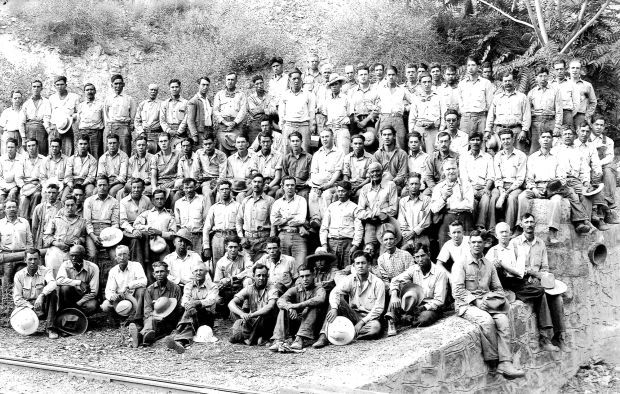
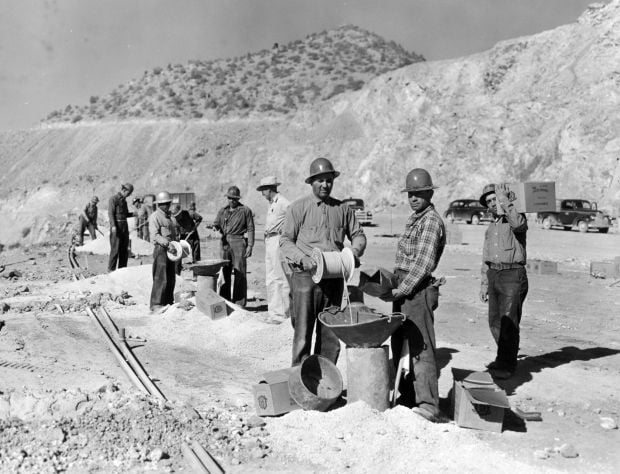
Mining resumed in 1937, this time by open pit method under Cates’ direction, overseen by Harrison Lavender and Walter C. Lawson. Cates’ experience with open pit mining included developing the Bingham Canyon open pit mine in Utah and the Ray open pit mine in Arizona.
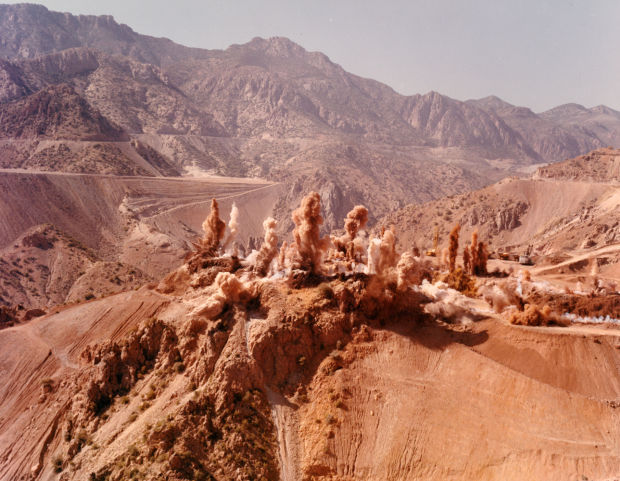
Before any copper could be removed, 50 million tons of overburden over 200 feet above the ore body had to be stripped away at an estimated cost of $42 million. Blast holes were drilled using churn drills to create 50-foot benches each 100 feet wide.
By 1942, a new onsite concentrator handled the ore brought in by rail and truck haulage extracted by power shovel. World War II initiated greater demand by the federal government for output at the Morenci mine with copper production increasing by 80 percent.
The Morenci Pit expanded and by 1950 stretched a mile wide and over 1,000 feet deep. The massive operation used 17 electric shovels, 16 electric locomotives, 9 diesel locomotives and 234 dump cars.
Phelps Dodge built three dams supplying water for mining operations at Clifton-Morenci: Horseshoe on the Verde River (1945), utilizing tributaries of the Little Colorado River for the Show Low (1953) and Blue Ridge (1965) dams.
Extensive mapping of the surface geology led by future Phelps Dodge president Richard Moolick, followed by drilling in the 1950s and ’60s, led to the development of the Metcalf ore body.
By 1969, the Metcalf area was actively mined as an open pit. Old town Morenci, dating back to 1884, was dismantled because it was an obstacle to the expansion of the upper levels of the Morenci Open Pit. The new town of Morenci was built by Phelps Dodge three miles south of the previous town and included a post office, churches, library and shopping center.
By 1980, both the Morenci and Metcalf open pit operations were consolidated. Total working area today covers 1.5 miles by 1.3 miles including two additional open pits mined nearby: the Coronado and the NWX (Northwest Extension), neither of which can be consolidated due to topographic constraints.
Unlike old Morenci and Metcalf, Clifton — the seat of Greenlee County — remains intact with an aesthetically appealing historic district and informative Greenlee County Historical Museum along Chase Creek Street.
Environmental and economic challenges forced the closure of the Morenci smelter in 1984. Since 1987, SX/EW or solvent extraction electrowinning processing has been the primary means of copper extraction from oxide ores.
In 1996, Morenci’s two 600-foot-high smelter stacks were demolished along with the 300-foot-high stack erected in 1913 by the Arizona Copper Co. the following year. Freeport-McMoRan acquired Phelps Dodge in 2007.
As of 2014, Morenci is the largest copper producer in North America, the world’s largest producer of copper cathode from SX/EW and one of the largest open-pit mines in the world. The copper ore mined at Morenci today averages less than 0.5 percent with a projected 990 million pounds mined from 2014-17.
William Ascarza is an archivist, historian and author. Email him at mining@tucson.com
Sources: Theodore L. Cogut and William C. Conger (1999), “History of Arizona’s Clifton-Morenci Mining District, Vol. II”; William C. Conger (1987), “History of the Clifton-Morenci District”; James H. McClintock (1916), “Arizona, Prehistoric, Aboriginal, Pioneer, Modern: Vol 2”; David F. Myrick (1984), “Railroads of Arizona, Vol. III”; Carlos A. Schwantes (2000), “Vision & Enterprise: Exploring the History of the Phelps Dodge Corporation”; www.fcx.com/operations/USA_Arizona_Morenci.htm


