

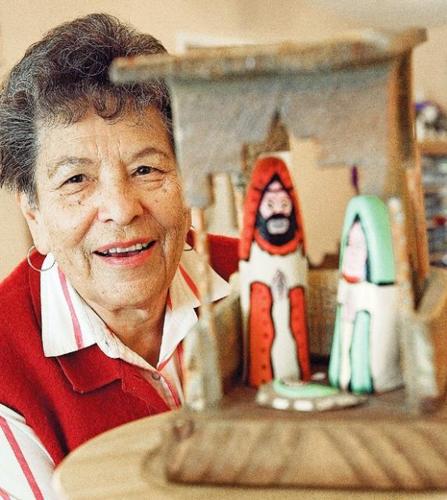
The East Side home of Adriana Cordova Herman is happily decorated for Christmas. But don't look for strings of red and green lights, cardboard cutouts of Santa and his reindeer or the old jolly guy and his elves swallowed up inside those lighted inflatable bubbles that have sprung up like ugly weeds.
Herman has none of those ubiquitous seasonal trappings. Her decorations are inside and speak more to the meaning of Christmas — Mary and Joseph and the newborn Jesus.
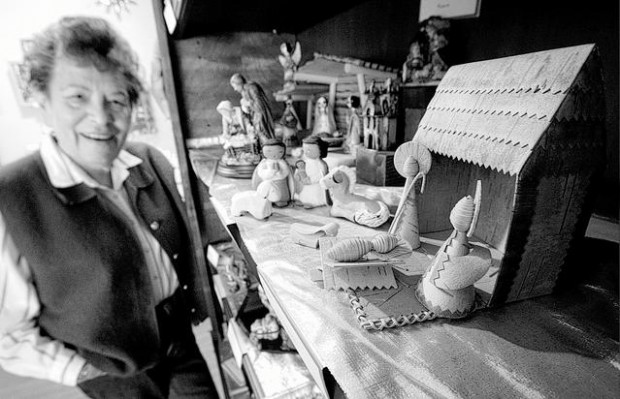
She has a collection of about 170 Nativity scenes, most of them miniatures displayed on shelves, tables or hung on the walls in her East Rosewood Street home.
"I love Christmas. I love the story of the birth of Jesus," Herman said.
She acquired her first Nativity scene in 1968 while visiting Scottsdale. She admired it and was overcome by a popular Christmas practice.
People are also reading…
"I saw it, and I had to have it," said Herman, 69, a retired Tucson Unified School District teacher.
Since then she's bought Nativity scenes here and in countries she's visited. Others have been given to her by her two daughters, Toni Cordova and Teresa Guerrero, and friends.
The sets are made of an array of materials — tin, wood, clay, dough, corn husks, linen, glass, porcelain, straw, toothpicks and matchsticks, Bavarian wax, papier-mâché, aluminum foil and more. Most were found in this country, but she has sets from Brazil, Vietnam, Russia, India, Paraguay, Kenya, Peru, Germany, Mexico, Israel and other countries.
Some scenes are paintings and prints; others are woven. She has pillows and an outdoor Nativity scene outlined with wire and lights.
One set came from the Avon lady and another from Thomas H. Franco, a Tohono O'odham man who lived at San Xavier. While visiting the Smithsonian Museum in Washington, D.C., she admired a Nativity scene crafted by Franco.
"Well, I said to myself, I must have one of his sets," she said.
Herman returned to Tucson, went to San Xavier, found Franco and asked him if he would make one for her.
He said no. She persisted. She told him she would return every week until he did. After several visits, Franco agreed.
It is made of mesquite, sand, cotton and horse hair. Mary, with two black braids, is dressed in blue and her head covered in a white scarf. The Christ child, clad in blue cloth, rests in a traditional O'odham hammock. Joseph has long black hair, holds a staff and is dressed in a brown robe, like a San Xavier Franciscan priest, covered with a colorful cape.
Most of Herman's Nativity scenes reflect the culture and people of the place they came from. Mary, Joseph and el niño Jesus are Asian, Indian, African, Latino and European.
A few Nativity scenes are whimsical. There are a Mary and Joseph as mice, and Herman has a cookie cutter Nativity scene.
Her appreciation for the story of Jesus' birth is rooted in Herman's childhood. She was born in the Depression-era mining town of Ruby, near Arivaca, but grew up in El Hoyo, the Mexican barrio south of Downtown.
While attending Carrillo Elementary School, Herman participated in Las Posadas, the re-enactment of Mary's and Joseph's search for shelter from Nazareth to Bethlehem. Her first-grade teacher, Marguerite Collier, helped create the tradition that continues 70 years later. Herman and her family continue to participate in Las Posadas held in the West Side barrios of Menlo Park and Hollywood.
Even her collection has ties to her childhood. One of Herman's Nativity scenes belonged to Collier.
The Nativity sets disappear after Jan. 6, Three Kings Day, the traditional end of the Christmas season among some Mexican families. Herman and her family will celebrate with rosca de reyes, sweet bread baked in the shape of a wreath.
She will wrap the Nativity sets carefully in bubble wrap, tuck them in boxes and store them where she can. She loves them all.
But ask her which is her favorite Nativity scene, Herman will quickly say: "The last one is always my favorite, of course."

 Tucson's El Güero Canelo for sale


