LAS VEGAS — Negotiations over how to stabilize the shrinking Colorado River are so deadlocked that one of the seven state officials involved now says he doesn't think it's possible to get a 20-year agreement to rewrite the river's operating rules.
They're so deadlocked that the acting U.S. Bureau of Reclamation chief, Commissioner Scott Cameron, is now ready to discuss the possibility of dictating a top-down fix for the river's chronic overuse of water — even though he makes it clear he doesn't like the idea one bit.
And they're so deadlocked that three days of panel discussions, keynote speeches and general networking at the annual Colorado River Water Association conference in Las Vegas failed to bring to the public's attention any new ideas for resolving the long north-south split over who should make the cuts in water use needed to balance the river's supply with people's demand for water.
People are also reading…
More than 1,700 people packed huge meeting rooms at Caesar's Palace at the conference held Tuesday through Thursday to hear officials and outside experts urge bold, quick and decisive action by the seven river basin states and by federal officials.
But after the last panel discussion of the conference, featuring the Colorado River commissioners of all the basin states, it was clear the prospect of consensus is as elusive as ever — and that the participants might well have fared better taking on the endless rows of slot machines separating the conference meeting rooms from the Las Vegas Strip on the outside.
That follows nearly three years of unsuccessful negotiations among the states in search of a compromise solution.

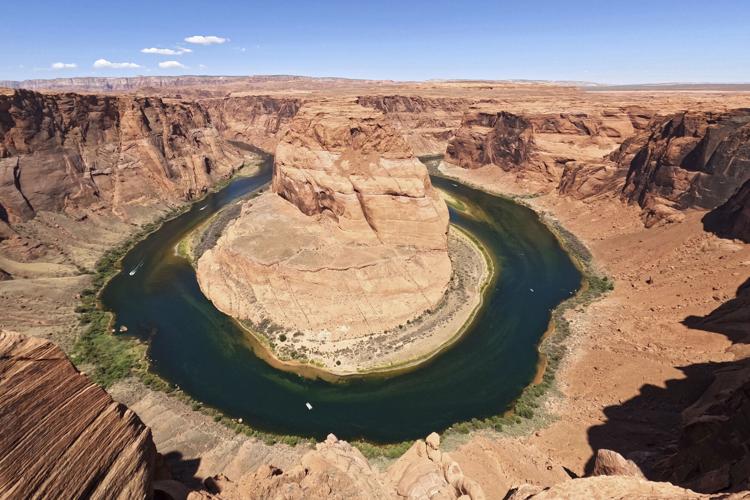
The Colorado River flows at Horseshoe Bend in Glen Canyon National Recreation Area near Page. Under any seven-state deal to cut river water use, cuts for Arizona's users will be mandatory, so Arizona needs to see the same from Upper Basin states, its water chief says.
Prospects for compromise seemed so elusive that the Southern Nevada Water Authority's general manager, John Entsminger, said he no longer believes it's possible for the states to achieve their longstanding goal of approving a plan by next year to manage the river and its reservoirs for the following 20 years. Such an agreement would replace the 20-year agreement the states and feds approved in 2007, which expires at the end of 2026.
"I went into this process advocating strenuously for a 20- to 30-year deal. I no longer think that's possible. With the time we have left and the hydrology we're facing, probably the best thing we can get at this juncture is a 5-year operating plan," said Entsminger, who was the last of the state representatives to speak.
His sentiment is not unanimous among the state Colorado River commissioners who attended. Becky Mitchell, commissioner for the state of Colorado, said through a spokeswoman, "We remain hopeful for a durable, long-term, sustainable consensus framework and we are focused on accomplishing that."
After the conference, Doug MacEachern, a spokesman for Arizona water resources chief Tom Buschatzke, said the director largely agrees with Entsminger on his point, but Buschatzke doesn't yet want to completely give up on the idea of a 20-year agreement.
"We've been talking two-plus years but we not found a way to break the logjam," Buschatzke told the closing conference panel.
Also, in an interview Thursday after the conference ended, Scott Cameron, the acting U.S. Bureau of Reclamation commissioner, said for one of the first, if not the first, times that Interior Secretary Doug Burgum would be prepared to impose a solution on the states if they can't reach a compromise, but made it clear he strongly hopes that won't happen.
"The (Interior) secretary will do his duty under the law. But I think everyone needs to realize that his flexibility is constrained by treaty, by law and by supreme Court decisions, and everybody across the seven states is far better off if there’s a seven-state agreement. It provides a lot more flexibility," he said.
Cameron has set a Feb. 14 deadline for the state officials to come up with a compromise plan — a compromise he would hope to etch into a final version of an environmental impact statement later next year after releasing a draft statement in late December or January. His February deadline will come about three months after the states and feds blew past his previous Nov. 11 deadline without reaching a plan.
But he declined to comment on how long he would wait if no agreement occurs by Feb. 14. And he said he remains optimistic a seven-state agreement can still happen.
"People respond to deadlines. We've got a deadline now that’s based on a variety of external, hydrological and legislative process constraints. I think that will make a difference," he said.
Points of vision remain the same
In various panel discussions at the conference and in interviews, it was clear the seven states have moved little if at all closer to reaching agreement on a water-saving plan than they were as of Nov. 11. The points of division remain the same.
The Lower Basin states, led by the Arizona Department of Water Resources and its director Buschatzke, remain unwilling to strike an agreement because the Upper Basin states, led by Colorado's Mitchell, are unwilling to commit to making any reductions in their own water use.
Arizona, Nevada and California make up the Lower Basin. Utah, Colorado, New Mexico and Wyoming make up the Upper Basin.
The Lower Basin states say they're willing to shave their water use by at least 20% from the start if the Upper Basin states are willing to share 50-50 any cuts needed beyond that point to protect the river's reservoir levels.
The Upper Basin states say they're unwilling to commit to making such cuts because they're already using a lot less water than the more populous Lower Basin, and their farmers, in particular, already sustained what Mitchell calls "death by 1,000 cuts" when dry years reduce the amount of water available for farmers to pull from the river and its tributaries. The Upper Basin states also note they aren't using anywhere near their legal rights to river water, while the much more populous Lower Basin states are using more than their share.
During the seven-state panel discussion, Entsminger observed, "If you distill what the other six panelists said, there were three common things: 'Here's all the great things the states have done. Here's why it's impossible to do more and why others have to do more.' As long as we keep polishing those arguments with each other, we are going nowhere."
Indeed, many of the state officials made the points Entsminger mentioned not once but twice during the three days. At the opening panel Tuesday, a meeting of the Upper Colorado River Commission, and on the closing panel Thursday, Mitchell hammered home similar points: that Colorado farmers and cities have taken huge strides in water conservation and that Colorado's farmers in particular face serious, systemic difficulties in conserving additional water.
Many people don’t understand what the strict administration of state water rights — necessary to enforce conservation requirements — means, Mitchell said.
"The pain is felt" in Colorado, she said, as the cuts result in greater flows of water leaving the state.
"We also celebrate conservation, and contribute to an average of over 8 million acre-feet in flow out of Colorado alone from the river and its tributaries every year," Mitchell said. "This has led to the death of 1,000 cuts. Many water users have had to make heartbreaking decisions on the front lines: cull herds; fallow fields; lay off staff. It's a precarious time. We're bringing every resource to this.
"The Lower Basin, what it put on the table, (to cut use by) 1.5 million acre-feet, is a huge step. But what Mother Nature has said, she is demanding more," Mitchell said.

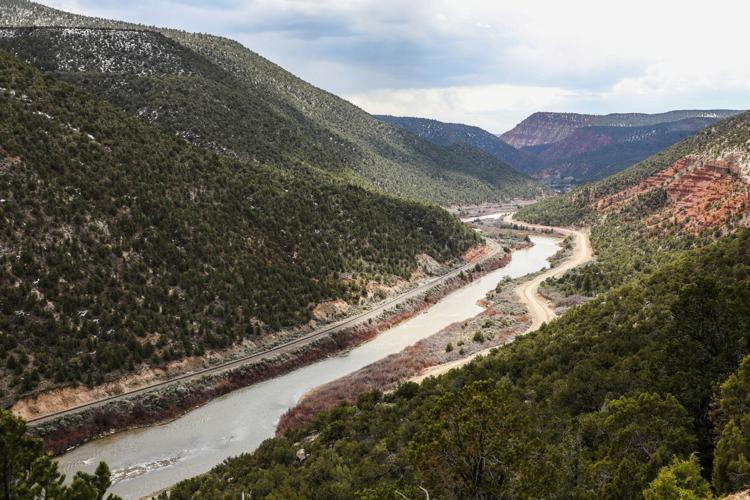
The Colorado River runs through mountains near Burns, Colorado. Colorado officials insist the Lower Basin states of California, Arizona and Nevada must do more to cut their river water use.
Water reuse is an important tool ''not only to reuse water but reuse it to extinction," she said. "Denver Water (the utility serving the city of Denver) intends to build enough recycled water infrastructure to offset the water use of 43,000 households."
While Mitchell didn't completely rule out the Upper Basin making any cuts, she said the Upper Basin states would want to conserve water for their own future use rather than "subsidizing overuse" in the Lower Basin.
Away from the panel discussions, Andy Mueller, general manager of the Colorado River District, a rural Colorado water district that mainly serves farmers, put it a little more bluntly still: "They say we have to engage in mandatory water cuts so that Arizona’s God-given right to growth can occur.
"Let me just put it this way: The idea our communities have to decrease their economic security and economic vitality in order for Arizona to have unsustainable growth is unacceptable," said Mueller.
But Sarah Porter, director of Arizona State University's Kyl Center for Water Policy, said Mueller's point is 10 years out of date, because the Colorado River has stopped being a supply for growth for much of the state since 2015, when it became clear the "excess" Central Arizona Project supplies that nobody was using would go away. The excess water was what Arizona's three-county Groundwater Replenishment District was relying on to provide supplies to replenish aquifers after new development started pumping from them.
Now, also, with cities like Tucson and Phoenix seeking to persuade Arizona to renew their designations of having a 100-year water supply to allow their continued growth, those cities are no longer looking to the Colorado River as their water supply for continued growth, Porter said.
"They're looking to keep the cuts in CAP from being as deep as they could be," so as not to seriously affect existing users, she said.
Arizona sets its conditions
At Thursday's final panel, Buschatzke, Arizona's water chief, laid down what he said were conditions he'd want accepted by all sides for a seven-state deal.
First, the two basins' leaders would have to agree to temporarily waive some of the federal rules that have been on the books since the approval of the 1922 Colorado River Compact. Chief among those issues of "compact compliance" that would be waived is the compact requirement the Upper Basin states release a minimum amount of water every 10 years from Lake Powell to Lake Mead.
That would eliminate the risk of litigation that nobody wants in the event that the river flows fell below that minimum over 10 years.
This is important now because scientists and other researchers on the river have said the flows have fallen so much in recent years that the Upper Basin may be releasing less than required as soon as 2027. "We're right on the edge," Buschatzke said.
Second, "we need conservation in the Upper Basin that is verifiable and mandatory," he said. "My cuts will be mandatory. My water users will not have a choice. We need that parity."
Buschatzke said he recognizes the difficulties mandatory conservation might create for the Upper Basin, administratively. He acknowledged, as Upper Basin officials have long said, that the Upper Basin has thousands of water users, many of them farmers and ranchers, who draw water from the river and its tributaries at different diversion points for each user. The Lower Basin users, however, typically draw their water from only a few obvious diversion points from the river and its reservoirs.
"But I believe that is just an implementation issue" that can be worked through, he said.
Without such an Upper Basin commitment, "I can't recommend a compact waiver to the Legislature the way things are now. I have to get the Legislature to approve it," Buschatzke said.
Noting that Arizona has left 5.5 million acre-feet of water in Lake Mead over the past decade, he said, "We have taken substantial action, put a substantial volume of water on the table. We will continue to be at the table, try to move forward toward something we can all live with and hopefully be standing here next year as we have achieved that end."
Babbitt: Feds must avert water crisis
One audience member who came away unimpressed from the conference proceedings was former U.S. Interior Secretary and former Arizona governor Bruce Babbitt.
"Blah, blah, blah. Same speeches. Not a single new idea or proposal from the Upper Basin," Babbitt said in an email to the Star, describing what the seven-state panelists said.
Babbitt's larger concern is with the actions or lack thereof of the current Interior Secretary, Burgum, and Acting Reclamation Commissioner Cameron.
In a talk at the conference on Wednesday, Cameron told a large crowd that delay is unacceptable.
"Instead we must all enter into a continued collaborative spirit, being willing to make and adhere to uncomfortable compromises," Cameron said. "Under this administration, Interior has been meeting frequently with the basin states, have been flying out West about every other week since early April to meet with the commissioners of the seven states."
Cooperation has worked in the past, he said, noting that the current 2007 guidelines were forged through interstate cooperation, as was the 2019 drought contingency plan — "they helped us through two decades of drought."
"Now we must work quickly to take on what’s coming next. The time to act is now. We must accelerate our efforts to build consensus and forge agreements, and ensure a new agreement is in place before the current agreements expire," he said. "Only then can we avoid disruption of river activities and the people it serves."
But Babbitt said Interior and Reclamation aren't acting aggressively enough to head off a severe water crisis.
"Look, we’re in a tough situation. We're at the very brink," he said, noting scientific and weather forecasters' warnings that water levels at Mead and Powell could fall far enough in the next one to two years to halt power production at Glen Canyon Dan and severely curtail it at Hoover Dam.
"This is terribly disappointing. We're at an absolute impasse. And Interior is here to continue sitting on the sidelines," Babbitt said.

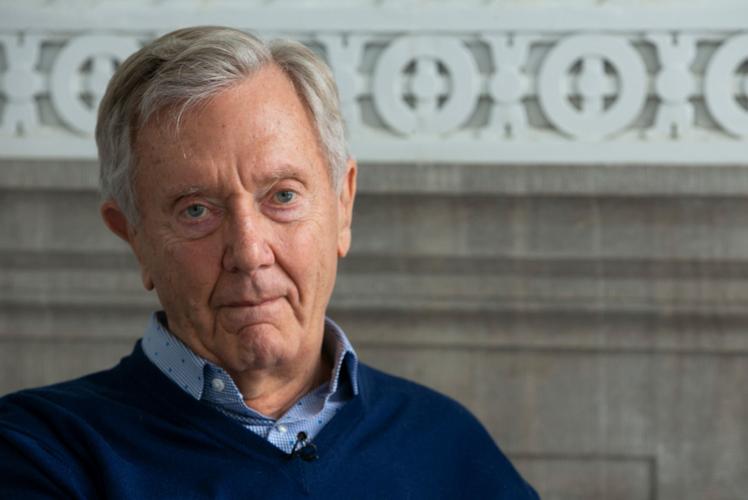
Bruce Babbitt, former Arizona governor and a former U.S. Interior secretary, says Interior and Reclamation aren't acting aggressively enough to head off a severe water crisis.
He said what Interior should do now is impose proportional cuts on all major water users in both the Upper and Lower basins. All users would take the same percentage.
"That's what the secretary ought to do today, is say that equity and fairness and the extent of the emergency dictates that all water users take the same percentage cut."
As Interior secretary — he served from 1993 to 2001 — he got California to slash its total river water use from more than 5 million acre-feet a year to its legal apportionment of 4.4 million, he said. He did that by giving California a deadline to make the cut and telling state officials he would cut each water user himself if state officials didn't.
"California officials, they said 'you don’t have legal authority to make us do it'. We had the authority. It was Section 6 of the Colorado River Basin Project Act," which in 1968 authorized construction of the 336-mile-long Central Arizona Project canal from the river to Tucson. "They came around real quick," Babbitt said of California officials.
That wasn't the last time Interior officials have put the basin states on a deadline to deal with the Colorado River's water use.
In 2005, Interior Secretary Gale Norton told the state officials if they couldn't come up with a plan to cut use by the end of 2007, she would impose her own. Two years later, the states and the feds approved the 2007 guidelines that, for the first time, set the stage for shortages to be declared on the river.
Then, in 2018, Reclamation Commissioner Brenda Burman told the basin state officials the same thing when water levels at the reservoirs were plunging — that they should approve a water-saving plan or she would impose one. In early 2019, the basin states approved the Drought Contingency Plan that spelled out a tougher regime of cuts than the 2007 guidelines.
Avoiding litigation a goal
When asked by the Star about the possibility of Interior ordering the states to curb water use, Cameron pointed out that when Congress ratified the Colorado River Compact in 1922, it didn't pass a "federal pre-emption statute" giving the federal government clear authority over the river's water use.
"Since 1922, Congress has recognized seven governors are fundamentally responsible for how they manage this river; that remains the case," he said.
Interior's solicitors, however, are examining all of the department's statutory authorities in the event it needs to exercise them, in the absence of a seven-state deal, Cameron added.
"But to reiterate, everyone absolutely will be better off if there’s a seven-state deal," not least because an order for cuts from Interior could provoke litigation that would tie the issue up for years or longer, he said.
The only thing litigation is going to achieve is "putting more lawyers' kids and grandkids through graduate school," he said. "There have to be more useful ways to spend that money to benefit the river."
But the risks and costs of litigation may very well look preferable to the terms the Upper Basin is offering, said ASU's Porter.
For now, as Nevada's Entsminger said, a short-term deal seems a lot more likely than a long-term deal, Porter said, adding she's doubtful a short-term deal can even be reached.
"The question is do we take our chances with federal action and litigation, or do we do a short-term deal and keep fighting for several years over the same things we've been unable to resolve?" she asked.
'We've not gotten anywhere'
Babbitt wasn't the only conference attendee frustrated at the lack of action.
"I think we’re all frustrated," said Sharon Megdal, director of the University of Arizona's Water Resources Research Center. "We want to move forward in this basin, with realistic actions to keep us in balance. Yes, we have to be in balance with what nature provides, but we have many different opinions about what that means.
"We’ve not gotten anywhere. The next six weeks are crucial," said Megdal, referring to the latest Feb. 14 deadline. "They need to do something differently."
Anne Castle, a former assistant U.S. Interior secretary for water and science, said on Wednesday that most of what she'd heard in the conference's discussions "could have been what we heard a year ago or two years ago."
"Cameron, also the states, are saying 'We're committed to pursuing a consensus agreement,' but there's been no details. I haven’t heard anything about what we’ve agreed on a particular measure in terms of shortage sharing, the coordinated operations of Powell and Mead or the amount of releases from Lake Powell. I would be surprised if I do hear any details."
The feds are not wielding a credible threat, meaning there's less incentive for the states to come together, Castle said.
"They're saying 'we're not going to dictate. We want you guys to figure it out.' But what has worked in the past is a dictate: 'Here’s what we’re going to do if you guys don’t do something'."
Tony Davis graduated from Northwestern University and started at the Arizona Daily Star in 1997. He has mostly covered environmental stories since 2005, focusing on water supplies, climate change, the Rosemont Mine and the endangered jaguar. Tony and David talk about the award winning journalism Tony has worked on, his journey into journalism, Arizona environmental issues and how covering the beat comes with both rewards and struggles. Video by Pascal Albright/Arizona Daily Star
Tony Davis graduated from Northwestern University and started at the Arizona Daily Star in 1997. He has mostly covered environmental stories since 2005, focusing on water supplies, climate change, the Rosemont Mine and the endangered jaguar. Tony and David talk about the award winning journalism Tony has worked on, his journey into journalism, Arizona environmental issues and how covering the beat comes with both rewards and struggles. Video by Pascal Albright/Arizona Daily Star
Tony Davis graduated from Northwestern University and started at the Arizona Daily Star in 1997. He has mostly covered environmental stories since 2005, focusing on water supplies, climate change, the Rosemont Mine and the endangered jaguar. Tony and David talk about the award winning journalism Tony has worked on, his journey into journalism, Arizona environmental issues and how covering the beat comes with both rewards and struggles. Video by Pascal Albright/Arizona Daily Star
Contact Tony Davis at 520-349-0350 or tdavis@tucson.com. Follow Davis on Twitter@tonydavis987.

Tony Davis
Reporter


 Report: Colorado River water too cheap to encourage conservation