When Pima County takes over the old Wells Fargo building to make it the new downtown library, a big part of the building’s identity will likely be missing.
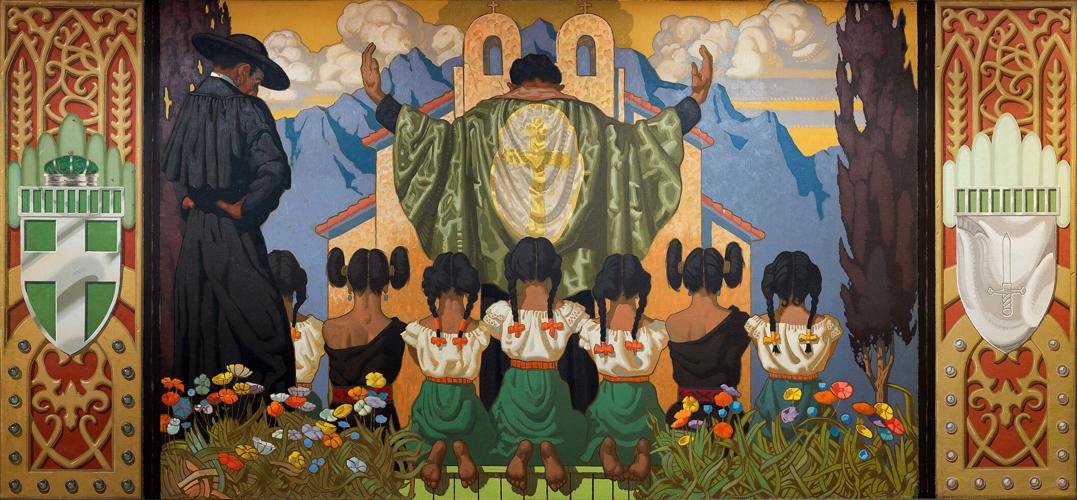
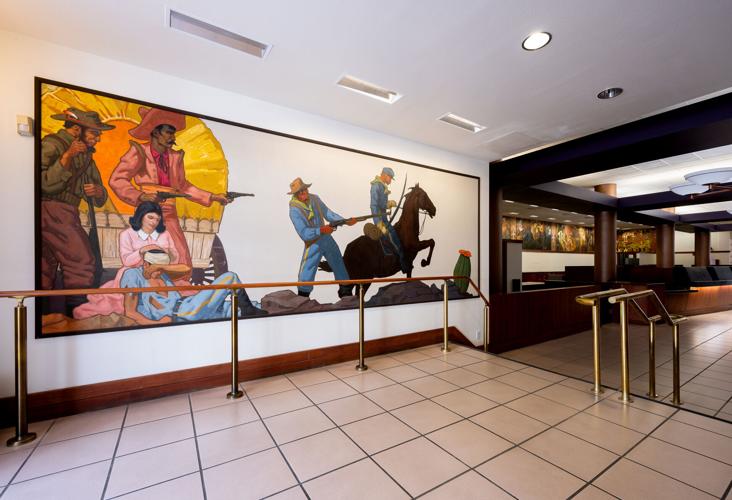
The 122-foot-long mural that has encircled the lobby’s interior since 1958 is no longer there. As it stands, the mural depicting the 1540s Coronado expedition to find the mythical Seven Golden Cities of Cibola is not part of the sale by Wells Fargo to Pima County.
“It was never part of the negotiated agreement,” Deputy Pima County Administrator Steve Holmes told me Tuesday. “Those murals were gone before we ever started actively pursuing the property.”

Oil on canvas painting by Jay Datus.
In fact, Wells Fargo had the murals professionally removed in early 2024 and stored away.
People are also reading…
“Our policy is to exclude art from any building sales so that we can ensure the pieces are protected and preserved properly,” Wells Fargo spokeswoman Sunny Rodriguez said in a statement.
I was able to look in the building Tuesday and saw where the paintings had been removed from the wall. The marks of torn adhesive are still there in the building Pima County decided to buy June 3. The main downtown library is expected to move from its current site to the bank building in coming years.

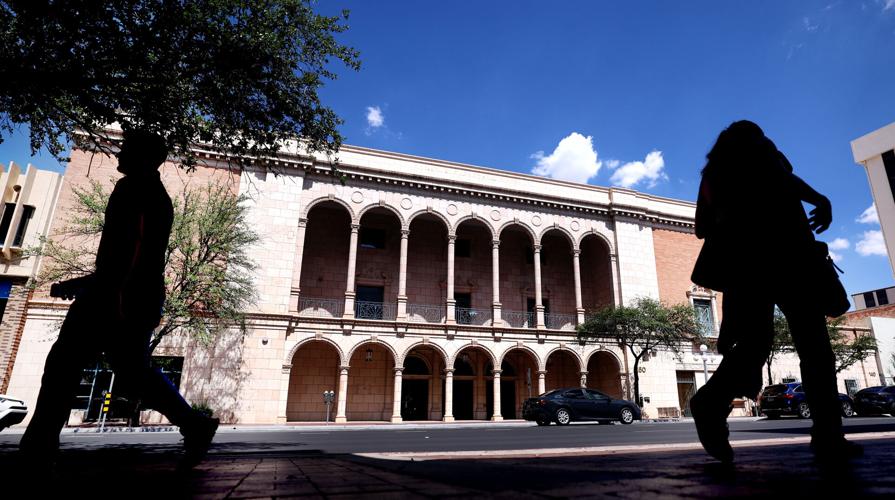
Pedestrians stroll by the former Wells Fargo Building, 150 N. Stone, which is on track to replace the current Joel D. Valdez Library across the street in downtown on June 3.
While the mural is gone for now, its destiny remains entwined with the future of the building. Southern Arizona Bank commissioned artist Jay Datus to create the mural for that lobby in the then-new bank building. It was unveiled to great fanfare in November 1958.
“Six murals depicting the ‘Seven Golden Cities of Cibola’ will be unveiled Saturday in the main lobby of the Southern Arizona Bank and Trust Co., 150 N. Stone Ave.,” the Arizona Daily Star reported in a front-page story on Nov. 7, 1958.
Star arts reviewer Beatrice Edgerly wrote two weeks later, “Meriting the highest possible commendation is the mural by Jay Datus of Phoenix recently installed in the Southern Arizona Bank.”
For years, the mural remained an attraction. In 1966, for example, Southern Arizona Bank held a special viewing on a Saturday for the public to come in and look at the mural. In more recent years, I would gaze at it while doing business at Wells Fargo. When I asked to take photos, though, the staff said no.
Art to convey power
In the 1950s, Southern Arizona Bank, then a prominent local institution, hired the locally famous Place and Place architecture firm to design the building at 150 N. Stone. At the time, it was common for banks to commission or buy paintings for display, said Demion Clinco, CEO of the Tucson Historic Preservation Foundation.
“They were using art collections and art to convey institutional power that gave customers confidence to give them their business,” Clinco said. “The main banks downtown all had art collections and had these cultural assets that are part of the urban city.”

Oil on canvas paintings by Jay Datus, which depicts the Spanish expedition headed by Coronado.
Datus was originally from Michigan and Massachusetts but got his first big break in the late 1930s when he won the right to paint murals in the Arizona State Library as part of a Works Projects Administration initiative. He took years researching topics such as how smoke signals actually were used before painting them on the murals, titled Arizona Pageant of Progress.
Datus was well-established as a Phoenix artist by the time Southern Arizona Bank commissioned him for the Tucson mural project.
The mural remained mounted in the building after Southern Arizona Bank was bought by First National Bank of Arizona in 1975. And it remained there after Wells Fargo bought the building in 1996. It was only after Wells Fargo closed that bank branch in 2023 that the mural came down.
In another downtown bank building, the Chase Bank site at 2 E. Congress Street, the owners were able to negotiate to keep most of the art in the lobby when Chase vacated the space in December 2023.
Colonial act of conquest
The fact that the Coronado mural is gone may help the Pima County library avoid uncomfortable conversations.
It depicts one of the more notorious acts of conquest in Spanish-American history. In January 1540, Francisco Vasquez de Coronado was commissioned to lead hundreds of Spanish soldiers in search of seven cities of gold, reputed to exist beyond the Spanish colony’s northern frontiers.
The expedition passed through present-day Sinaloa, Sonora and southeastern Arizona on the way to Pueblo villages near present-day Gallup, New Mexico. There, they attacked the residents of a village called Hawikuh and took control of the village, using it as a base in the winter of 1540-1541.
The Spanish explored as far northeast as near present-day Salina, Kansas before giving up. It turns out, of course, there were no cities of gold.
Library board member Sharon Foltz, who toured the building Tuesday afternoon, told me she is happy to have the mural gone.
“The last thing we need is to (spend) resources saving historic murals that don’t help the day-to-day living of Tucsonans,” she said.
While these historical events raise uncomfortable issues about the region’s history, I think they are worth having a talk about. In fact, it turns out, Wells Fargo is looking for a place to put the mural in Tucson.
“At the time of removal, we were unaware of the sale to Pima County and due to the size of these specific murals, it was impossible to donate them to the community within the building decommission timeframe,” Rodriguez said in her statement. “We are aware of the importance of the artist, Jay Datus, and are attempting to find an appropriate local cultural institution for donation.”
The most logical place for the mural to end up is back in the building it was made for, the old Wells Fargo building, when it becomes the new main library. The fact that the mural depicts morally dubious historical acts shouldn’t stop us from considering keeping it in the building it was made for.
Barring that, the mural should be displayed somewhere public in Tucson, in a building where the employees can’t stop you from taking pictures.
Contact columnist Tim Steller at tsteller@tucson.com or 520-807-7789. On Twitter: @timothysteller

Tim Steller
Columnist


 Tim Steller's column: TEP snatches defeat from the jaws of victory