
Leave the carts, bring on the beads: It’s a golf tournament with a twist, all “fore” the benefit of medically fragile kids.
The Inaugural Beads of Courage Classic Topgolf Tournament will offer participants the opportunity to pit their swings against golfers in Tucson and five other cities nationwide while playing for prizes, dining, enjoying raffles and participating in the Golf Carry-A-Bead Program.
“We love that they are doing the tournament simultaneously in several cities and that the funds raised in each city will stay in that community; it should be really fun,” said Jennifer Edgington, whose family is a Team Sponsor for the tournament from 6 to 9 p.m. on Thursday, Sept. 23 at Topgolf, 3050 W. Costco Drive.
Edgington and her family have personal incentive to support Beads of Courage (BOC), which is dedicated to improving quality of life for children and teens coping with serious illnesses by helping them to record, tell and own their stories of survival through beads.
People are also reading…
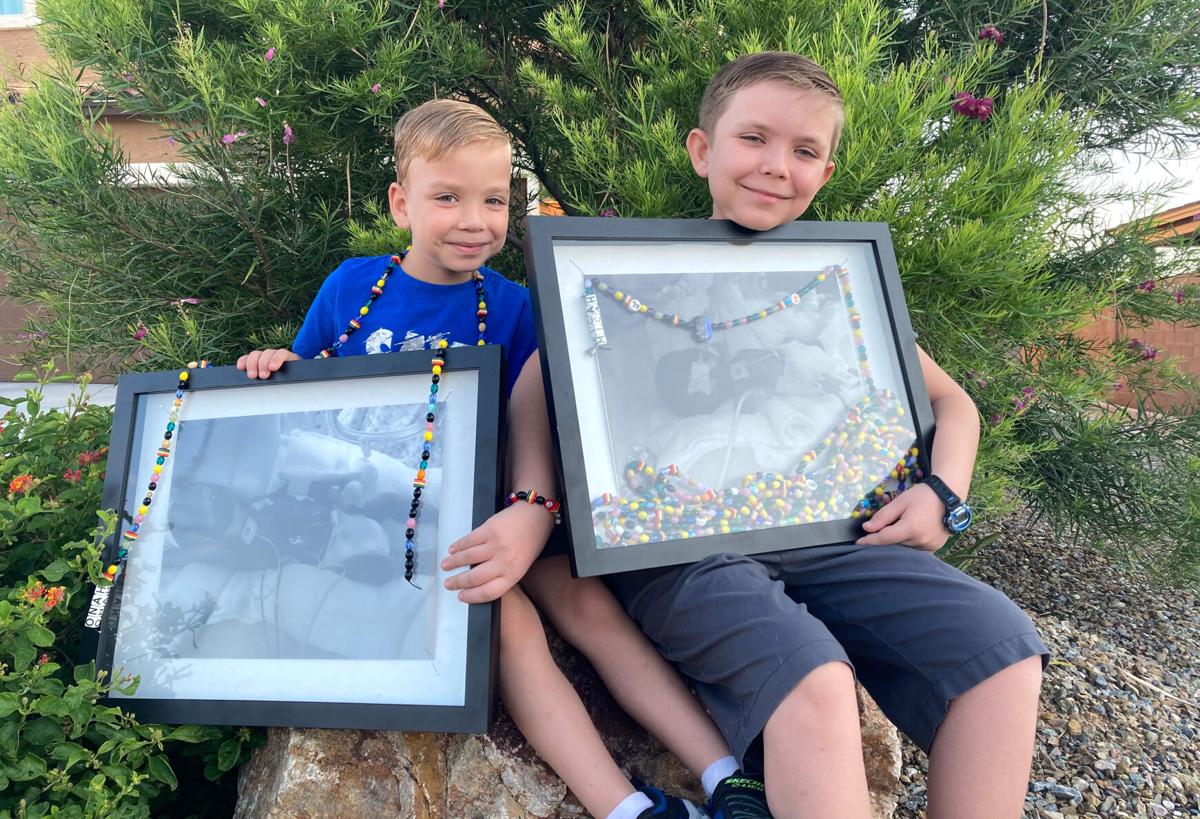
In 2015, Edgington and her husband, Matthew, became parents to twins born 10 weeks early; Jonah and Micah received beads through the BOC NICU Program provided by staff at Tucson Medical Center.
The beads are poignant reminders of the boys early lives, marked by special beads for each night in the hospital, each blood draw and procedure, the first bottle, and other milestones. When strung together, Jonah’s beads are four to five feet long; Micah’s are much longer, weighing in at about 15 pounds.
“We knew the boys were going to be early, but there is so much more to it that you can’t anticipate or understand. Jonah was released at eight weeks old, and Micah was still there. For a long time, the beads were a way for our oldest son, Asher, who was five at the time, to keep track of what his brothers were doing and what they were going through since he couldn’t visit them,” said Edgington.
As time gone by, the beads have become even more meaningful for the entire family, particularly since Micah passed away at six months of age.
“Micah was here for such a short time, and his beads are something tangible that his brothers can see and touch and hold. For Jonah, as he gets older, he sees how much he did and how strong he was and how much he has grown past,” Edgington said.
Edgington said that she can see how valuable BOC programs are to the children who receive services.
“I think about all the children with cancer and other illnesses. When kids are old enough to keep track of their beads on their own, you can imagine how they help them get through procedures. Beads give them something else to think about when they are stuck in the hospital all day and something to show so that people can see and understand how much they have been through,” she said.
Edgington said that BOC Sibling Bead Program also provides a distraction for children who have a sick sibling.
“It is hard for them to see their siblings go through such difficult situations and not to be able to do much. Plus, the sick child gets attention from everyone, and siblings can feel left out and confused and concerned. Asher got his own beads to show how strong he was and how supportive he was of his brothers,” she said.
BOC programs have become even more vital for patients during the COVID pandemic, according to Jean Gribbon, who founded the nonprofit in 2005.
“During COVID, hospitals have continued to shut down all of the outside activities and support for patients, but beads are on the inside. Many child life specialists and therapists haven’t been able to go in to work with patients, but our organization provides beads to the hospitals at no cost — it is all donor funded — so they can support patients,” said Gribbon.
In addition to the 350 programs in 150 hospitals nationwide, the nonprofit has offered virtual programming during the pandemic: The BOC Bead Strong Program provides education on mindfulness and breathwork in conjunction with specific beading activities. More than 600 children, teens and their families have received virtual services through the program this year.
Ultimately, Gribbon credits the growth of the grassroots effort to the many supporters, businesses, foundations and service organizations of all sizes that have embraced the cause.
Among those is the Active 20-30 Club of Tucson (https://www.active20-30.org or call Trevor Cameron at 520-867-1114). A long-time supporter, the club recently made a $5,000 donation after raising funds at the Annual Active 20-30 Convention hosted in Tucson this summer.
That donation qualifies the organization for a sponsored program bead; the club is now recognized as the Helping Hand Bead Sponsor. The bead is not tied to any medical procedure, but signifies general support so patients know that “someone is rooting for them,” according to Kevin Volk, secretary of the Active 20-30 Club of Tucson.
“Our mission at the Active 20-30 Club is specifically about helping people who are helping children. We love the efficiency and scaleability of the Beads of Courage mission, where they have used these small items and imbued them with so much sentiment and value and the benefits are so compelling. It is cool that Tucson is the birthplace of an organization that looks at how to care for kids holistically and is so innovative in making healthcare approachable and affirming for children — and arguably for everyone,” said Volk.

 Jim Click’s Tucson dealerships sell for $93 million