

SPRINGERVILLE - A massive wildfire in Eastern Arizona that has claimed more than 30 homes and cabins and forced nearly 10,000 people to flee was poised to move into New Mexico on Friday, threatening more towns and possibly endangering two major power lines that bring electricity from Arizona to West Texas.
The Wallow Fire has burned 408,887 acres, or 639 square miles of forest. That's an increase of 114 square miles from a day earlier, officials said.
Lighter winds Thursday and Friday helped the 3,000 firefighters on the lines make progress, but critical fire conditions remain, said Jim Whittington, a spokes-man for the teams battling the fire. High winds were expected to return with a vengeance today.
"We have until then to get as much work as we can done and get to the point where we can sit back and watch the winds come," Whittington said.
People are also reading…
Fire crews plan to try to strengthen what lines they've been able to establish and continue burning out forested areas in front of the main fire to try to stop its advance. It was officially just 6 percent contained Friday, but the actual numbers likely are higher, Whittington said.
The advances came on the fire's north side, near the working-class towns of Springerville and Eagar on the edge of the forest. Nearly 10,000 people have been evacuated from the two towns and from several mountain communities in the forest.
"I can't even speculate on when we can let people back in, but I can tell you we're not going to let people back in until we can be sure they will be safe and don't have to leave again," Whittington said.
On Friday, fire officials gave reporters the first look at two of the mountain communities - Alpine and Nutrioso - in nearly two weeks, driving them through the deserted resort towns and surrounding areas.
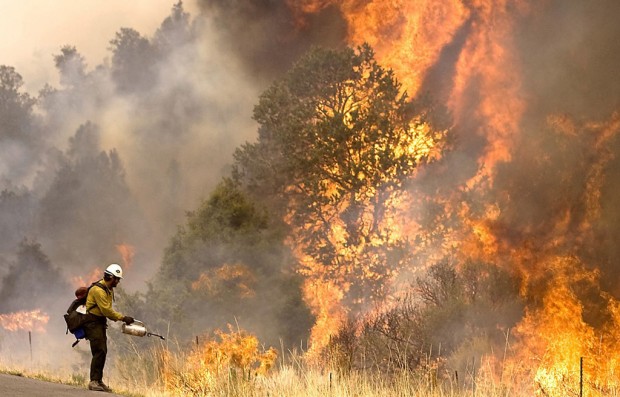
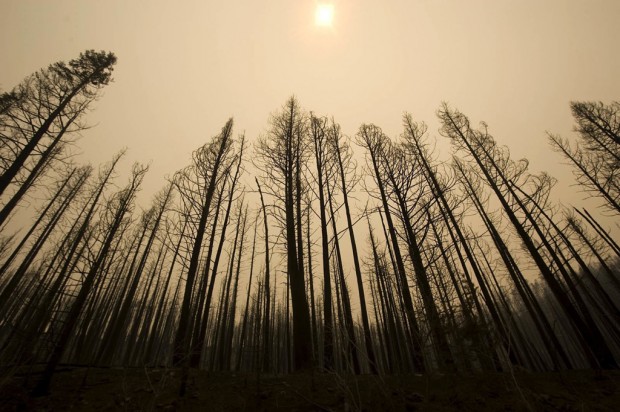
Some stands of trees in the forest were untouched while others looked like blackened matchsticks sticking up through lingering smoke. Firefighters were working in the area, using drip torches to light fires and burn out undergrowth.
Deer and elk grazed in unscorched areas, while wild turkeys walked through tall grass along the road. Two miles south of Alpine, whole hillsides of ponderosa were burned.
The two Arizona-Texas power lines were still in the fire's path, although Whittington said Friday that he was less concerned about them. El Paso Electric has warned its 372,000 customers that they may see rolling blackouts if the lines are cut.
The fire is the second-largest in state history and could eclipse the 2002 Rodeo-Chediski fire in size, although only a fraction of the homes burned in the earlier fire have been lost this time.
The fire, in the Apache-Sit-greaves National Forest, has destroyed 31 homes or cabins, including 22 in the picturesque mountain community of Greer, Whittington said. Two dozen outbuildings and a truck also were lost, and five homes were damaged in Greer when the fire moved in Wednesday night.
A DC-10 tanker made three retardant drops near the community Thursday, and officials hope that by today the threat won't be as great.
Five homes were confirmed destroyed in Alpine and Nutrioso, and fire officials were trying to confirm if two others may have been lost.
Much of the growth toward New Mexico has been from fires started by crews trying to burn out fuels ahead of the blaze so it can be stopped, Whittington said. That technique allows the fires to be controlled and less hot. But there is little doubt it will cross the border, he said.
"This fire is eventually going to get there, so we want something to check it when it does," he said.
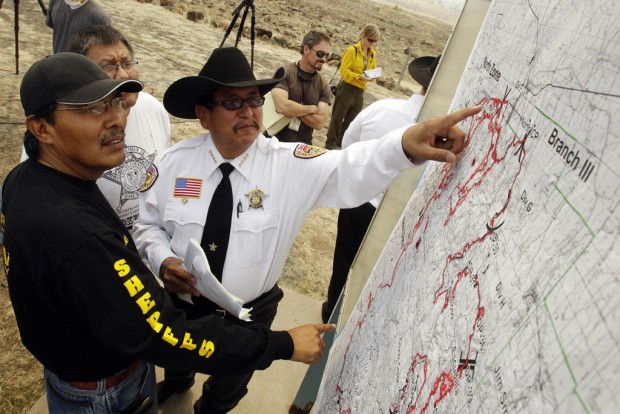
The fire doesn't appear to have moved into New Mexico yet, Catron County Undersheriff Ian Fletcher said. He said fire crews were cutting down trees and burning fuels along U.S. 180 near the Arizona border.
"I'm not sure when we're going to get to the point of it actually getting here," he said at midday Friday. Residents of about 100 homes in a subdivision near the border were still being kept away, and about the 200 residents of Luna were prepared to evacuate.
Both Luna and the county seat of Reserve were being powered by a large generator because of worries that electricity to the area would be cut, Fletcher said.
Deputies have gone to scattered homes in a remote area known as the Blue Range on the state line south of Luna to warn people that they should leave.
"Some have, some haven't," Fletcher said. "You always have some who say they'll be OK, and then they have to scramble and try to get out at the last minute."
Whittington said Friday afternoon the fire may be moving into that area.
Authorities suspect the 408,887-acre blaze, which has been burning since May 29, was sparked by a campfire.
Did You Know
The Wallow Fire, burning through the Apache-Sitgreaves National Forest in Eastern Arizona, is the second-largest fire in Arizona history at 408,887 acres as of Friday.
That's 639 square miles, or more than 2 1/2 times the size of Tucson (230 square miles).
Tucson, though, is mostly flat, and the terrain on the Wallow Fire is pleated with ridges and mountains, multiplying the surface area being burned.
So imagine a fire burning through all of the mountains closest to Tucson.
The Rincon and Santa Catalina Mountains, managed by the Coronado National Forest, contain 265,148 acres.
Saguaro National Park, both east and west, including the wilderness segment in the Rincons, adds 91,440 acres.
Tucson Mountain Park adds another 20,000 acres.
That's a total of 376,588 acres, still 32,000 acres short of the Wallow Fire.
And the Wallow Fire is still growing.
Tom Beal
Tucson blackout called unlikely
The possibility of a blackout in Tucson because of the Wallow Fire in Eastern Arizona is unlikely, Tucson Electric Power officials said Friday.
The power lines closest to the fire near the New Mexico border are about eight miles away, said Joe Salkowski, a TEP spokesman.
There is still a threat and the fire could reach the grasslands near TEP's Springerville Generating Station but even then there are no blackouts expected in the Tucson area, he said.
"We can get enough energy from local power plants to cover the needs without energy received through those transmission lines," Salkowski said. "It would just be like driving with our spare tire; we would just be operating in a more vulnerable position" if something else happened.
Officials have brought additional generation plants online and have begun coordinating with other utilities in preparation for the possible loss of those lines, Salkowski said.
On StarNet: Go to azstarnet.com/gallery for more photos of the Wallow and Horseshoe 2 wildfires. See an interactive fire tracker at azstarnet.com/multimedia


