JERUSALEM — Palestinian militants carried out the deadliest single attack on Israeli forces in Gaza since the Hamas raid that triggered the war, killing 21 soldiers, the military said Tuesday, a significant setback that could add to mounting calls for a cease-fire.
Hours later, the military announced that ground forces encircled the southern city of Khan Younis, Gaza’s second largest, and thick, black smoke could be seen rising over the city as thousands of Palestinians fled south.
Witnesses said Israeli tanks and troops also moved into Muwasi, a nearby coastal area that the military previously declared a safe zone for Palestinians.
Prime Minister Benjamin Netanyahu mourned the Israeli soldiers, who died when the blast from a rocket-propelled grenade triggered explosives they were laying to blow up buildings. He vowed to press ahead toward “absolute victory,” including crushing Hamas and freeing more than 100 Israeli hostages still held by militants.
People are also reading…
Israelis are increasingly questioning whether it’s possible to achieve those war aims.

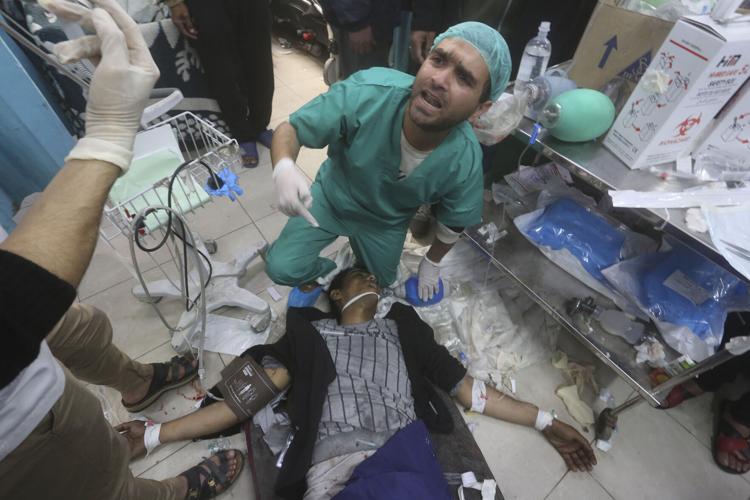
Palestinians wounded during the Israeli air and ground offensive in Khan Younis are brought to a hospital Tuesday in Rafah, Gaza Strip.
In the wake of Hamas’ Oct. 7 attack, outraged Israelis set aside long simmering political differences and rallied behind the war.
More than 100 days later, divisions are re-emerging, and anger is growing over Netanyahu’s conduct of the war. Families of the hostages have called for Israel to reach a deal with Hamas, saying time is running out to bring their relatives home alive.
A senior Egyptian official said Israel has proposed a two-month cease-fire in which the hostages would be freed in exchange for the release of Palestinians imprisoned by Israel and top Hamas leaders in Gaza would be allowed to relocate to other countries.
The official, who spoke on condition of anonymity, said Hamas rejected the proposal and insists no more hostages will be released until Israel ends its offensive and withdraws from Gaza.
Israel’s government declined to comment on the talks.
Egypt and Qatar — which have brokered past agreements between Israel and Hamas — were developing a multistage proposal to try to bridge the gaps, the official said.

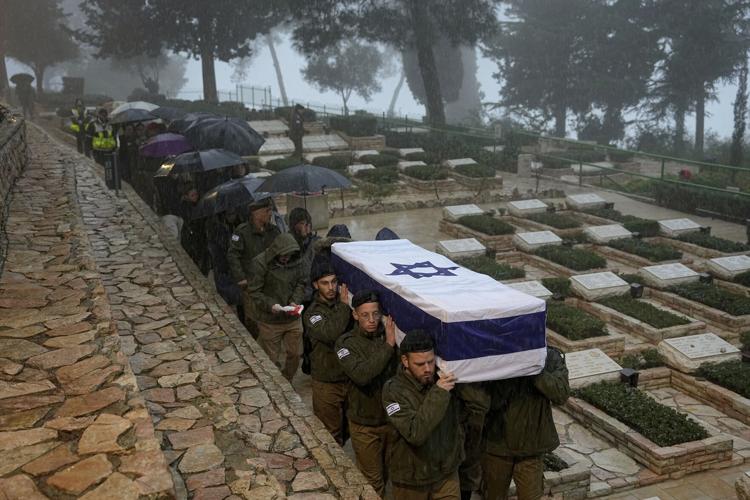
Israeli soldiers carry the flag-draped casket of reservist Elkana Vizel during his funeral Tuesday at Mt. Herzl military cemetery in Jerusalem.
‘One of the hardest days’
Israeli reservists were preparing explosives Monday to demolish two buildings outside central Gaza’s Maghazi refugee camp, near the Israeli border, when a militant fired a rocket-propelled grenade at a tank nearby. The blast triggered the explosives, collapsing both two-story buildings onto the soldiers.
Throughout the war, Israeli troops have used controlled detonations to destroy structures that the military claims hide Hamas tunnels or have been used by militants as firing positions — one reason for the massive destruction wreaked by the ground offensive.
Blasts have destroyed entire city blocks, apartment complexes, government buildings and universities, fueling Palestinians’ fears that the territory will left unlivable.
At least 217 soldiers have been killed since the ground offensive began in late October, including three killed in a separate event Monday, according to the military.
Netanyahu acknowledged on social media that it was “one of the hardest days” of the war but vowed to keep up the offensive.

Palestinians fleeing the Israeli assault in Khan Younis arrive Monday in Rafah, southern Gaza.
“We are in the middle of a war that is more than justified. In this war, we are making big achievements, like the encircling of Khan Younis, and there are also very heavy losses,” he later said in a video statement.
Israel launched its offensive after Hamas crossed the border Oct. 7. The fighting killed more than 1,200 people and militants abducted some 250 others.
The offensive has caused widespread death and destruction, killing at least 25,490 people — the majority women and children — and wounding another 63,354, according to Gaza’s Health Ministry. Its count does not differentiate between civilians and combatants.
An estimated 85% of Gaza’s 2.3 million people have been driven from their homes in a humanitarian crisis that has left one-quarter of the population facing starvation.

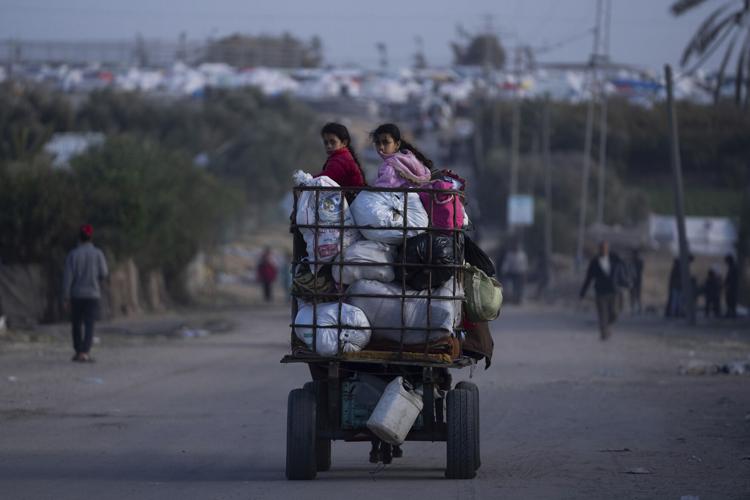
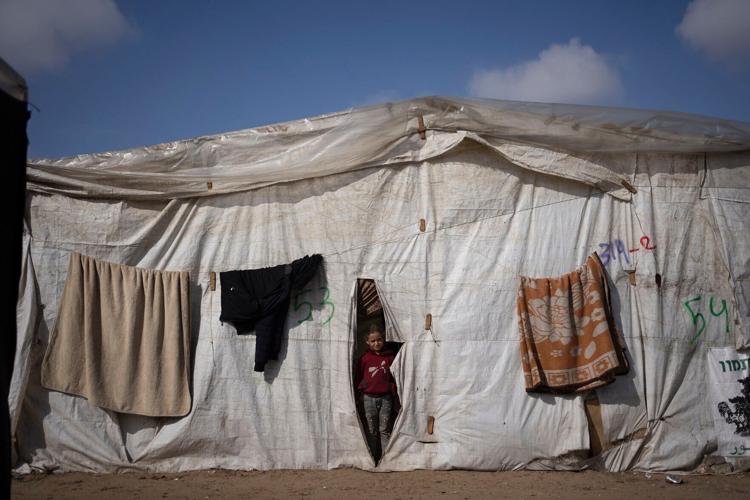
A Palestinian girl displaced by the Israeli ground offensive in the Gaza Strip is seen Tuesday at the makeshift tent camp in Rafah.
Troops in ‘safe zone’
With fighting raging in neighboring Khan Younis city, witnesses said in the past few days Israeli troops and tanks entered parts of Muwasi. Previously, the military told Palestinians to take refuge in the tiny rural area on the Mediterranean coast, saying it would be spared military operations.
On Monday, troops stormed Al-Khair Hospital inside the zone and struck the nearby Al-Aqsa University where displaced people were sheltering, according to health officials.
The advance sent families who fled to the area from fighting elsewhere fleeing once more, said one witness, Aseel al-Muqayed. One main street “had been very crowded with displaced people, you could hardly find a place without a tent. Now the area is almost empty,” she said, adding that she had seen tanks now stationed nearby.
Inside Khan Younis, heavy fighting raged around the two main hospitals. Shelling hit the fourth floor of Al-Amal Hospital, where a shell hit the fourth floor, killing one person and wounding 10 others, according to Raed al-Nems, a spokesperson for the Palestine Red Crescent rescue service, which runs the facility.
Shelling on Monday also hit a U.N. school in the city sheltering displaced people, killing at least six people, according to the U.N. agency for Palestinian refugees.
Today in history: Jan. 23
1932: Franklin D. Roosevelt

In 1932, New York Gov. Franklin D. Roosevelt announced his candidacy for the Democratic presidential nomination.
1962: Jackie Robinson

In 1962, Jackie Robinson was elected to the Baseball Hall of Fame in his first year of eligibility.
1962: Tony Bennett

In 1962, Tony Bennett recorded “I Left My Heart in San Francisco” in New York for Columbia Records.
1968: USS Pueblo

In 1968, North Korea seized the U.S. Navy intelligence ship USS Pueblo, commanded by Lloyd “Pete” Bucher, charging its crew with being on a spying mission; one sailor was killed and 82 were taken prisoner. (Cmdr. Bucher and his crew were released the following December after enduring 11 months of brutal captivity at the hands of the North Koreans.)
1973: Richard Nixon

In 1973, President Richard Nixon announced an accord had been reached to end the Vietnam War, and would be formally signed four days later in Paris.
1977: "Roots"

In 1977, the TV mini-series “Roots,” based on the Alex Haley novel, began airing on ABC.
2002: John Walker Lindh

In 2002, John Walker Lindh, a U.S.-born Taliban fighter, was returned to the United States to face criminal charges that he’d conspired to kill fellow Americans. (Lindh was sentenced to 20 years in prison after pleading guilty to providing support for the Taliban; he was released in May 2019 after serving more than 17 years.)
2020: Coronavirus

In 2020, Chinese state media said the city of Wuhan would be shutting down outbound flights and trains, trying to halt the spread of a new virus that had sickened hundreds of people and killed at least 17. The World Health Organization said the viral illness in China was not yet a global health emergency, though the head of the U.N. health agency added that “it may yet become one.”
2021: Hal Holbrook

One year ago: Hal Holbrook, the actor who toured the world for more than 50 years as Mark Twain in a one-man show and appeared as “Deep Throat” in “All the President’s Men,” died at 95 in California.
2021: Larry King

One year ago: Larry King, known for decades of broadcast interviews with world leaders, movie stars and ordinary Joes, died at a Los Angeles hospital at 87.