WASHINGTON — X, the social media platform formerly known as Twitter, has threatened to sue a group of independent researchers whose research documented an increase in hate speech on the site since it was purchased last year by Elon Musk.
An attorney representing the social media site wrote to the Center for Countering Digital Hate on July 20 threatening legal action over the nonprofit's research into hate speech and content moderation. The letter alleged that CCDH's research publications seem intended “to harm Twitter’s business by driving advertisers away from the platform with incendiary claims.”

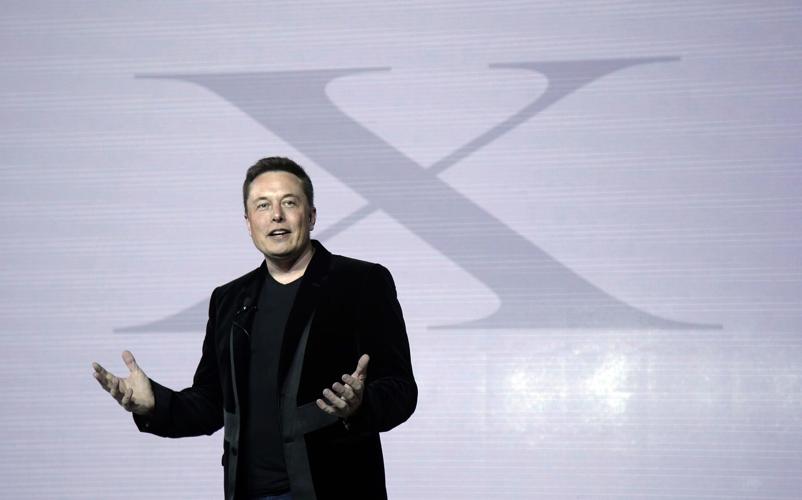
Elon Musk, CEO of Tesla Motors Inc., seen introducing the Model X car Sept. 29, 2015, in Fremont, Calif., has fired back at researchers who documented an increase in hate speech on Twitter since he purchased it.
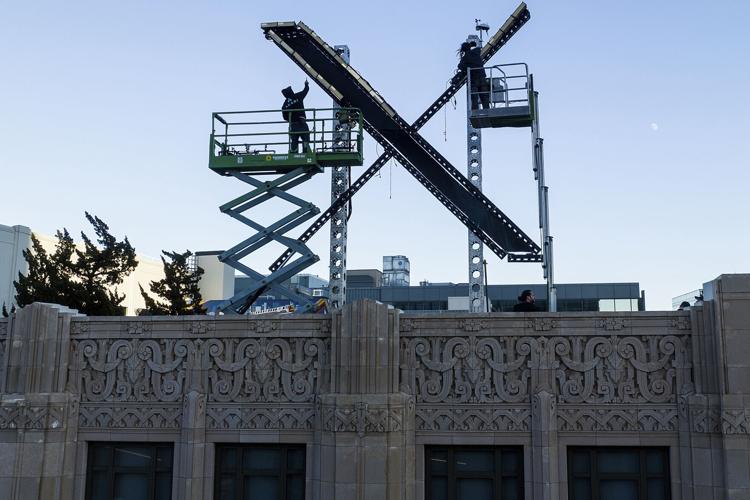
Also Monday, a brightly flashing “X” sign was removed from the San Francisco headquarters of the company formerly known as Twitter just days after it was installed.
The San Francisco Department of Building Inspection said Monday it received 24 complaints about the unpermitted structure over the weekend. Complaints included concerns about its structural safety and illumination. The company removed the Twitter sign and iconic blue bird logo from the building last week. That work was temporarily paused because the company did not have the necessary permits.
People are also reading…
Musk is a self-professed free speech absolutist who has welcomed back white supremacists and election deniers to the platform, which he renamed X earlier this month. But the billionaire has at times proven sensitive about critical speech directed at him or his companies.
The center is a nonprofit with offices in the U.S. and United Kingdom. It regularly publishes reports on hate speech, extremism or harmful behavior on social media platforms like X, TikTok or Facebook.
The organization has published several reports critical of Musk's leadership, detailing an increase in anti-LGBTQ hate speech as well as climate misinformation since his purchase. The letter from X's attorney cited one specific report from June that found the platform failed to remove neo-Nazi and anti-LGBTQ content from verified users that violated the platform’s rules.
In the letter, attorney Alex Spiro questioned the expertise of the researchers and accused the center of trying to harm X's reputation. The letter also suggested, without evidence, that the center received funds from some of X's competitors, even though the center has also published critical reports about TikTok, Facebook and other large platforms.
“CCDH intends to harm Twitter’s business by driving advertisers away from the platform with incendiary claims,” Spiro wrote, using the platform's former name.
Imran Ahmed, the center’s founder and CEO, said Monday that his group has never received a similar response from any tech company, despite a history of studying the relationship between social media, hate speech and extremism. He said that typically, the targets of the center’s criticism have responded by defending their work or promising to address any problems that have been identified.
Ahmed said he worried X’s response to the center’s work could have a chilling effect if it frightens other researchers away from studying the platform. He said he also worried that other industries could take note of the strategy.
“This is an unprecedented escalation by a social media company against independent researchers. Musk has just declared open war,” Ahmed said. “If Musk succeeds in silencing us, other researchers will be next in line.”

Workers install lighting on an "X" sign July 28 atop the downtown San Francisco building that housed what was formally known as Twitter, now rebranded X by owner Elon Musk.
Messages left with Spiro and X were not immediately returned Monday.
It's not the first time that Musk has fired back at critics. Last year, he suspended the accounts of several journalists who covered his takeover of Twitter. Another user was suspended for using publicly available flight data to track Musk's private plane; Musk had initially pledged to keep the user on the platform but later changed his mind, citing his personal safety. He also threatened to sue the user before allowing him back on the platform under certain restrictions.
He initially had promised that he would allow any speech on his platform that wasn't illegal. “I hope that even my worst critics remain on Twitter, because that is what free speech means,” Musk wrote in a tweet last year.
X's recent threat of a lawsuit prompted concern from U.S. Rep. Adam Schiff, D-Calif., who said the billionaire was trying to use the threat of legal action to punish a nonprofit group trying to hold a powerful social media platform accountable.
“Instead of attacking them, he should be attacking the increasingly disturbing content on Twitter,” Schiff said in a statement.
Elon Musk and Twitter: A timeline
January 31: Musk begins building up his Twitter stake

Musk starts quietly buying up Twitter shares, building his stake in the company. But it would be months before he disclosed this fact to the public.
March 14: Musk's Twitter stake tops 5%

Musk's stake in Twitter tops 5%, but that fact is not disclosed until the following month. Musk was obligated to disclose his stake within 10 days of crossing the 5% threshold, but waited 21 days to do so. During that time, he continued building up his stake.
March 24: Asking whether Twitter should change

The billionaire begins to make pointed statements about the platform from his account. "Twitter algorithm should be open source," he wrote, with a poll for users to vote "yes" or "no."
The following day, Musk tweets out another poll to his followers: "Free speech is essential to a functioning democracy. Do you believe Twitter rigorously adheres to this principle?"
March 26: Musk reaches out to Jack Dorsey

Musk reaches out to Twitter cofounder and former CEO Jack Dorsey to "discuss the future direction of social media," according to a company filing later put out by the company. The two tech founders are known to have a bit of a billionaire bromance on and off Twitter.
April 3: Twitter leadership meets to discuss Musk

Twitter's board and some of its leadership team meet with representatives from Wilson Sonsini, a law firm, and J.P. Morgan to discuss the possibility of Musk joining the company's board, according a later securities filing. Dorsey is said to have told the board that "he and Mr. Musk were friends," according to the filing.
In the meeting, the Twitter board discussed wanting Musk to agree to "'standstill' provisions"," according to the filing. This would effectively "limit his public statements regarding Twitter, including the making of unsolicited public proposals to acquire Twitter (but not private proposals) without the prior consent of the Twitter Board."
April 4: Surprise! Musk becomes Twitter's largest shareholder

Musk is revealed to be Twitter's largest individual shareholder, with a more than 9% stake in the company.
News of the purchase sends shares of the social media company soaring more than 20% in early trading and kicks off a wave of speculation about how Musk might push for changes on the platform.
April 5: Musk agrees to join the board

Twitter CEO Parag Agrawal announces Musk will join Twitter's board of directors. "Through conversations with Elon in recent weeks, it became clear to us that he would bring great value to our Board," Agrawal says in a post on Twitter.
As part of the appointment, Musk agrees not to acquire more than 14.9% of the company's shares while he remains on the board. His term on the board is set to go through 2024, according to a regulatory filing.
April 10: Just kidding. Musk ditches the board

Agrawal announces that Musk has decided not to join the board after all. "I believe this is for the best," Agrawal writes in a letter to the Twitter team.
The reversal opens the door for Musk to pursue a greater stake in the company -- and frees him to tweet his many thoughts about the company.
April 14: Musk offers to buy Twitter and 'unlock' its potential

Musk stuns the industry by making an offer to acquire all the shares in Twitter he does not own at a valuation of $41.4 billion. The cash offer represents a 38% premium over the company's closing price on April 1, the last trading day before Musk disclosed that he had become the company's biggest shareholder.
"I invested in Twitter as I believe in its potential to be the platform for free speech around the globe, and I believe free speech is a societal imperative for a functioning democracy. However, since making my investment I now realize the company will neither thrive nor serve this societal imperative in its current form. Twitter needs to be transformed as a private company," Musk writes in his offer letter. "Twitter has extraordinary potential. I will unlock it."
April 15: The poison pill

Twitter's board of directors adopts a "poison pill" provision, a limited-term shareholder rights plan that potentially makes it harder for Musk to acquire the company.
April 21: Musk lines up $46.5 billion in financing

Musk lines up $46.5 billion in financing for the deal, including two debt commitment letters from Morgan Stanley and other unnamed financial institutions and one equity commitment letter from himself, according to a regulatory filing.
The billionaire also reveals that he has not received a formal response from Twitter a week after his acquisition offer. He said he is "seeking to negotiate" a definite acquisition agreement and "is prepared to begin such negotiations immediately" — an apparent reversal from his statement in his acquisition offer letter that it would be his "best and final" offer.
Although he is the richest person in the world, much of Musk's wealth is tied up in Tesla stock, and some followers of the company speculate that it could be challenging for Musk to raise debt against the historically volatile stock.
April 25: Twitter agrees to sell itself to Elon Musk

Twitter announces that it has agreed to sell itself to Musk in a deal valued at around $44 billion. At a conference later in the day, Musk describes his offer to buy Twitter in characteristically sweeping terms as being about "the future of civilization," not just making money.
At an all-hands meeting that afternoon, Twitter employees raise questions about everything from what the deal would mean for their compensation to whether former US President Donald Trump would be let back on the platform.
April 29: Musk cashes out billions in Tesla stock

Filings reveal Musk sold $8.5 billion of his Tesla stock in the three days after Twitter board agreed to the sale for an average of $883.09 per share. The filings did not disclose the reason for the sale, but Musk appeared to be raising funds to buy Twitter.
May 4: With a little help from his billionaire friends

Musk raises another $7 billion in financing for the deal. The new investors include Oracle founder Larry Ellison, cryptocurrency platform Binance and venture capital firm Sequoia Capital, according to a filing.
May 10: Musk says he would reinstate Trump's account

Musk confirms what many have assumed for weeks: he would reverse Twitter's Trump ban if his deal to buy the company is completed.
"I do think it was not correct to ban Donald Trump, I think that was a mistake," Musk said. "I would reverse the perma-ban. ... Banning Trump from Twitter didn't end Trump's voice, it will amplify it among the right and this is why it's morally wrong and flat out stupid."
May 6: Musk's lofty goals for Twitter, revealed

Musk aims to increase Twitter's annual revenue to $26.4 billion by 2028, up from $5 billion last year, according to a New York Times report, citing Musk's pitch deck presented to investors. To achieve that lofty goal, Musk intends to bolster Twitter's subscription revenue and build up a payments business while decreasing the company's reliance on advertising sales, according to the report.
May 12: A partial hiring freeze and executive departures

Twitter confirms to CNN Business that the platform is pausing most hiring and backfills, except for "business critical" roles, and pulling back on other non-labor costs ahead of the acquisition. In addition, Twitter says general manager of consumer, Kayvon Beykpour, and revenue product lead, Bruce Falck, are leaving the company.
May 13: Twitter deal 'temporarily on hold'

Musk tweets that the deal is on hold, linking to a Reuters report from nearly two weeks earlier, about Twitter's most recent disclosure about its amount of spam and fake accounts. The figure cited in the report, however, is in line with prior quarterly disclosures.
"Twitter deal temporarily on hold pending details supporting calculation that spam/fake accounts do indeed represent less than 5% of users," Musk tweeted.
Shares of the social media site plummet after Musk's announcement, dropping more than 10% at market open. Two hours after announcing the hold, Musk says he remains set on purchasing Twitter. "Still committed to acquisition," he wrote.
Later in the day, Musk says his team is testing Twitter's numbers and "picked 100 as the sample size number, because that is what Twitter uses to calculate <5% fake/spam/duplicate."
May 14: Oops. NDA problems?

Musk tweets out that Twitter's legal team accused him of breaking a nondisclosure agreement when the billionaire revealed the platform's sample size for automated user checks is allegedly just 100 users.
"Twitter legal just called to complain that I violated their NDA by revealing the bot check sample size is 100! This actually happened," wrote Musk.
May 16: Poop emoji

The standoff over bot accounts continues as Musk exchanges a series of tweets with Agrawal over the issue. After Agrawal carefully explains how Twitter attempts to combat and measure spam accounts, Musk responds with a poop emoji.
Musk follows up with a somewhat more thoughtful question. "So how do advertisers know what they're getting for their money?" Musk asked. "This is fundamental to the financial health of Twitter," he added.
May 17: Musk says Twitter deal 'cannot move forward.' Twitter disagrees

Musk announces that his acquisition of Twitter "cannot move forward" until he sees more information about the prevalence of spam accounts, claiming that the social media platform falsified numbers in filings. Without citing a source, he claims in a tweet that Twitter is "20% fake/spam accounts" and suggests Twitter's previous filings with the SEC were misleading.
Later in the day, Musk posts a poll to his Twitter followers: "Twitter claims that >95% of daily active users are real, unique humans. Does anyone have that experience?" before calling on the SEC to evaluate the platform's numbers. "Hello @SECGov, anyone home?" Musk tweets, in an apparent attempt to get the regulator to look into the matter.
In a statement, Twitter says it remains "committed to completing the transaction on the agreed price and terms as promptly as practicable." Later, the company says it intends to "enforce the merger agreement."