DUBAI — The whereabouts of Mojtaba Khamenei have been a mystery to Iranians and the rest of the world alike since his appointment as supreme leader a week after the strike that killed his father at the end of February.
His absence from the main funeral ceremonies for former leader Ayatollah Ali Khamenei left people to guess at his plans for Iran at a turbulent time in the Islamic Republic's 47-year history.
Installed with the backing of the powerful Revolutionary Guard, he suffered facial disfigurement and other injuries in the strike, senior sources say. They say he has been making decisions but has not yet been well enough to appear in public.
Now, after hostilities with the U.S. reignited this past week, his role and health are of critical — and growing — concern.
"I understand that, from a security standpoint, he should not appear in public. But the country is going through a very difficult time," said Taghi, 47, a shop owner in Isfahan who asked not to give his family name. "There is a need for the Supreme Leader to be seen. Even if he has been injured, people need to see that there is a leader and that he is running the country."
People are also reading…

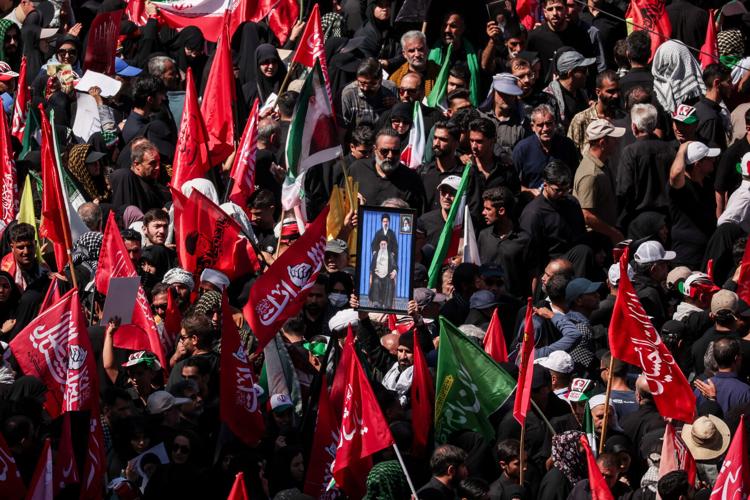
A man raises a picture featuring Iran's Supreme Leader Mojtaba Khamenei and Iran’s late Supreme Leader Ayatollah Ali Khamenei, as mourners gather on the day of the burial of Ayatollah Ali Khamenei in Mashhad, Iran, July 9.
Other relatives represent ruling family
The choreography of Thursday's burial, with prayers for the late Khamenei conducted over his coffin by his three other sons at Iran's holiest shrine, underscored the central place of family relationships among the Islamic Republic's leadership.
Mojtaba Khamenei's three brothers are not seen as significant political players in Iran — or likely to become so — though they have all become senior clerics.
Senior sources in Iran attributed the lack of any new image or voice recording since his March 8 appointment by a clerical assembly to health and security considerations.
The security risks are substantial given the assassination of his father in the very first U.S. and Israeli strikes of an unannounced war launched in the midst of diplomatic efforts to resolve the countries' disputes with Iran.
As a political, strategic, religious and revolutionary figurehead bearing ultimate authority in Iran, he may need to appear more physically capable than his recuperation yet allows.
The last official word on his condition came from President Masoud Pezeshkian, who said in May that he met the leader and his condition was improving.
While the Revolutionary Guard appears to hold a tight rein over the country for now, it is not clear how long the leader of a theocratic state can remain out of sight.
"How do you have a charismatic succession when the successor isn't there? It's going to be a problem for them even if they ride it out for the time being. It's not sustainable in the long run," said Ali Ansari, modern history professor at St Andrews University in Scotland.

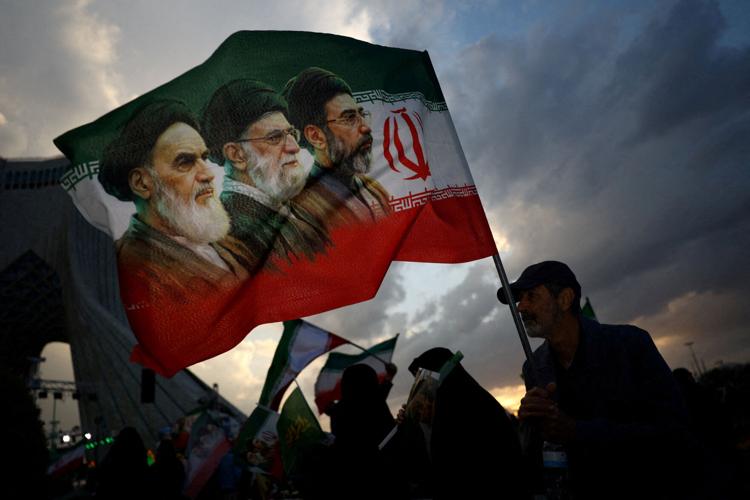
A man holds a flag with a picture of late leader of the Islamic Revolution Ayatollah Ruhollah Khomeini, late Supreme Leader of Iran Ayatollah Ali Khamenei and Iran's new Supreme Leader Mojtaba Khamenei, during a rally in Tehran, Iran, April 29.
New leader built close ties with Revolutionary Guard
His absence is starting to nag at Iranians, with more than 20 of those Reuters contacted in recent weeks voicing concern about it in conversations about Iranian politics.
"The supreme leader's absence, now that the war is over, will lead to growing uncertainty and disorder in the country, especially after the burial of the late leader," said Mohammadreza, 51, a teacher in Tehran.
The role of supreme leader is unlike that of most other heads of state, with Iran's official ideology recognizing its officeholder as the representative on earth for Shi'ite Islam's 12th imam who disappeared in the ninth century.
It is not clear what Mojtaba Khamenei will make of it. The first leader, Ayatollah Ruhollah Khomeini, was the charismatic father of the revolution and Iran's most venerable religious scholar, a man whose untouchable standing and fierce mien inspired unquestioning obedience.
His successor, Ali Khamenei, was president when he was appointed leader but was never seen as an especially senior religious figure and initially lacked the authority of Khomeini.
However, during his 37 years as leader he outmaneuvered rivals and, with the close aid of the Revolutionary Guard, imposed his absolute writ on almost every aspect of the country's political life.
Mojtaba Khamenei also lacks religious credentials and, unlike his father, was not a powerful political figure in his own right. Instead he ran his father's sprawling office and its web of contacts across the country and built close ties with the Revolutionary Guard.
His opinions, authority and capability remain a blank slate, though it seems likely the Revolutionary Guard will remain central to the way he rules.
With Iran still mired in the conflict despite the on-off truce, with its economy still throttled by sanctions, and with further bouts of mass unrest like the one violently suppressed in January, the country's leader remains a cipher.