As the Trump administration’s January deadline looms for states to enforce new Medicaid work requirements, some state lawmakers seek to publicly name the largest companies that have employees enrolled in the government program covering low-income and disabled people.
California lawmakers seek to revive an expired law that would require the state to identify companies that employ 100 or more people and have employees enrolled in Medi-Cal, the state’s Medicaid program. Nevada has had a similar law in place since 2017; a proposal for one in Oregon stalled.
The California bill author, Democratic state Sen. Lola Smallwood-Cuevas, said she is deeply troubled by what will happen when work requirements kick in. According to the state, almost 5 million out of more than 14 million residents on Medi-Cal will be subject to the rule.
“We think this is a bill that’s about fairness,” she said. “It’s a basic principle that taxpayers deserve transparency about which large employers are shifting their healthcare costs onto the public.”
People are also reading…
Large employers that top Nevada’s list, such as Walmart and Amazon, said the state included part-time and seasonal workers in their counts and their full-time hourly employees make too much to qualify for Medicaid.
Walmart spokesperson Katrina Proffitt said the company offers affordable medical coverage to most employees, including eligible part-time workers, and most of its plans include no-cost virtual care options.
“Healthcare affordability and access to quality care remain real barriers for many Americans, and Walmart continues to be committed to being part of the solution,” Proffitt said.
The push to name and shame companies reflects dueling narratives about the biggest abusers of the joint state-federal Medicaid program, which reached almost $932 billion in government spending in 2024. The Trump administration, led by Centers for Medicare & Medicaid Services Administrator Mehmet Oz, called out blue states for not doing enough to fight insurer fraud and abuse.

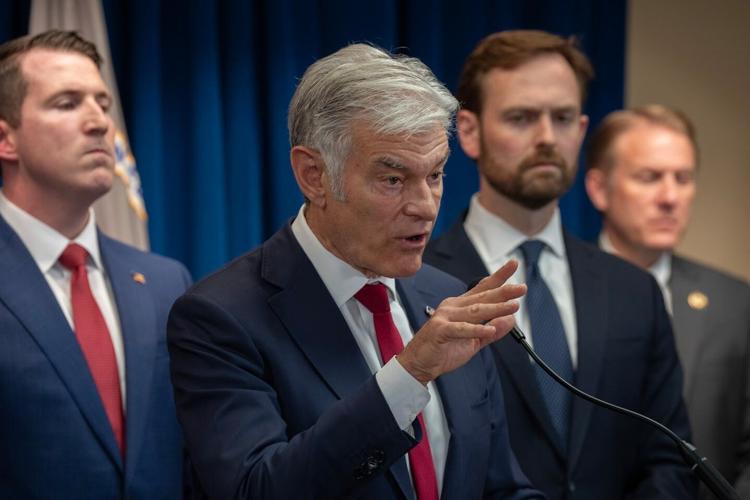
Centers for Medicare and Medicaid Services Administrator Dr. Mehmet Oz speaks May 21 at a news conference in Minneapolis.
State Democratic leaders, meanwhile, called attention to big employers that don’t offer affordable health benefits, which leaves taxpayers subsidizing healthcare costs for the low-wage workforce.
Some states considered financial penalties.
Democratic New Jersey Gov. Mikie Sherrill signed a bill in June to fine businesses that have at least 50 Medicaid-enrolled employees. Companies with 50 to 249 workers on Medicaid will pay $325 a year per person, and those with at least 500 will pay $725. Similar bills failed in Washington state and Colorado this year.
In California, Democrats want to figure out a way to make large businesses pay for their employees’ health coverage. State lawmakers struck a deal with Democratic Gov. Gavin Newsom to explore tax options.
States face losing billions of dollars under the GOP tax cuts and spending law known as the One Big Beautiful Bill Act, notably through a provision that requires nondisabled Medicaid enrollees ages 19 to 64 in most states to prove they work, volunteer or go to school at least 80 hours a month to keep their coverage.
Federal work requirements are projected to increase the number of uninsured people nationwide by more than 5 million by 2034, according to the Congressional Budget Office.
Edwin Park, a health policy research professor at the Center for Children and Families at Georgetown University, said employer Medicaid reports highlight the lack of affordable healthcare options available to low-wage workers.
“There’s a whole set of people who are working — they may not satisfy the work requirement provisions, they may not get the exemption that they’re qualified for, and they don’t have access to that employer-sponsored insurance either,” he said.
More than half of adults enrolled in Medicaid who don’t have dependent children already meet the new requirements or likely would qualify for an exemption, according to KFF.

People approach a Walmart in Pico Rivera, Calif.
Employers push back
While employer lists haven’t succeeded in bringing down Medicaid costs, supporters say measuring the burden can be the first step and help lawmakers make the case for further action.
In Nevada, Amazon employed more Medicaid enrollees than any other company since 2020, according to the state’s report published in January. For state fiscal year 2025, Walmart, the Clark County School District, the state government and Tesla rounded out the top five.
Employers argued that the reports are misleading because they included part-time and seasonal employees. The state’s latest report includes only full-time employees, plus those who could not be confirmed as either full- or part-time employees.
That came to 4,914 Amazon employees and 3,503 Walmart workers in Nevada on Medicaid in 2025.
There are no penalties for companies on the list.
Amazon said it pays its workers more than double the $7.25-an-hour federal minimum wage and noted Medicaid eligibility is based on household income and size rather than an individual’s wage. That means two employees who earn the same pay may have different eligibility depending on whether they have children or live with parents.
“Pointing fingers at Amazon over Medicaid is a red herring,” spokesperson Alisa Carroll said. “What really needs to happen is a significant and large increase in the federal minimum wage — that would be a big boost for American families.”

Nevada Medicaid spent almost $950 million on healthcare for more than 133,000 full-time employees and more than 140,000 of their dependents. While the total amount spent dipped in fiscal year 2025, the average cost per member per year increased by nearly 17%.
Yvanna Cancela, a former Nevada lawmaker who sponsored the legislation on Medicaid work reports, said the annual reports force an important conversation “about whether or not this is the kind of economy we want and whether or not it is right or just that people who work full-time don’t make enough to have health insurance.”
Health researchers say uninsured people delay or skip using healthcare and their children may lose coverage, too. One analysis found more than 2 million fewer children were enrolled in Medicaid and the Children’s Health Insurance Program this April than in January 2025.
KFF Health News is a national newsroom that produces in-depth journalism about health issues and is one of the core operating programs of KFF — the independent source for health policy research, polling and journalism.