WASHINGTON — The U.S. military carried out new strikes in Iran targeting a military site that officials believed posed a threat to U.S. forces and commercial maritime traffic in the Strait of Hormuz, a U.S. official told Reuters on Wednesday.
The official, who spoke on condition of anonymity, said the U.S. military also intercepted and shot down multiple Iranian drones that posed a similar threat.
Also on Wednesday, President Donald Trump dismissed an Iranian state television report of a framework deal to restore shipping through the Strait of Hormuz within a month and to lift a U.S. naval blockade on Iranian ships.
Trump told a Cabinet meeting that Iran remained keen to end the war, which choked global energy supplies through the strategic waterway, but that the terms did not satisfy Washington.
"Iran is very much intent, they want very much to make a deal. So far they haven't gotten there … We're not satisfied with it, but we will be. Either that or we'll have to just finish the job," he said, without elaborating.
People are also reading…

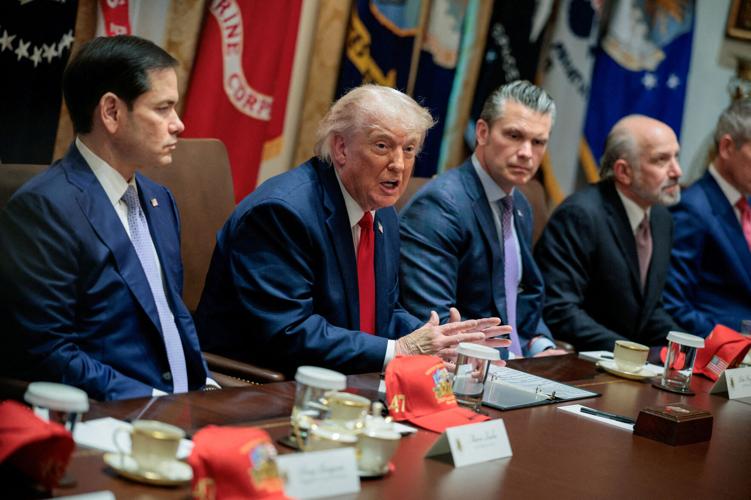
President Donald Trump speaks Wednesday next to, from left, Secretary of State Marco Rubio, Defense Secretary Pete Hegseth and Commerce Secretary Howard Lutnick during a Cabinet meeting at the White House in Washington.
"The deal has got to be perfect," he later added, insisting that the Strait of Hormuz would be open immediately after a deal is reached and that no single country would have control over the waterway.
Iranian state TV reported that it obtained an unofficial draft of a memorandum of understanding under which the U.S. would lift its blockade and withdraw its forces from Iran's vicinity. It said the issue of U.S. troops in the region needed further discussion, without elaborating.
It didn't mention Iran's nuclear program, which the U.S. wants disbanded.
In a statement on social media, the White House dismissed the report as a "complete fabrication," while Tehran did not comment. Publicly, the two sides previously have outlined positions starkly at odds.
U.S. Secretary of State Marco Rubio told the Cabinet meeting: "There's been some progress and some interest, and we'll see over the next few hours and days whether progress could be made."
"The bottom line is Iran's never going to have a nuclear weapon," he added.
In 2018, during his first term as president, Trump withdrew from a 2015 international agreement designed to deny Tehran the ability to build nuclear weapons.

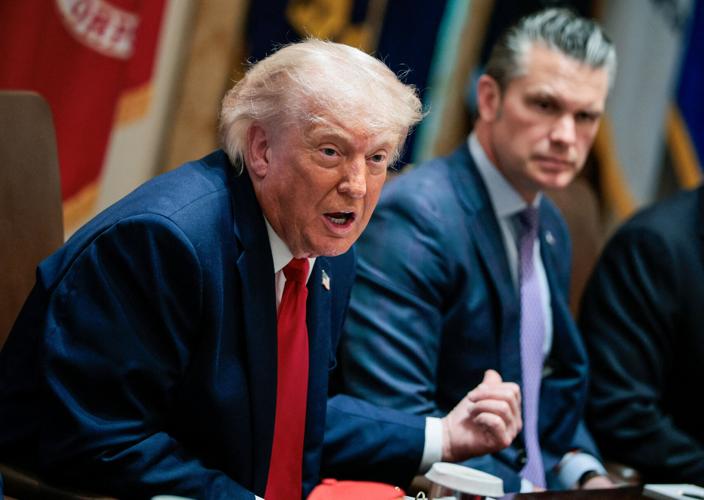
President Donald Trump speaks Wednesday next to Defense Secretary Pete Hegseth during a Cabinet meeting at the White House in Washington.
Political pressure
Trump said he's unconcerned about the domestic political fallout of an extended conflict with Iran, and that Iranian leaders miscalculated if they thought the November midterm elections would force him into a deal.
"They thought they were going to outwait me," Trump said, referring to Iran's leadership. "You know, 'We'll outwait him. He's got the midterms.' I don't care about the midterms."
Still, many of his Republican allies are uneasy with his earlier dismissive comments about the economic effect of the war on Americans.
The president initially said the war would last four to six weeks, and it is now approaching its fourth month. At times, he suggested the conflict could end within days only to later suggest that the conflict could go on for some time.
Growing voter disquiet about high prices, especially for gasoline, has added to political pressure on Trump’s Republican Party, which is widely expected to struggle to keep control of the House of Representatives and possibly the Senate.
That disquiet was amplified by Trump's decision to endorse Ken Paxton, a scandal-plagued primary challenger, over incumbent Republican Senator John Cornyn of Texas.
Paxton, who was indicted for felony fraud and is being divorced by his wife on biblical grounds, handily beat Cornyn in a Tuesday party primary after securing the president's endorsement. Democrats now view the Senate seat in the solidly Republican state as competitive in November.
"Look at what happened last night," Trump said, referring to Paxton's win. "That was a prelude to the midterms."

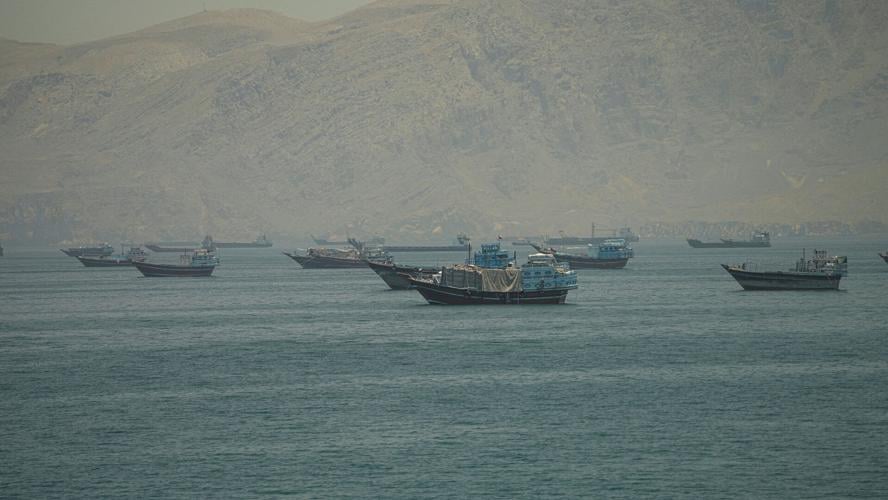
Vessels are anchored Monday at the Strait of Hormuz, seen from Musandam, Oman.
Controlling the strait
Key sticking points in the talks included reopening and management of the Strait of Hormuz waterway, through which a fifth of the world's oil and liquefied natural gas flowed before the conflict, and the issue of the dismantling of Iran's nuclear capacity.
Trump said no single country would have control over the waterway, and appeared to threaten Oman, a country with which the United States has decades-long military and economic ties.
"Nobody's going to control (the strait)," Trump said at a cabinet meeting attended by reporters. "It's international waters and Oman will behave just like everybody else or we'll have to blow them up. They understand that, they'll be fine."
The White House and Oman's embassy in Washington did not immediately respond to a request for comment.
The U.S. military has about 15,000 troops enforcing a blockade of Iran and has thousands of additional forces at bases throughout the region, including in Gulf states like Qatar, the United Arab Emirates and Bahrain.

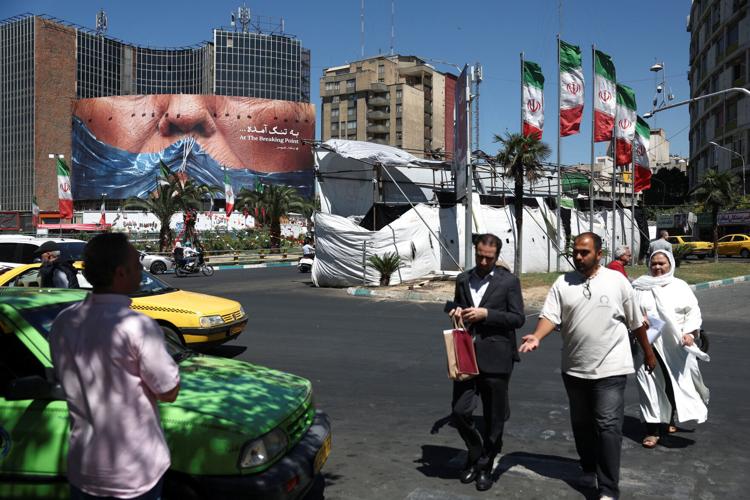
People walk past an anti-U.S. billboard depicting U.S. President Donald Trump and the Strait of Hormuz on Tuesday in Tehran, Iran.
Nuclear issue
Iranian sources have said talks on the nuclear issue will come in a second round of negotiations — something that might not be acceptable to some of Trump's closest supporters. Iran says its nuclear program is for peaceful purposes.
Earlier on Wednesday, a senior Iranian official told reporters on the sidelines of the first International Security Forum in Moscow that reopening the Strait of Hormuz remained a sticking point.
“As long as we have not agreed on all issues, we consider that nothing has been agreed,” said Iran’s deputy secretary of the Supreme National Security Council, Ali Bagheri Kani.
Iran's Islamic Revolutionary Guards Navy said Wednesday that 23 ships including oil tankers, container ships and other commercial vessels passed through Hormuz with its permission in the previous 24 hours, a fraction of the daily 125 to 140 vessels passing through before the conflict.