WASHINGTON — Senate Republicans grappled with the fate of President Donald Trump's sidelined $1.8 billion "anti-weaponization" fund Thursday, barely defeating a Democratic effort to permanently kill the fund and derail a $70 billion bill to pay for Trump's immigration crackdown.
Lawmakers began voting on amendments to the immigration bill in a vote-heavy session that was expected to end in a vote on the underlying measure later in the day.
An initial motion by Senate Democratic leader Chuck Schumer to kill what Democrats call a "slush fund" for Trump's allies quickly brought the session to a largely procedural halt for hours after Republican Sen. Susan Collins voted for the motion.

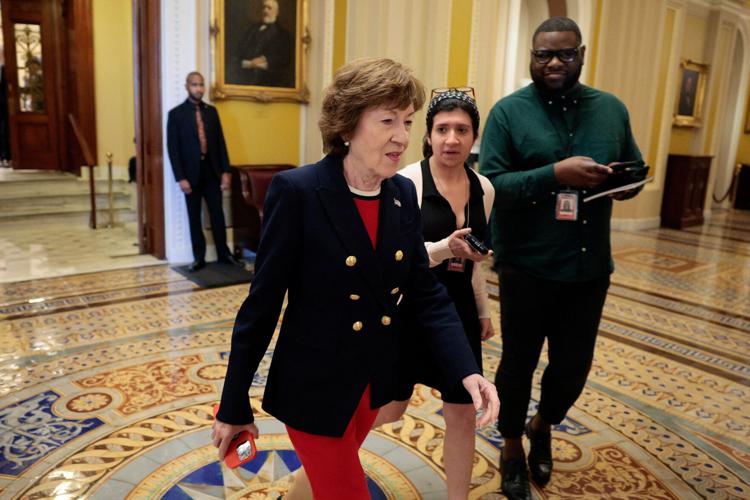
U.S. Sen. Susan Collins, R-Maine, walks Thursday on Capitol Hill in Washington.
She was later joined by fellow Republicans Jon Husted and Dan Sullivan.
"It's heinous and it won't die until we permanently ban it by law," Schumer said of the fund in a Senate floor speech.
People are also reading…
His measure failed in a 50-49 vote but exposed the political turmoil in the Senate Republican conference, where some lawmakers sought their own amendments to eliminate the fund permanently, five months before the November midterm elections.
Collins, Husted and Sullivan all face competitive races for reelection at a time when Trump's approval rating is down, even among Republicans.

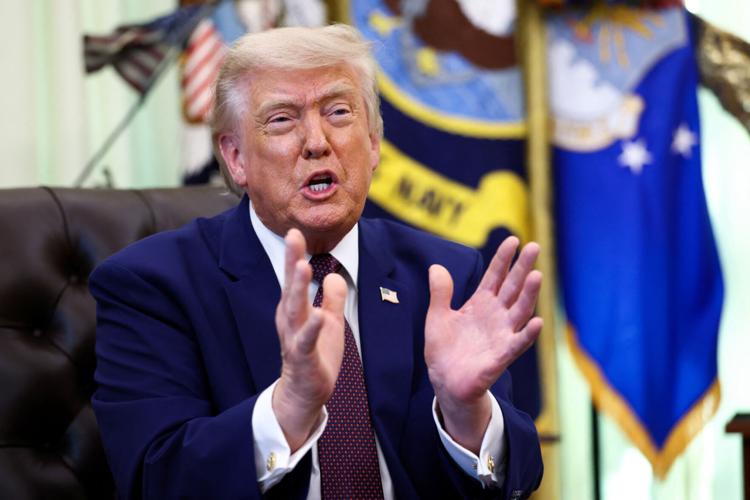
President Donald Trump speaks to reporters Wednesday after signing an executive order at the Oval Office of the White House in Washington.
Trump wants fund
The White House and Justice Department claim they shelved the fund, which critics say would allow Trump to use taxpayer dollars to compensate his political allies, over opposition from Senate Republicans.
But on Wednesday, Trump declined to say whether the fund was actually terminated, telling reporters: "I love it. I think it's so important."
Republican Sen. Thom Tillis, who opposed Schumer's motion, told reporters he would not support passage of the ICE funding bill without a Republican amendment vote to codify Acting Attorney General Todd Blanche's congressional testimony that the administration will abandon the fund.

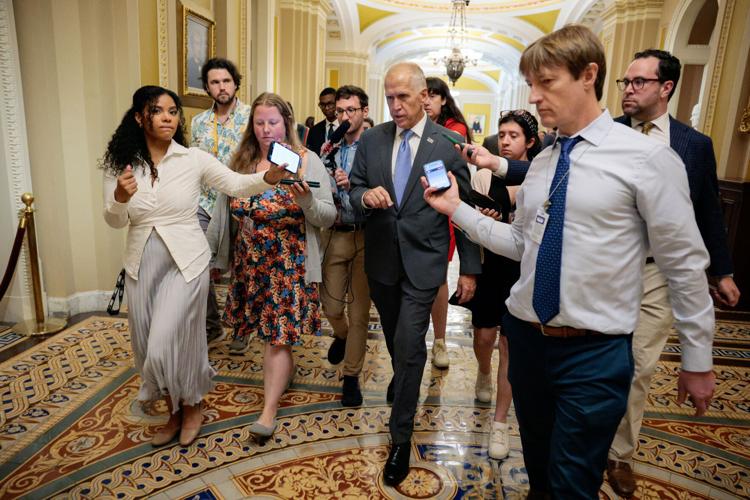
U.S. Sen. Thom Tillis, R-N.C., walks with members of the media Thursday on Capitol Hill in Washington.
"Why not use this moment to codify that?" Tillis told reporters. "Otherwise, you're exposing every one of our members who are in (an election) cycle to having to deal with this between today and Election Day, and that makes no sense for something that the DOJ says they're not moving forward on."
Tillis later offered his own amendment to reallocate the Trump fund's resources to fraud enforcement operations. It failed in an 84-15 vote while garnering support from 12 Republicans.
Republican Sen. Bill Cassidy, who proposed his own amendment to end the fund, also joined Democratic Sen. Cory Booker in an amicus brief urging U.S. District Judge Leonie Brinkema to maintain the block on Trump's fund that she imposed last week.
They argued the fund "presents an immediate and dire threat to our constitutional order and the authority of Congress."

U.S. Sen. Bill Cassidy, R-La., walks Thursday on Capitol Hill in Washington.
Sen. Rand Paul expressed concern that a successful amendment to kill the fund could violate fast-track Senate rules under which Republicans are trying to circumvent Democratic opposition and pass the underlying legislation to fund U.S. Immigration and Customs Enforcement and Border Patrol through fiscal year 2029.
The legislation must also pass the House before Trump can sign it into law, and Paul said there is concern that some House Republicans could oppose the measure if it contains language to kill Trump's fund.

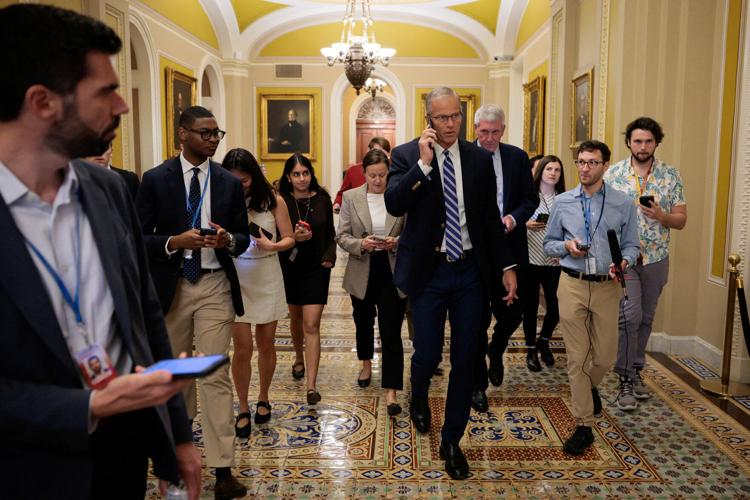
U.S. Senate Majority Leader John Thune, R-S.D., uses a phone Thursday on Capitol Hill in Washington.
November elections
A number of recent actions by Trump prompted open criticism from some Republicans, from seeking $1 billion in taxpayer funding for a White House ballroom and security upgrades to his decision to nominate Blanche as attorney general and name political ally Bill Pulte as U.S. intelligence chief.
Cassidy, who lost his primary last month to two Trump-aligned challengers in Louisiana, proposed a series of amendments, including one to nullify an agreement with the Internal Revenue Service protecting Trump from tax audits.
Schumer's motion was the first in a slew of expected Democratic amendments aimed at sowing division among Republicans over issues including the audit ban, the Iran war, Trump's tariffs and immigration enforcement actions including the killings of two U.S. citizens this year.
Democrats hope their legislative onslaught will hurt Republicans in the November elections, in which Democrats are favored to take control of the House of Representatives and also have a shot at capturing the Senate.