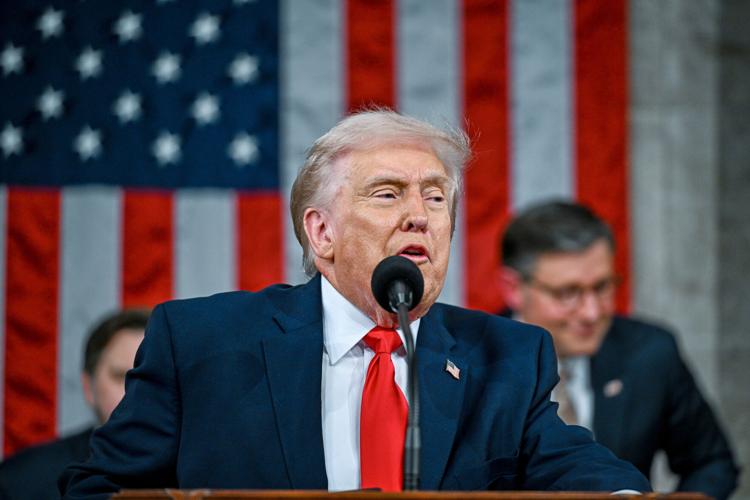

President Donald Trump delivers the State of the Union address to a joint session of Congress in the House chamber at the U.S. Capitol in Washington, Feb. 24.
WASHINGTON — A new AP-NORC poll found that many U.S. adults continued to view Iran's nuclear program as a threat — but they also didn't have high trust in President Donald Trump's judgment on the use of military force abroad.
About half of U.S. adults were "extremely" or "very" concerned that Iran's nuclear program poses a direct threat to the United States, according to the new poll from The Associated Press-NORC Center for Public Affairs Research. About 3 in 10 were "moderately" concerned and only about 2 in 10 are "not very" concerned or "not concerned at all."
The survey was conducted Feb. 19-23, as military tensions built in the Middle East between the United States and Iran, and before the U.S. and Israel conducted strikes on Iran on Saturday.
The U.S. sought a deal to limit Iran's nuclear program and ensure it does not develop nuclear weapons, while Iran says it is not pursuing weapons and so far resisted demands that it halt uranium enrichment on its soil or hand over its stockpile of highly enriched uranium.
People are also reading…
Trump, who scrapped a nuclear agreement with Iran during his first term, threatened to use force to compel Iran to agree to constrain its atomic program, which Trump claimed to have "obliterated" following the 12-day war in June when the U.S. bombed Iranian nuclear sites. Iran responded to Saturday's strikes with attacks of its own.
Trump also threatened Iran over the killing of protesters. Both countries signaled they were prepared for war if the talks on Tehran's nuclear program failed, and the U.S. assembled its largest military force in the Mideast in decades.
Most Americans, 61%, said Iran is an "enemy" of the U.S., up slightly from a Pearson Institute/AP-NORC poll conducted in September 2023. However, their confidence in the president's judgment when it comes to relationships with adversaries and the use of military force abroad was low, the new poll shows.
Even some Republicans — particularly younger Republicans — have reservations about Trump's ability to make the right choices on these high-stakes issues.
Most US adults have concerns about Trump's judgment on military force
The Trump administration this year has held nuclear talks with Iran under Omani mediation. Similar talks last year between the U.S. and Iran about Iran's nuclear program broke down after Israel launched what became the 12-day war in June.
"We are in negotiations with them," Trump said during his State of the Union address on Tuesday night, which took place after the poll was conducted. "They want to make a deal, but we haven't heard those secret words: We will never have a nuclear weapon."

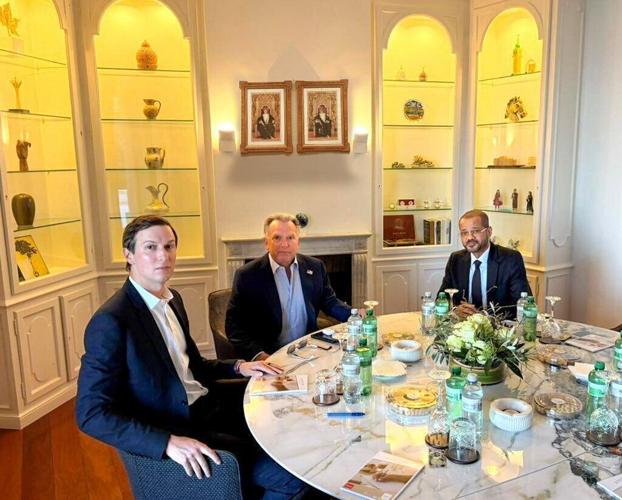
Oman's Minister of Foreign Affairs Sayyid Badr bin Hamad Al Busaidi, right, holds a meeting with White House special envoy Steve Witkoff, center, and Jared Kushner, as part of the ongoing Iranian-American negotiations, in Geneva, Switzerland, Feb. 26.
Americans have significant reservations about Trump's judgment on foreign conflicts, the AP-NORC poll shows. Only about 3 in 10 U.S. adults had "a great deal" or "quite a bit" of trust in Trump's judgment on the use of military force, relationships with U.S. adversaries or the use of nuclear weapons. More than half trust him "only a little" or "not at all."
On each measure, Republicans are more likely than Democrats and Independents to trust that the president will make the right decisions. About 6 in 10 Republicans had a high level of trust in Trump, while roughly 9 in 10 Democrats had a low level of trust in him.
Some Republicans' confidence is more qualified. Younger Republicans — those under 45 — were less likely than older Republicans to say they trust Trump "a great deal" or "quite a bit" on his use of military force. About half of younger Republicans said this, compared with about two-thirds of older Republicans.

Many view Iran's nuclear program as a threat
The new finding that 48% of U.S. adults were "extremely" or "very" concerned that Iran's nuclear program poses a direct threat to their country is in line with an AP-NORC poll conducted in July 2025, indicating that even with recent escalations between the two countries, Americans had not changed their views.
Before the June war, Iran enriched uranium up to 60% purity, a short, technical step away from weapons-grade levels. The U.N. nuclear watchdog — the International Atomic Energy Agency — said Iran was the only country in the world to enrich to that level that wasn't armed with the bomb.
Iran refused IAEA requests for the agency to inspect the sites bombed in the June war, raising nonproliferation experts' concerns.
Worries about Iran's nuclear program cross party lines in the U.S., though Republicans were more concerned. Most Republicans — 56% — said they are "extremely" or "very" concerned about Iran's nuclear program, compared with 44% of Democrats.

Younger Americans are less worried about Iran
Americans generally hold a negative view of Iran, but that view was sharper among older Americans.
About 6 in 10 U.S. adults said Iran is an "enemy" of the United States, up slightly from 53% from the Pearson/AP-NORC poll from 2023. About 3 in 10 said the countries are "not friendly, but not enemies," and only about 1 in 10 Americans considered the two nations "friendly" or "close allies."
At the same time, only about half of U.S. adults under 45 said Iran is an enemy, compared with about 7 in 10 Americans ages 45 and older. There is also a wide generational divide in concern about Iran's nuclear program, with only about one-third of Americans under 45 saying they are highly concerned, compared with about 6 in 10 older Americans.
Tensions over Iran's nuclear program existed for decades, which may help explain why older Americans are more concerned. Nuclear talks were deadlocked for years after Trump's decision in 2018 to unilaterally withdraw the U.S. from Iran's 2015 nuclear deal with world powers.

Liechtenstein reported from Vienna. AP reporter Jon Gambrell in Dubai contributed to this report.
___
The AP-NORC poll of 1,133 adults was conducted Feb. 19-23 using a sample drawn from NORC's probability-based AmeriSpeak Panel, which is designed to be representative of the U.S. population. The margin of sampling error for adults overall is plus or minus 4.0 percentage points.
___
The Associated Press receives support for nuclear security coverage from the Carnegie Corporation of New York and Outrider Foundation. The AP is solely responsible for all content.