NEW YORK — Former President Donald Trump on Monday said Jews who vote for Democrats "hate Israel" and hate "their religion," igniting a firestorm of criticism from the White House and Jewish leaders.
Trump, in an interview, had been asked about Democrats' growing criticism of Israeli Prime Minister Benjamin Netanyahu over his handling of the war in Gaza as the civilian death toll continues to mount.
"I actually think they hate Israel," Trump responded to his former aide, Sebastian Gorka. "And the Democrat party hates Israel."
Trump, who last week became the Republican Party's presumptive nominee, went on to charge: "Any Jewish person that votes for Democrats hates their religion. They hate everything about Israel and they should be ashamed of themselves because Israel will be destroyed."

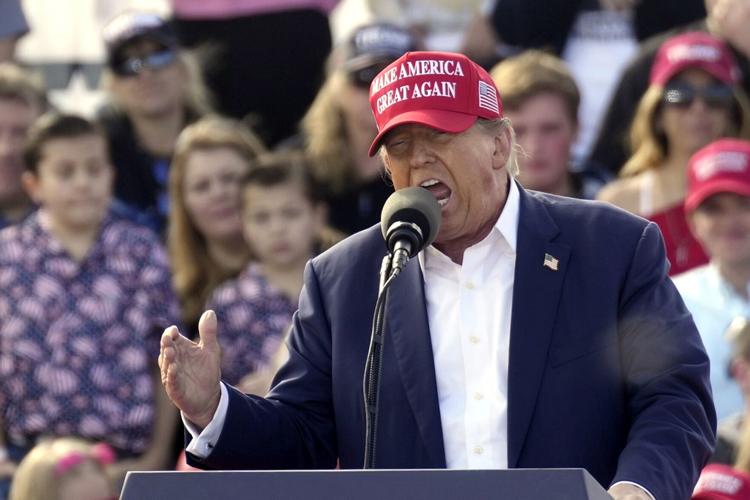
Republican presidential candidate Donald Trump speaks Saturday at a Buckeye Values PAC rally in Vandalia, Ohio.
The comments sparked immediate backlash from the White House, President Joe Biden's campaign and Jewish leaders. The vast majority of Jewish Americans identify as Democrats, but Trump often accuses them of disloyalty, perpetuating what critics say is an antisemitic trope.
People are also reading…
At the White House, spokesperson Andrew Bates cast the comments as "vile and unhinged Antisemitic rhetoric" without mentioning Trump by name.
"As Antisemitic crimes and acts of hate have increased across the world — among them the deadliest attack committed against the Jewish people since the Holocaust — leaders have an obligation to call hate what it is and bring Americans together against it," he said. "There is no justification for spreading toxic, false stereotypes that threaten fellow citizens. None."
Biden's campaign said, "The only person who should be ashamed here is Donald Trump."
"Trump is going to lose again this November because Americans are sick of his hateful resentment, personal attacks, and extreme agenda," said spokesman James Singer.
Jonathan Greenblatt, who heads the Anti-Defamation League, said, "Accusing Jews of hating their religion because they might vote for a particular party is defamatory & patently false."
"Serious leaders who care about the historic US-Israel alliance should focus on strengthening, rather than unraveling, bipartisan support for the State of Israel," he wrote on social media.
Trump's comments come as Biden faces mounting pressure from progressives over his administration's support for Israel in its retaliatory offensive in Gaza. More than 30,000 Palestinians have been killed since Hamas militants attacked Israel on Oct. 7, according to the Health Ministry in the Hamas-ruled territory.
While Biden continues to back Israel's right to defend itself, he has increasingly criticized Netanyahu. After his State of the Union speech, he said he needed to have a "come to Jesus" conversation with the Israeli leader. He has also accused Netanyahu of "hurting Israel more than helping Israel," saying, "he must pay more attention to the innocent lives being lost as a consequence of the actions taken."

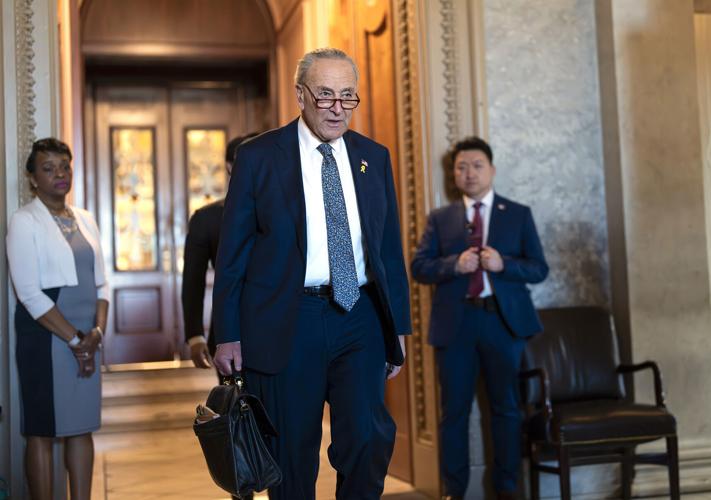
Senate Majority Leader Chuck Schumer, D-N.Y., departs Thursday after saying he believes Israeli Prime Minister Benjamin Netanyahu has "lost his way" and is an obstacle to peace in the region amid a growing humanitarian crisis in Gaza, at the Capitol in Washington.
Trump took particular issue with recent comments from Senate Majority Leader Chuck Schumer, the country's highest-ranking Jewish official. In a speech last week, Schumer sharply criticized Netanyahu's handling of the war in Gaza, warning that the civilian toll was damaging Israel's standing around the world. He also called for Israel to hold new elections.
While the White House formally distanced itself from Schumer's comments, the Democratic leader and key ally was voicing an opinion increasingly held across Biden's administration.
Schumer — whom Trump accused of being "very anti-Israel now" — responded by accusing Trump of "making highly partisan and hateful rants."
"To make Israel a partisan issue only hurts Israel and the US-Israeli relationship," he wrote on social media.
The Pew Research Center reported in 2021 that Jews are "among the most consistently liberal and Democratic groups in the U.S.," with 7 in 10 Jewish adults identifying with or leaning toward the Democratic Party. In 2020, it found that nearly three-quarters of American Jews disapproved of Trump's performance as president, with just 27% rating him positively.
Americans have also increasingly soured on Israel's military operation in Gaza, according to surveys from The Associated Press and the NORC Center for Public Affairs Research. In January, 50% of U.S. adults said the military response from Israel in the Gaza Strip had gone too far, up from 40% in November.
That number was higher among Democrats, 6 in 10 of whom said the same thing in both surveys.
Where each Trump case stands
Classified documents case

Pictured: Boxes of records stored in a bathroom and shower in the Lake Room at Trump's Mar-a-Lago estate in Palm Beach, Fla.
Special counsel Jack Smith has been leading two federal probes related to Trump, both of which have resulted in charges against the former president.
The first charges to result from those investigations came in June when Trump was indicted for mishandling top secret documents at his Florida estate. The indictment alleges that Trump repeatedly enlisted aides and lawyers to help him hide records demanded by investigators and cavalierly showed off a Pentagon “plan of attack” and classified map.
A superseding indictment issued in July added charges accusing Trump of asking for surveillance footage at his Mar-a-Lago estate to be deleted after FBI and Justice Department investigators visited in June 2022 to collect classified documents he took with him after leaving the White House. The new indictment also charges him with illegally holding onto a document he’s alleged to have shown off to visitors in New Jersey.
In all, Trump faces 40 felony charges in the classified documents case. The most serious charge carries a penalty of up to 20 years in prison.
U.S. District Judge Aileen Cannon on May 7 canceled the May 20 trial date in the case, postponing it indefinitely. She struck a paragraph from the indictment June 10 but denied a defense request to dismiss some of the charges. The paragraph concerns allegations that Trump, in 2021 and while no longer president, showed a classified map of a foreign country to a representative of his political action committee while discussing a military operation that he said was not going well. Defense lawyers said the paragraph was prejudicial because it was not connected to any crime charged in the indictment
Walt Nauta, a valet for Trump, and Carlos De Oliveira, the property manager at Trump’s Florida estate, have also been charged in the case with scheming to conceal surveillance footage from federal investigators and lying about it.
Trump, Nauta and De Oliveira have pleaded not guilty. Lawyers for Nauta and De Oliveira asked U.S. District Judge Aileen Cannon in April to throw out the charges they face. The judge did not immediately rule.
Election interference

Pictured: Supporters of former President Donald Trump protest Jan. 6, 2023, outside of the Supreme Court on the second anniversary of the riot at the U.S. Capitol in Washington.
Special counsel Jack Smith’s second case against Trump was unveiled in August when the former president was indicted in Washington on felony charges for working to overturn the results of the 2020 election in the run-up to the violent riot by his supporters at the U.S. Capitol on Jan. 6, 2021.
The four-count indictment includes charges of conspiracy to defraud the United States government and conspiracy to obstruct an official proceeding: the congressional certification of Joe Biden’s victory. It says that Trump repeatedly told supporters and others that he had won the election, despite knowing that was false, and describes how he tried to persuade state officials, then-Vice President Mike Pence and finally Congress to overturn the legitimate results.
After a weekslong campaign of lies about the election results, prosecutors allege, Trump sought to exploit the violence at the Capitol by pointing to it as a reason to further delay the counting of votes that sealed his defeat.
In their charging documents, prosecutors referenced a half-dozen unindicted co-conspirators, including lawyers inside and outside of government who they said had worked with Trump to undo the election results and advanced legally dubious schemes to enlist slates of fake electors in battleground states won by Biden.
The Trump campaign called the charges “fake” and asked why it took two and a half years to bring them. He has pleaded not guilty.
The case had been set for trial on March 4 in federal court in Washington. But that date was canceled amid an appeal by Trump on the legally untested question of whether a former president is immune from prosecution for official acts taken in the White House.
The Supreme Court injected fresh uncertainty into the trial date, saying Wednesday that it would hear arguments in late April. That leaves it unclear whether a trial can be completed before the November election.
Hush-money scheme

Pictured: Former President Donald Trump speaks before entering the courtroom Feb. 15, 2024, at Manhattan criminal court, where he faces state charges stemming from hush money payments made during the 2016 presidential campaign to bury allegations of extramarital sexual encounters.
Trump became the first former U.S. president in history to face criminal charges when he was indicted in New York in March on state charges stemming from hush money payments made during the 2016 presidential campaign to bury allegations of extramarital sexual encounters.
Originally set to proceed to trial March 25, Manhattan Judge Juan Manuel Merchan agreed to a 30-day delay starting March 15 until April as he sought answers about a last-minute evidence dump that the former president's lawyers said hampered their ability to prepare their defense. The trial kicked off with jury selection April 15. A full jury was seated April 18.
Trump has already pleaded not guilty to 34 felony counts of falsifying business records. Each count is punishable by up to four years in prison, though it’s not clear if a judge would impose any prison time if Trump were convicted.
The counts are linked to a series of checks that were written to his lawyer Michael Cohen to reimburse him for his role in paying off porn actor Stormy Daniels, who alleged a sexual encounter with Trump in 2006, not long after Melania Trump gave birth to son Barron. Those payments were recorded in various internal company documents as being for a legal retainer that prosecutors say didn’t exist.
Opening statements provided a clear roadmap of how prosecutors will try to make the case that Trump broke the law, and how the defense plans to fight the charges on multiple fronts.
Lawyers presented dueling narratives as jurors got their first glimpse into the prosecution. Still to come are weeks of what's likely to be dramatic and embarrassing testimony about the presumptive Republican presidential nominee's personal life as he simultaneously campaigns to return to the White House in November.
Georgia election indictment

Pictured: People watch as the motorcade with former President Donald Trump travels to the Fulton County Jail Aug. 24, 2023, in Atlanta.
Trump is charged alongside 18 other people — including former New York Mayor Rudy Giuliani and former White House chief of staff Mark Meadows — with violating the state’s anti-racketeering law by scheming to illegally overturn his 2020 election loss.
The indictment, handed up in August, accuses Trump or his allies of suggesting Georgia’s Republican secretary of state could “find” enough votes for him to win the battleground state; of harassing an election worker who faced false claims of fraud; an, attempting to persuade Georgia lawmakers to ignore the will of voters and appoint a new slate of Electoral College electors favorable to Trump.
In the months since, several of the defendants, including lawyers Sidney Powell and Kenneth Chesebro, have pleaded guilty.
An appeals court on June 5, 2024, halted the case while it reviews the lower court judge's ruling allowing Fulton County District Attorney Fani Willis to remain on the case.
The Georgia Court of Appeals' order prevents Fulton County Superior Court Judge Scott McAfee from moving forward with pretrial motions as he had planned while the appeal is pending. While it was already unlikely that the case would go to trial before the November general election, when Trump is expected to be the Republican nominee for president, this makes that even more certain.
The appeals court docketed the appeals filed by Trump and eight others and said that “if oral argument is requested and granted” it is tentatively scheduled for Oct. 4. The court will then have until mid-March to rule, and the losing side will be able to appeal to the Georgia Supreme Court.
Trump and eight other defendants had tried to get Willis and her office removed from the case, arguing that a romantic relationship she had with special prosecutor Nathan Wade created a conflict of interest. McAfee in March found that no conflict of interest existed that should force Willis off the case, but he granted a request from Trump and the other defendants to seek an appeal of his ruling from the state Court of Appeals.
Special prosecutor Nathan Wade formally withdrew March 15, 2024, after a judge ruled he had to leave or Willis couldn't continue to pursue the charges. His resignation allows Willis to remain on the most sprawling of four criminal cases against the presumptive Republican nominee in the 2024 presidential election.
Arizona election indictment

Pictured: Former New York Mayor of New York Rudy Giuliani speaks Dec. 15, 2023, outside the federal courthouse in Washington. Guiliani, a lawyer for former President Donald Trump, was among those indicted April 24, 2024, in an Arizona election interference case.
An Arizona grand jury on April 24, 2024, indicted former President Donald Trump 's chief of staff Mark Meadows, lawyer Rudy Giuliani and 16 others for their efforts to use so-called fake electors to try to overturn Trump’s loss to Joe Biden in the 2020 presidential election.
The indictment names 11 Republicans who submitted a document to Congress falsely declaring that Trump won Arizona in 2020, including the former state party chair, a 2022 U.S. Senate candidate and two sitting state lawmakers. They're charged with nine counts each of conspiracy, fraud and forgery. The identities of seven other defendants, including Giuliani and Meadows, were not immediately released because they had not yet been served with the charges.
Trump, who is described in the indictment as an unindicted co-conspirator, has argued that he can’t be prosecuted for acts he committed while serving as president. The U.S. Supreme Court on Thursday will hear arguments on his bid to avoid federal prosecution over his efforts to reverse his loss.
With the indictments, Arizona becomes the fourth state where allies of the former president have been charged with using false or unproven claims about voter fraud related to the election. Heading into a likely November rematch with Biden, Trump continues to spread lies about the last election that are echoed by many of his supporters.
Descriptions of other unnamed defendants point to Mike Roman, who was Trump’s director of Election Day operations; John Eastman, a lawyer who devised a strategy to try to persuade Congress not to certify the election; and Christina Bobb, a lawyer who worked with Giuliani. Eastman and Bobb did not respond to text messages seeking comment, nor did a lawyer who is representing Roman in a case in Georgia.
The 11 people who had been nominated to be Arizona’s Republican electors met in Phoenix on Dec. 14, 2020, to sign a certificate saying they were “duly elected and qualified” electors and claiming that Trump carried the state. A one-minute video of the signing ceremony was posted on social media by the Arizona Republican Party at the time. The document was later sent to Congress and the National Archives, where it was ignored.
Biden won Arizona by more than 10,000 votes. Of the eight lawsuits that unsuccessfully challenged Biden’s victory in the state, one was filed by the 11 Republicans who would later sign the certificate declaring Trump as the winner.
Their lawsuit asked a judge to de-certify the results that gave Biden his victory in Arizona and block the state from sending them to the Electoral College. In dismissing the case, U.S. District Judge Diane Humetewa said the Republicans lacked legal standing, waited too long to bring their case and “failed to provide the court with factual support for their extraordinary claims.”
Days after that lawsuit was dismissed, the 11 Republicans participated in the certificate signing.
The Arizona charges come after a string of indictments against fake electors in other states.
The Republicans facing charges are Kelli Ward, the state GOP’s chair from 2019 until early 2023; state Sen. Jake Hoffman; Tyler Bowyer, an executive of the conservative youth organization Turning Point USA who serves on the Republican National Committee; state Sen. Anthony Kern, who was photographed in restricted areas outside the U.S. Capitol during the Jan. 6 attack and is now a candidate in Arizona’s 8th Congressional District; Greg Safsten, a former executive director of the Arizona Republican Party; energy industry executive James Lamon, who lost a 2022 Republican primary for a U.S. Senate seat; Robert Montgomery, chairman of the Cochise County Republican Committee in 2020; Samuel Moorhead, a Republican precinct committee member in Gila County; Nancy Cottle, who in 2020 was the first vice president of the Arizona Federation of Republican Women; Loraine Pellegrino, past president of the Ahwatukee Republican Women; and Michael Ward, an osteopathic physician who is married to Kelli Ward.
Civil cases

Pictured: Former U.S. President Donald Trump, with lawyers Christopher Kise and Alina Habba, attends the closing arguments in the Trump Organization civil fraud trial at New York State Supreme Court on Jan. 11, 2024, in the Manhattan borough of New York.
Beyond the criminal cases, Trump has also been the subject of a civil proceeding in New York City. The state's attorney general, Letitia James, argued that Trump and his companies engaged in a yearslong scheme to dupe banks and others with financial statements that inflated his wealth.
A judge has ordered Trump and his companies to pay $355 million as a penalty in the case. Trump won’t have to pay out the money immediately as an appeals process plays out, but the verdict still is a stunning setback for the former president.
New York state lawyers and an attorney for Trump settled their differences in April over a $175 million bond that Trump posted to block a large civil fraud judgment while he pursues appeals.
The agreement cut short a potential court hearing in Manhattan that was to feature witnesses.
The bond stops the state from potentially seizing Trump’s assets to satisfy the more than $454 million that he owes after losing a court case brought by the Democratic attorney general. She had alleged that Trump, along with his company and key executives, defrauded bankers and insurers by lying about his wealth.
If he’s ultimately forced to pay, the magnitude of the penalty, on top of earlier judgments, could dramatically diminish his financial resources. And it undermines the image of a successful businessman that he’s carefully tailored to power his unlikely rise from a reality television star to a onetime — and perhaps future — president.
That ruling comes on top of the $83.3 million Trump was ordered to pay to E. Jean Carroll in January for his continued social media attacks against the longtime advice columnist over her claims that he sexually assaulted her in a Manhattan department store. He was already the subject of a $5 million sexual assault and defamation verdict last year from another jury in the case.