WASHINGTON — A major question hangs over the Supreme Court's closely watched case on President Donald Trump's far-reaching tariffs: Will the conservative majority hold the Republican president to the same exacting standards it used to limit his Democratic predecessor, Joe Biden?
Key legal principles at the heart of conservative challenges to major initiatives in the Biden years are driving the arguments in the fight against Trump's tariffs, which is scheduled for arguments at the high court on Wednesday.
The businesses and states that sued over the tariffs are even name-checking the three Trump-appointed conservative justices whose votes they hope to attract to stop a centerpiece of Trump's economic agenda in a key test of presidential power.

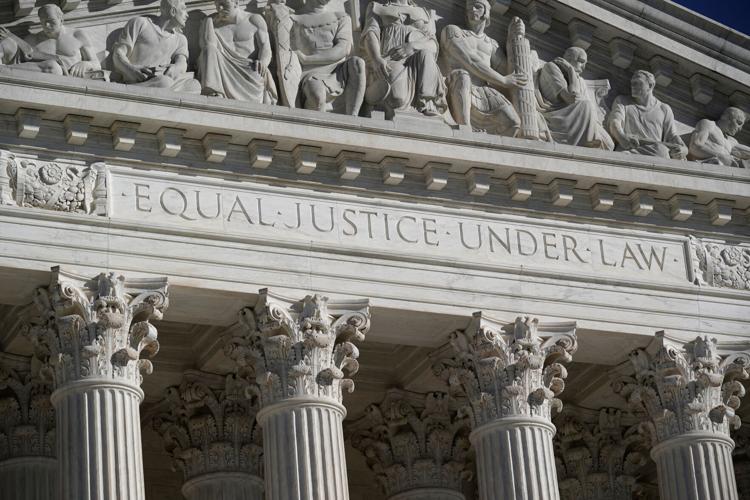
The Supreme Court is pictured Nov. 4, 2020, in Washington.
Emergency powers law
Trump imposed two sets of tariffs, determining that sustained trade deficits brought the United States to "the precipice of an economic and national-security crisis" and that hundreds of thousands of deaths from imported fentanyl had created a crisis of its own, the administration told the justices.
People are also reading…
Until this year, no president used the International Emergency Economic Powers Act to impose tariffs since its enactment in 1977.
The law makes no mention of tariffs, taxes, duties or other similar words, though it allows the president, after he declares an emergency, to regulate the importation of "any property in which any foreign country or a national thereof has any interest."
That authorization, the administration argued, is enough to support the tariffs, and the absence of any "magic words" is irrelevant.
The court ruled Congress must speak clearly on major policy questions
During Biden's presidency, conservative majorities made it harder to fight climate change under existing law and blocked several actions related to the coronavirus pandemic.
The court ended a pause on evictions, prohibited a vaccine mandate for large businesses and rejected Biden's $500 billion student loan forgiveness program.

Former U.S. President Joe Biden speaks April 15 at Advocates, Counselors, and Representatives for the Disabled conference in Chicago.
In each case, the court held that Congress didn't clearly authorize an action of economic and political significance, a legal principle known as the major questions doctrine.
The Washington-based U.S. Court of Appeals for the Federal Circuit had little trouble applying those precedents to the tariffs case.
Referring to the eviction pause and the student debt cases, a seven-judge majority wrote, "Indeed, the economic impact of the tariffs is predicted to be many magnitudes greater than the two programs that the Supreme Court has previously held to implicate major questions."
The tariff challengers are defending the appellate decision at the Supreme Court by leaning into the opinions from the earlier cases.
"Absent vigilance under the major questions doctrine, 'legislation would risk becoming nothing more than the will of the current President,'" lawyers for a Chicago-area toy company, Learning Resources Inc., wrote, quoting an opinion by Justice Neil Gorsuch in the climate change case.
A separate group of small businesses cited Justice Amy Coney Barrett's opinion in the student loan case to make the point that in relying on IEEPA for the tariffs, Trump "asserts 'highly consequential power … beyond what Congress could reasonably be understood to have granted.'"
The businesses also invoked a dissenting opinion by Justice Brett Kavanaugh in another pandemic case about the dangers of easily accepting emergency declarations.
"This Court's history is littered with unfortunate examples of overly broad judicial deference to' assertions of 'emergency powers,'" lawyers for the businesses wrote.

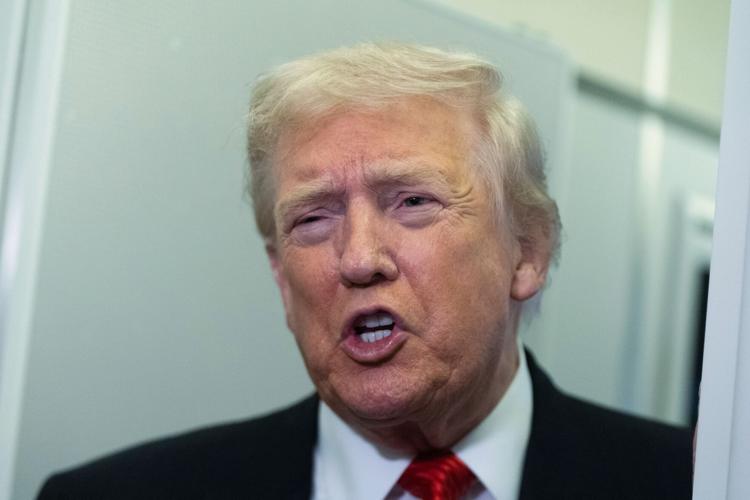
President Donald Trump speaks to reporters Sunday aboard Air Force One on his way back to the White House from a weekend trip to his Mar-a-Lago estate in Palm Beach, Fla.
Does doctrine apply?
The Trump administration argues that the major questions doctrine does not apply to the tariffs case, and it cites a lengthy dissenting appellate opinion, as well as Kavanaugh.
Presidents have wide latitude when it comes to foreign affairs and national security, and it would be odd for the emergency powers law to be as limited as the challengers say it is, Judge Richard Taranto wrote in his dissent, which was joined by three other judges.
"Such a limitation would be especially out of place in an emergency statute like IEEPA," Taranto wrote, explaining that it was intended to give presidents flexibility to cope with crises.
Congress, he concluded, made "an eyes-open" choice to give the president broad authority. The major questions doctrine does not apply, Taranto wrote.
Kavanaugh expressed a similarly expansive view of presidential power in an opinion in June about congressional authority.
The major questions doctrine has never been invoked in a case about foreign policy or national security, Kavanaugh wrote.

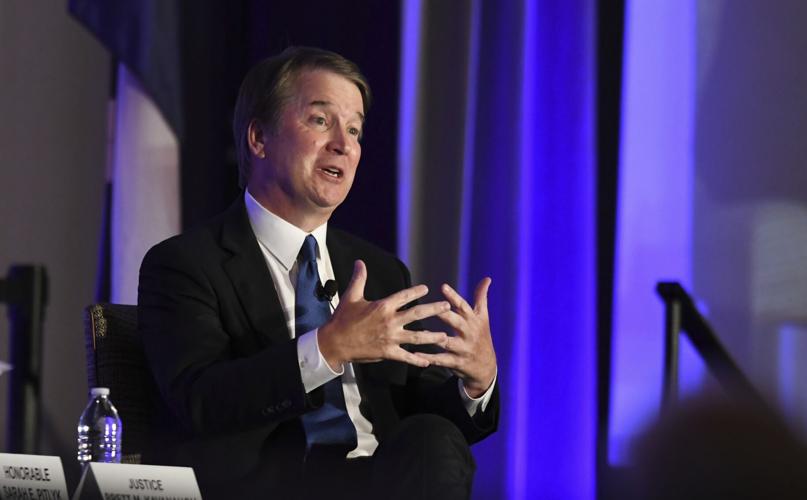
Justice Brett Kavanaugh speaks July 31 at a panel at the Eighth Circuit Court Judicial Conference in Kansas City, Missouri.
"On the contrary, the usual understanding is that Congress intends to give the President substantial authority and flexibility to protect America and the American people," he wrote.
Taranto's opinion drew from a 1981 Supreme Court decision in a case relating to the Iranian hostage crisis that upheld President Jimmy Carter's invocation of the emergency powers law to unfreeze Iranian assets.
Justice William Rehnquist, five years before becoming chief justice, wrote the court's opinion. One of his clerks that term was the current chief justice, John Roberts.