LEWISTOWN, Montana — Jerry Van Haur was 10 years old when the first Minuteman nuclear missile showed up on his grandfather’s farm.
"I’m not arguing with the project — I just want them to know the effects. I’m afraid me and the wife would have to vacate for two or three years" during the installation process, he said after hearing U.S. Air Force officials present plans for the first major upgrade of the U.S. intercontinental ballistic missile system in 50 years.
New Sentinel ICBMs are planned to replace the half-century-old Minuteman III rockets in 450 silos scattered across 40,000 square miles of Montana, Wyoming, Nebraska, North Dakota and Colorado.
Assuming the project goes through (the Defense Department already has to justify a “critical breach” of about $36 billion in cost overruns to Congress), folks sharing the landscape with the land-based leg of the strategic nuclear triad have a lot of tires to kick. Some wondered why they attended a recent discussion at all.
People are also reading…
“We haven’t done anything like this since the first time we did it,” Air Force Col. Charles “Foghorn” Clegg told a packed trade center building at Montana's Fergus County Fairgrounds on Jan. 24. “This is extremely large.”
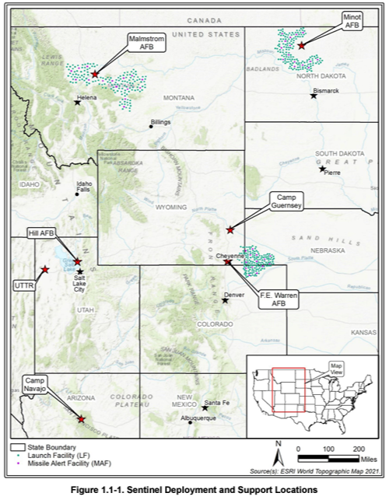
And complicated. The Air Force has three concentrations of land-based nuclear missiles. The swarm of silos near Warren Air Force Base in Wyoming, Colorado and Nebraska will be the first to undergo Sentinel replacement. Montana’s Malmstrom Air Force Base oversees the second leg of the project. A third cluster arcs around Minot Air Force Base in North Dakota and will be last on the upgrade list. The whole process could take about 10 years to complete.
At two recent public meetings in Montana, residents had questions. The project will employ thousands of outside workers: Where will they live and who will keep them out of trouble? It will require hundreds of truckloads of cement: Can the dirt roads and wooden bridges handle the traffic? Sentinel is about $40 billion over budget estimates: Will it go forward? Are nuclear missiles still a strategic or moral necessity?
Big changes to nuclear strategy
Each Minuteman III intercontinental ballistic missile, or ICBM, weighs 79,432 pounds. Within minutes of a launch order, they can fly at least 6,000 miles and reach speeds of 15,000 mph. By treaty, they carry a single 300-kiloton nuclear warhead capable of hitting within 400 feet of its intended target. Anything within 3.5 miles of that spot would be incinerated. Little Boy, the atomic bomb dropped on Hiroshima, Japan, in 1945, had a 15-kiloton blast that initially killed at least 70,000 people.
The original Minuteman missiles went on full alert Oct. 27, 1962, during the Cuban Missile Crisis. They have remained on active launch status since. Rotating crews of “missileers” sit in the underground launch centers all day, every day, drilling the steps for firing the rocket in the silo a few meters away. Other squads travel from site to site, sometimes doing small maintenance tasks, sometimes playing an international shell game of hide-the-warhead.

The U.S. Air Force's three ICBM concentrations are located in Montana, North Dakota, Wyoming, Colorado and Nebraska.
“You don’t know what to expect until you’ve seen it,” Lewistown, Montana, City Commission Chairwoman KellyAnne Terry said of the occasional missile convoys that come through town. “First you have the six Blackhawk helicopters flying right up Main Street. Then there’s the 10 or 12 trucks, and you don’t know which one has the missile in it, and the security trucks, and they’re all close together so no one can get between them. It’s quite a production to watch.”
There might be no missile inside. The Air Force has 400 of them, shuffled among 450 silos dotted across the northern Great Plains. To frustrate any nuclear adversary thinking of launching a preemptive strike, the military doesn't reveal how many silos are loaded.
The land-based missiles are part of a “nuclear triad” defense strategy that also features bombs on aircraft and submarines. That whole concept is undergoing a modernization involving B-21 stealth bombers and Columbia-class submarines, according to ICBM Modernization Director Brig. Gen. Colin Connor. That complete plan is estimated to cost $1.5 trillion.
Why are ICBM missiles needed?
While large majorities of the Montana town hall attendance in Great Falls and Lewistown approved of the ICBM presence, a few did not.
“I don’t think these nuclear silos are effective. Israel has 64 nuclear weapons, and that didn’t deter Hamas,” Jasmine Krotkev said while holding a protest sign outside the Great Falls High School where the Air Force was making its presentation.

Anti-nuclear war protester Lori Benjamin of Fort Benton holds a small electric candle as Great Falls residents come to hear U.S. Air Force officials explain plans for replacing Montana's 150 Minuteman III ICBMs with new Sentinel nuclear missiles on Jan. 25, 2024.
On Jan. 23, the Bulletin of the Atomic Scientists kept its Doomsday Clock to 90 seconds before “midnight” for 2024 to visualize the continuing threat of nuclear catastrophe. It was at 100 seconds in 2022 before Russia attacked Ukraine and Russian President Vladimir Putin threatened using nuclear weapons. This year’s continuing conflict in Gaza and drought-driven refugee migrations added to the sense of urgency, the group’s leaders said.
“That’s what keeps us safe,” Connor told a questioner who asked why Montana had to be the sacrificial “nuclear sponge” for the rest of the nation. “That’s what prevents our adversaries from attacking Montana and the rest of the United States.”

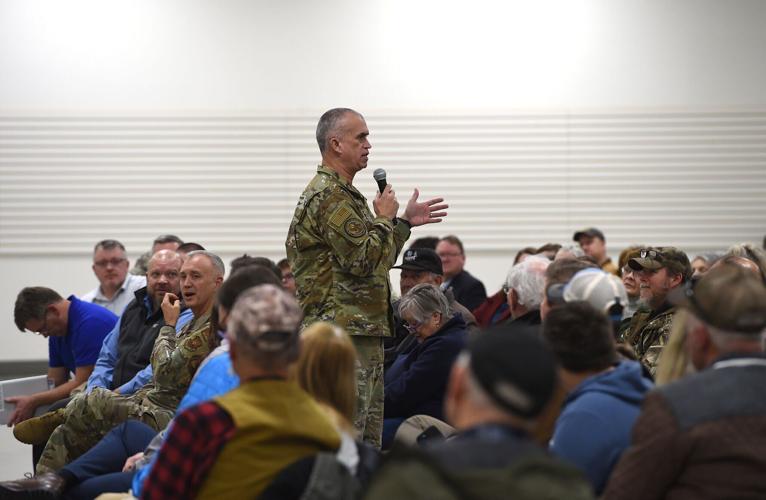
U.S. Air Force Brig. Gen. Colin Connor, director of Intercontinental Ballistic Missile Modernization at Barksdale Air Force Base, Louisiana, takes questions about the proposed Sentinel missile installation in Lewistown on Jan. 24, 2024.
A study published in Scientific American last December calculated that 1 to 2 million people would die of radiation exposure following a nuclear attack on the Midwest missile silos, and another 300 million would suffer from exposure to the fallout. The radiological risk zone from such an attack touches nearly the entire contiguous United States as well as Canada and Mexico.
Missile upgrade project over budget
Inside the auditorium, others asked if the Sentinel project literally had the money to get off the ground. What was announced in 2023 as a $96 billion upgrade incurred a “critical breach” in 2024, when its budget hit an estimated $132 billion. That violates the Nunn-McCurdy Act’s budget oversight rules and requires the secretary of defense to rejustify to Congress why the project needs a 37% upcharge.
The Air Force was recalculating its Sentinel cost and should have new numbers by June or July. That could affect the rest of the timeline, according to Clegg, who is director of the Sentinel program at Hill Air Force Base, Utah.

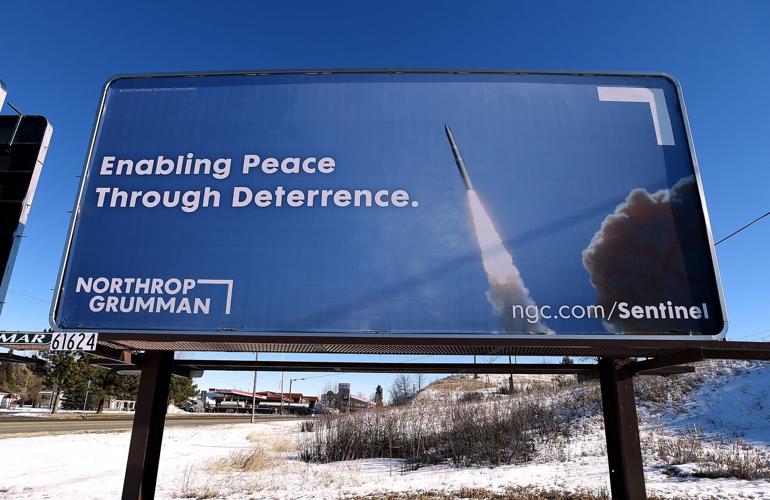
A billboard in Lewistown introduces residents to the new Sentinel intercontinental ballistic missile, which the U.S. Air Force plans to place in 150 silos throughout central Montana.
However, a Government Accountability Office review found Air Force Sentinel contractor Northrop Grumman Corp. was “struggling with staffing shortfalls, supply chain problems and clearance processing delays,” according to the national security newsletter Defense One. On Jan. 24, Northrop Grumman CEO Kathy Warden said the overruns were because of construction costs and inflation.
Lt. Gen. Rick Moore told the Center for Strategic and International Studies the Sentinel replacement had to go forward: “One way not to solve this is to think that we can just extend Minuteman III. There is not a viable service life extension program that we can foresee for Minuteman III.”
How rocket replacement would work
The coming Sentinels are three-stage, solid-fuel rockets carrying a single nuclear bomb. Further details of their capabilities are not reliably available. Minuteman III missiles were capable of delivering three nuclear warheads, but staged with only one by treaty limitations.

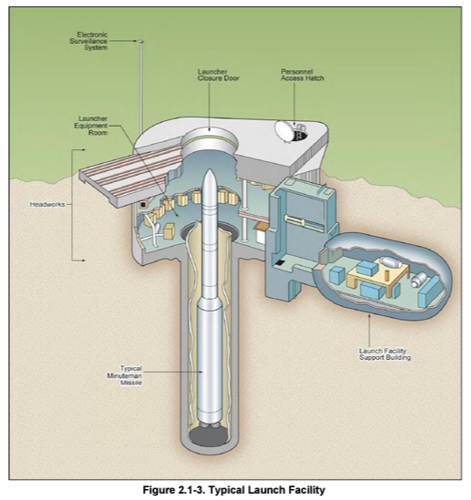
Air Force ICBM underground launch facility.
A hardwired web of buried cables link the missileers to the president of the United States, who has the ultimate authority to order a launch. Much of the most modern technology in the system dates to the 1980s. As Clegg told the Associated Press, to test an individual missile, someone must dig up the cable and splice in a patch to isolate it from the rest of the system: “It’s a very cyber-resilient platform.”
The new launch-control system will partially depend on new 300-foot-tall communications towers dispersed among the silos, each on a 5-acre plot. Ranchers wanted to know if those would be entirely fenced off, or left open so cattle could graze around the tower and guy-line footings. Farmers wanted to know about weed-control efforts to keep invasive weeds out of their cropland.
Construction workers would get bused from their base homes to each silo worksite to reduce traffic on local roads. Each silo make-over is expected to take about 40 months, with multiple silos getting serviced at a time.
Property owners along with state and federal transportation officials nevertheless warned that the dirt roads and wooden bridges serving most of the missile silos weren’t up to enduring four to six loads of concrete a day plus buses and heavy equipment moving back and forth. The Air Force officials replied that returning the roads to their baseline or better was an intrinsic part of their planning.

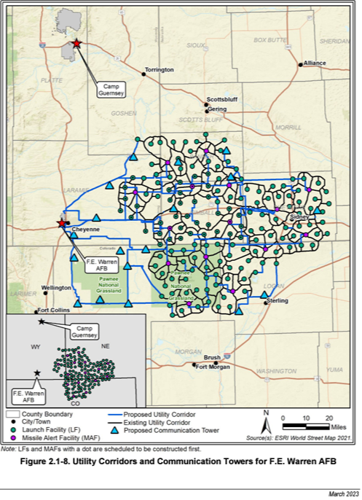
ICBMs overseen from Wyoming's Warren Air Force Base also spread into Colorado and Nebraska.
At Warren AFB, the missile field of 150 silos covers 12,600 square miles over seven counties: Logan and Weld counties in Colorado; Banner, Cheyenne and Kimball counties in Nebraska; and Goshen and Laramie counties in Wyoming.
It would involve 910 miles of new utility corridors in addition to the existing 1,611 miles of corridor, and 18 communications towers.
The workforce hub would likely be near Kimball, Nebraska. Sites for positioning construction supplies and equipment would be in Kimball; Albin, Wyoming; Sidney, Nebraska; and Stoneham, Colorado.

The U.S. Air Force has 150 missile launch facilities, or silos, dispersed across central Montana as part of its land-based nuclear deterrence strategy. Now loaded with 50-year-old Minuteman III ICBMs, the Air Force plans to install a new Sentinel ICBM system in 450 sites in Montana, Wyoming, North Dakota and Nebraska over the next several years.
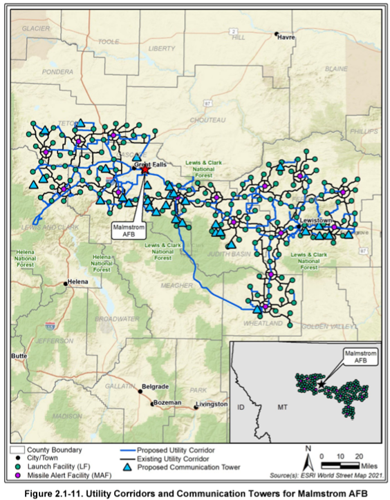
The Montana portion of the project involves 150 silos across 13,800 square miles in Cascade, Choteau, Fergus, Judith Basin, Lewis and Clark, Meagher, Teton and Wheatland counties. They will be connected by 31 communications towers, possibly 1,277 miles of new utility corridor and 1,750 miles of existing corridor right-of-way. Two workforce hubs would be acquired near Great Falls and Lewistown. Thirteen-acre laydown sites would be at Augusta, Belt, Denton, Judith Gap, Lewistown, Stanford, Vaughn and Winifred.
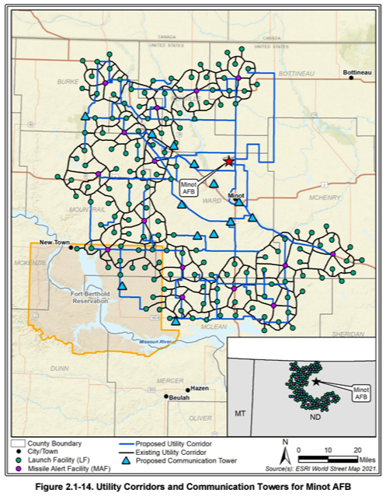
Minot AFB in Ward County, North Dakota, is about 13 miles north of Minot. Its 150 silos are dispersed across 8,500 square miles in Bottineau, Burke, McHenry, McLean, Mountrail, Renville, Sheridan and Ward counties. It would involve upgrading 1,531 miles of utility corridors and adding 939 miles of new utility corridor. Thirteen 300-foot-high communications towers would be added to the network.

Minot Air Force Base missile silo map.
Minot’s workforce hub would be near the city of Minot. Its laydown areas would be in or near Balfour, Bowbells, Garrison, Mohall, Ruso, Stanley and Wabek.
Workforce hubs
To get the work done, the Air Force plans to build temporary “workforce hubs” housing 2,000 to 3,000 workers. Those 60-acre hubs would have rows of three-story modular apartments, recreation and training buildings, a grocery store and medical clinic. The locations of those compounds haven’t been chosen yet.
Those workers will be experienced tradecraft experts who specialize in federal construction projects. They typically come without families, work two or three weeks at a stretch of 10-hour days and stay on the hub grounds. All will go through background checks ,and many will have security clearances.
In Montana, Great Falls City Commissioner Rick Tryon wondered who would be responsible for all those new workers; who would pay for the extra law enforcement, fire protection, court time and medical needs of the crew.
“I’ve heard counties request a dozen or more extra deputies for their sheriff’s department to get ready for these workforce hubs,” Tryon said during the town hall in Great Falls Jan. 25. “Will there be federal government resources to help?”
Northrop Grumman Corp. also has the Air Force contract to handle the installation work. Its regional operations representative, Matt Dillow, described the kind of workers coming.
“These are going to be very experienced, older electricians and pipefitters who will be coming to work two to three weeks at a time, for 10-hour days,” Dillow said. “A lot of them come from the Gulf Coast, and they mainly stay on the hub. A lot of places’ big concern is that the workforce won’t have enough time to access (local community businesses).”
Those workers would all have background checks and many would have security clearances to handle the military components. Few would have personal cars. Even fewer would bring family along, so there wouldn't likely be much impact on local schools.
When it's done
Although the temporary workers might not have a lasting economic impact on the region, the several hundred Air Force personnel who operate and maintain the ICBMs will continue to eat at local restaurants, buy local gas and patronize other local businesses.
The future of the workforce hubs was also a sticky subject. Dillow said the 60-acre complexes could either be scraped clean and revegetated, or transferred to some local entity for reuse.

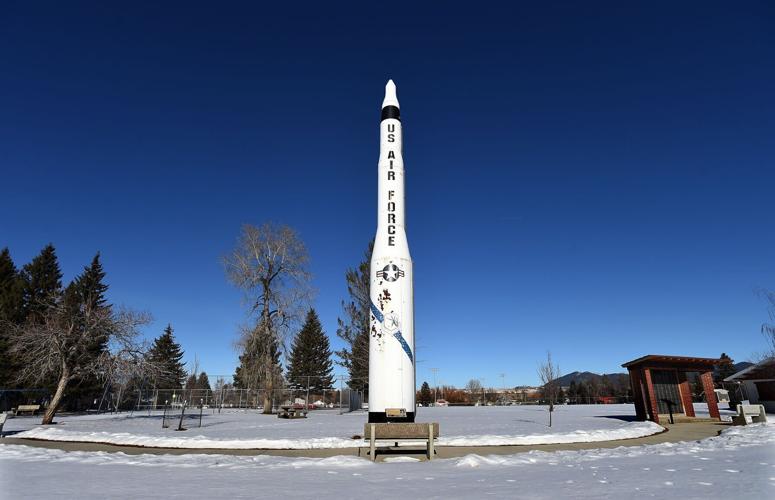
Playground equipment and a Minuteman intercontinental ballistic missile share space in Symmes Park in Lewistown.
But you might see some new relics of the U.S. nuclear strategic triad. A Minuteman I rocket stands in the Lewistown town park. Sentinel Acquisition Program Manager Russell Bartholomew said that once the warheads and solid-fuel motors are disposed of, souvenirs could be available.
“If you want one of the old missiles, there’s paperwork for that,” Bartholomew told the Montana crowd. “There will be a lot of those coming up out of the holes.”

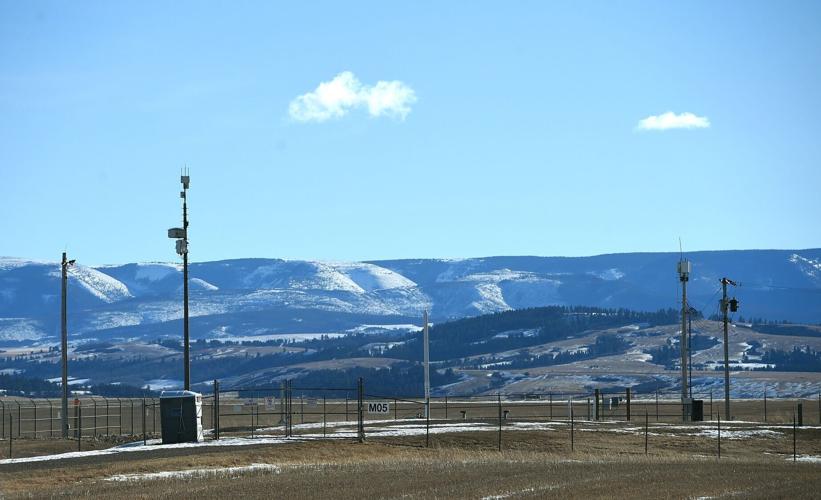
A Minuteman III missile silo can be seen near Lewistown. Missiles in the Malmstrom Air Force Base complex will be upgraded to the new Sentinel intercontinental ballistic missiles.