As a warming Earth simmered into worrisome new territory this week, scientists said the unofficial records being set for average planetary temperature are a clear sign of how pollutants released by humans are warming their environment. The heat is just one way the planet is telling us something is gravely wrong, they said.
"Heat sets the pace of our climate in so many ways … it's never just the heat," said Kim Cobb, a climate scientist at Brown University.
Dying coral reefs, more intense Nor'easters and the wildfire smoke that choked much of North America this summer are among the many other signals of climate distress.

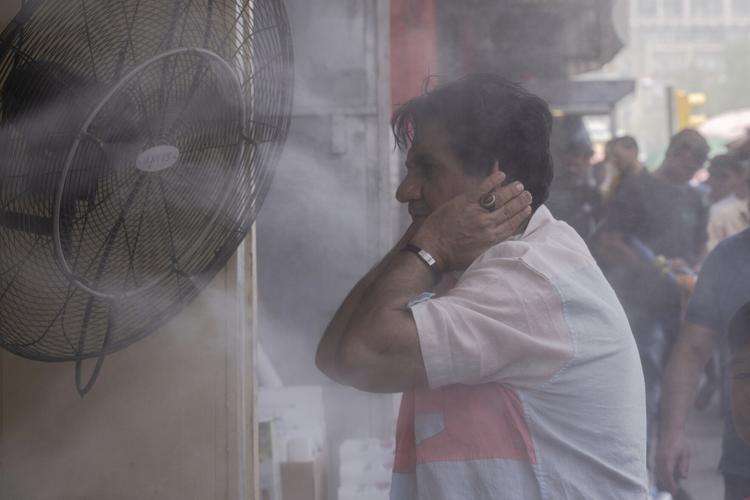
A man cools off Thursday under an air mister during a heat wave in Baghdad, Iraq.
"The increasing heating of our planet caused by fossil fuel use is not unexpected, but it is dangerous for us humans and for the ecosystems we depend on. We need to stop it, fast," said Stefan Rahmstorf of the Potsdam Institute for Climate Impact Research.
People are also reading…
Some other recent "firsts" and events that indicate climate change entered uncharted territory:
Wildfires raging across Canada have already broken records for total area burned, the number of people forced to evacuate their homes and the cost of fighting the blazes, and the fire season is only halfway finished, officials said Thursday.

U.S. Forest Service smokejumper Mike Dunn steps through a puddle Wednesday while exiting a plane in Fort St. John, British Columbia. His crew is assisting Canadian firefighters battling blazes throughout the region.
Smoke originating from those fires brought dangerous air quality levels to eastern North America. The high levels of wildfire smoke have become familiar on the West Coast, but scientists say climate change will make wildfires and smoke more likely and intense, and the East Coast will see more of it.
Ryan Allen, a professor of health sciences at Simon Fraser University in Burnaby, British Columbia, said the fine particles found in fire smoke have the ability to travel long distances and can penetrate deep into airways.
“When you’re emitting large amounts of fire smoke into the air, and that smoke is reaching populated areas, there will be health effects,” he said.

A woman uses a long-sleeve shirt to shield from the sun Thursday as she walks at an outdoor shopping mall on a sweltering day in Beijing. The government ordered employers in China's capital to stop outdoor work Thursday after the temperature was forecast to reach 104 degrees Fahrenheit.
Most of the planet is covered by oceans, which absorbed 90% of the recent warming caused by gases such as carbon dioxide and methane. In April, global ocean temperature soared to 69.98 degrees Fahrenheit, which was attributed to the combination of greenhouse gas emissions and the early El Nino formation.
Newly published data from the Copernicus Climate Change Service documented "exceptionally warm" ocean temperatures in the North Atlantic with "extreme" marine heat waves near Ireland, the U.K. and in the Baltic Sea.
The current El Nino — a period of warming Pacific Ocean waters — formed a month or two earlier than usual, replacing a La Nina that cooled Pacific waters and served as a damper on global temperatures. This means the El Nino will have more time than usual to strengthen. The World Meteorological Organization predicts there is a 98% chance at least one of the next five years will be the warmest on record, beating 2016, when an exceptionally strong El Nino was present.

A woman carries her dog through a water fountain Thursday on the waterfront in Halifax, Nova Scotia. A heat warning was issued for all Maritime provinces, amid soaring temperatures and high humidity across the region.
Scientists are watching Antarctic sea ice shrink to record lows. The 4.5 million square miles covered by the sheet on June 27 was nearly 1 million square miles less than average for the same date for the 1981-2010 period, according to the National Snow and Ice Data Center.
Put another way, an area almost four times the size of Texas was gone from the ice sheet.
No central air conditioning? These are the best fans and portable AC units
1. SereneLife 3-in-1 Portable Air Conditioner

This portable air conditioner from SereneLife works best for up to 350 square feet. It has a dehumidifier function that helps you remain cool on muggy summer days. The unit also has a fan function if you don’t want to limit the amount of electricity you use during the day. The window mount kit helps draw in some fresh air, and the remote control makes it easy to change settings without disruption.
2. Frigidaire Window AC Unit

If you’re looking for a compact window air conditioning unit, try this highly-rated model from Frigidaire. The washable filter is easy to clean and reuse. Customers also loved how cool this window unit got their room without a high power output.
3. SUMLGT Personal Mini Air Conditioner

If you work from home, it can be difficult to concentrate on hot days without air conditioning. Rather than running up a big electricity bill, try this mini AC and fan from SUMLGT. It’s the perfect addition to your home office for under $50.
4. Bionaire Window Fan

This window fan from Bionaire draws cool air in and pushes hot air out to keep your home comfortable on hot days. Unlike many window fans, this model is programmable and will automatically turn on and off to maintain the temperature you set.
5. DELLA Smart Window Air Conditioner

This smart AC unit from DELLA can help you cut down on energy costs with an easy-to-use app that lets you control your settings from your phone. The highly-rated window unit can cool about 300 to 350 square feet